
You can earn a degree in Serbia in English, but the choice at bachelor's level is much narrower than at master's level. Study in Serbia, the information platform founded by the Tempus Foundation, counts more than 180 accredited programmes taught fully or partly in English across all levels. For a school leaver, the realistic options are the engineering and economics faculties of the public universities in Novi Sad, Niš and Kragujevac, medicine at the four public medical faculties, and a handful of private universities, mostly in Belgrade. The English version nearly always costs more than the Serbian one: in 2026/27 the Faculty of Technical Sciences in Novi Sad charges international students $3,410 (€3,000) instead of $2,270 (€2,000), and Metropolitan University charges $5,680 (€5,000) instead of $2,830–4,870 (€2,490–4,290).
This guide maps English-taught bachelor's programmes by institution, shows what the English track really costs, explains how admission works and how to check that an English group will actually run. For a general overview of institutions, see universities in Serbia; medicine has its own guide, medicine in Serbia. The country as a whole, with visas and budgets, is covered on study in Serbia.
| At a glance | Details |
|---|---|
| Number of English-taught programmes | 180+ at all levels, fully or partly in English (Study in Serbia) |
| Where bachelor's programmes exist | FTN Novi Sad, Niš Faculty of Electronic Engineering and Faculty of Economics, Kragujevac and Čačak faculties, medical faculties, private universities in Belgrade and Novi Sad |
| Annual fee, English bachelor's, 2026/27 | from $2,500 (€2,200) in Čačak to $5,680 (€5,000) at Metropolitan; medicine $6,810–9,080 (€6,000–8,000) |
| State-funded places | the 2026/27 calls we checked list only fee-paying places on English tracks |
| Entry requirements | recognised school certificate, proof of English as set by the faculty, entrance exam or test |
| Entry for Russian and Kazakh citizens | visa-free for up to 30 days; students then apply for temporary residence |
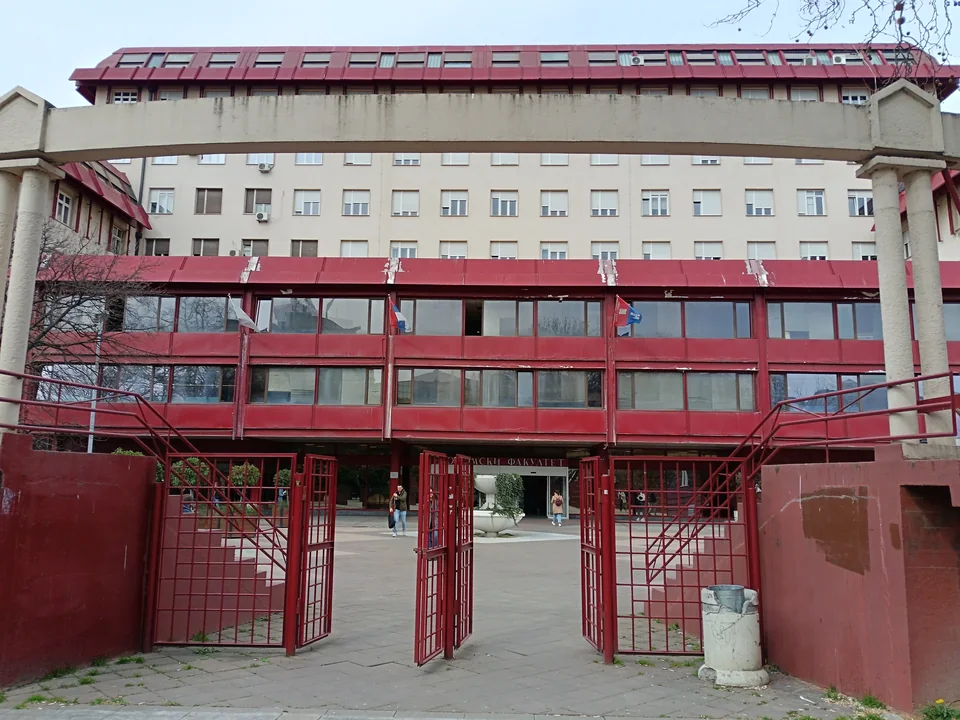
Where you can take a bachelor's degree in English
The key distinction is between public faculties and private universities. A public faculty runs an English version of a programme it already teaches in Serbian and sets a separate fee for it. Private universities more often build the English track as their main offer for international students.
Public universities (annual fee for international students, 2026/27):
| Faculty | City | English-taught programmes | Annual fee |
|---|---|---|---|
| Faculty of Technical Sciences (FTN), University of Novi Sad | Novi Sad | nearly all academic bachelor's programmes, including applied software engineering, computing and control, mechatronics, architecture, civil engineering, engineering management | $3,410 (€3,000): the $2,270 (€2,000) international rate plus 50% |
| Faculty of Electronic Engineering, University of Niš | Niš | electrical and computer engineering, Communications and IT module, 30 fee-paying places | $3,970 (€3,500) |
| Faculty of Economics, University of Niš | Niš | economics | $4,310 (€3,800) for all students |
| Faculty of Economics, University of Kragujevac | Kragujevac | economics and business management | $3,410 (€3,000) |
| Faculty of Engineering Sciences, University of Kragujevac | Kragujevac | electrical and computer engineering | $3,410 (€3,000) |
| Faculty of Technical Sciences Čačak, University of Kragujevac | Čačak | information technology | $2,500 (€2,200) |
| University of Kragujevac | Kragujevac | Sport, Health and Bioengineering, three years | $4,540 (€4,000) |
| Faculty of Economics, University of Belgrade | Belgrade | economics, business management and statistics | $1,700 (€1,500) in the university's 2025/26 fee table; ask the faculty for the 2026/27 English rate |
In Belgrade, the guide of the National Accreditation Body (NAT) also lists Serbian-and-English accreditation for the Faculty of Organizational Sciences, the School of Electrical Engineering and the Faculty of Mechanical Engineering. Yet the University of Belgrade's 2025/26 fee table shows only the Serbian version of these bachelor's programmes. The Faculty of Economics does have an English line in the table, and it also runs English-taught dual-degree programmes with the University of London, which have their own admission and fee terms; its Serbian-taught rate for international students rose to $2,040 (€1,800) for 2026/27. Accreditation allows a faculty to teach in English; it does not oblige it to open a group. Ask the faculty to confirm in writing that the English track enrols in your year before you apply.
Medicine is taught in English at all four public medical faculties, in Belgrade, Novi Sad, Niš and Kragujevac. A year costs from $6,810 (€6,000) in Niš and Kragujevac up to $9,080 (€8,000) in Belgrade; dentistry and pharmacy have their own rates, for example $5,680 (€5,000) and $3,970 (€3,500) in Belgrade under the 2025/26 table. Exams, deadlines and a six-year budget are covered in medicine in Serbia.
Private universities with English programmes
The private sector offers more choice in business and IT, and admission is more flexible: Metropolitan, for instance, schedules an individual entrance exam online or on campus. The trade-off is a higher fee, which stays fixed for the whole degree only if your contract says so.
| University | Location | English-taught bachelor's | Annual fee, 2026/27 |
|---|---|---|---|
| Singidunum University | Belgrade, units in Niš and Novi Sad | business economics; tourism, hospitality and food economics; information technology; software and information engineering; computer science; applied artificial intelligence; English studies | $4,430 (€3,900) per 60 ECTS, current-semester textbooks included |
| Metropolitan University | Belgrade, Niš | information technology, software engineering, video game development, engineering and operations management, digital business and marketing, graphic design, interactive media design, fashion design, English with business | $5,680 (€5,000) for international students |
| Union – Nikola Tesla University | Belgrade | engineering management (Faculty of Engineering Management) | see the university's fee decision |
| Educons University | Sremska Kamenica, near Novi Sad | business economics, organic agriculture, environmental protection | see the university's fee decision |
The Study in Serbia programme database also lists three-year applied programmes in English, such as physiotherapy and nursing at the ICEPS college and mechatronics at the Polytechnic Academy of Applied Studies in Belgrade. An applied degree is designed mainly for employment; how it affects the route to a master's is explained in bachelor's degrees in Serbia.
English versus Serbian: the price difference
The fee gap is the main argument for spending a year on Serbian first. The table compares the same programme or institution in both languages.
| Institution | Serbian-taught, international rate | English-taught |
|---|---|---|
| FTN Novi Sad, most programmes (2026/27) | $2,270 (€2,000) | $3,410 (€3,000) |
| Faculty of Economics, Niš (2026/27) | $1,700 (€1,500) | $4,310 (€3,800) |
| Singidunum, business economics (2026/27) | $2,730 (€2,400) | $4,430 (€3,900) |
| Metropolitan, information technology (2026/27) | $3,400 (€2,990) | $5,680 (€5,000) |
| Belgrade Faculty of Medicine, medicine (2025/26) | $2,840 (€2,500) | $9,080 (€8,000) |
Over four years, the English track at FTN costs about $4,540 (€4,000) more, and economics in Niš about $10,450 (€9,200) more. One-off fees rise too: FTN charges international applicants $200 (€180) for the entrance exam on the English track versus $140 (€120) on the Serbian one, and $260 (€225) versus $170 (€150) at enrolment. FTN lets students pay the annual fee in two halves, at enrolment and before the winter semester is certified.
These are tuition fees only. Housing, insurance, recognition and residence fees come on top; the full first-year budget is in cost of studying in Serbia.
How to apply to an English-taught programme
The procedure mirrors the Serbian track; only the exam language and the language proof change. Article 97 of the Law on Higher Education lets foreign nationals enrol under the same conditions as Serbian citizens regarding prior education, provided they know the language of instruction. Each institution sets its own method for checking that.
- March–April. Shortlist two or three programmes and check each one in the NAT guide and on the faculty website: the English version must appear both in the accreditation and in the fee decision for your year.
- April–May. Submit your school certificate for recognition to the Qualifications Agency of Serbia. Faculties usually accept proof that recognition is under way and ask for the decision itself before classes start or by a date set in the call. See diploma recognition in Serbia.
- May–June. Arrange proof of English. Rules differ: the Faculty of Medicine in Novi Sad accepts a certificate from an authorised body or tests you with its own committee, and waives the check if your earlier schooling was in English.
- June–July. First admission round. The Niš Faculty of Electronic Engineering, for example, took English-track applications by email from 19 to 26 June 2026 and held its online mathematics exam in English on 2 July.
- September. Second round for remaining places: FTN took applications from 31 August to 4 September 2026, examined on 7 September and enrolled on 11 September.
- After admission. Payment, the enrolment certificate and an application for temporary residence to the Serbian Ministry of Interior; see student residence permit in Serbia.
Rankings are usually out of 100 points: up to 40 for school results and up to 60 for the exam. At FTN the school score is the sum of your average grades for each upper-secondary year multiplied by two. Faculties publish 2027/28 dates in their 2027 calls; aim for June–July and treat September as a fallback.
How to check that the English group will run
An English programme title on a website does not mean you will be taught in English. Under Article 95 of the Law on Higher Education, a programme may be taught in a foreign language only if that language version has been approved or accredited. Check four things:
- The NAT guide marks the programme "na srpskom i engleskom jeziku", and the accreditation date is less than seven years old, which is how long accreditation lasts.
- The faculty's fee decision for your academic year includes a line for the English version.
- The admission call states the number of English-track places. FTN, for instance, offers applicants a similar programme if fewer than 25% of the announced places are filled.
- Whether you can switch from English to Serbian later. The Faculty of Medicine in Novi Sad does not allow it.
If the faculty cannot confirm enrolment in writing, keep a fallback: another institution with an English track, or the Serbian version after a language year.
Do you still need Serbian?
Serbian is not required to enrol on an English-taught programme. You will need it for daily life, banks and the Ministry of Interior, part-time jobs and, in medicine, clinical work. Article 125 of the Law on Higher Education requires official education documents to be issued in Serbian Cyrillic; for programmes taught in another language the form is bilingual, and the diploma supplement may also be issued in English.
An English programme combines well with an evening Serbian course. University-based courses and their prices are covered in Serbian language courses in Serbia.
Is an English-taught degree recognised?
The language of instruction does not change the status of the degree: it is a diploma from an accredited Serbian programme with a supplement listing courses and ECTS credits. Russia and Serbia signed an intergovernmental agreement on mutual recognition of education documents on 10 April 2013; it appears on the Russian Ministry of Science and Higher Education list of treaties. For regulated professions such as medicine, law or architecture, recognition of education does not replace the licence to practise, which follows the rules of the country where you will work. In Kazakhstan, foreign degrees are recognised through the National Centre for Higher Education Development (ENIC-Kazakhstan); check its current procedure before you enrol.
Common mistakes
- Choosing a programme by its English title on a website. Check the accreditation of the English version and the line in the fee decision.
- Budgeting at the Serbian rate. The English version of the same programme usually costs 50% more or even double.
- Waiting for September. The second round fills only leftover places, and an English group may not open if too few apply.
- Delaying recognition of your school certificate. Without the Qualifications Agency decision, enrolment can be cancelled.
- Skipping Serbian entirely. You can study without it, but housing, paperwork and internships become harder.
FAQ
No. The 2026/27 admission calls for English-taught programmes list only fee-paying places, and international students pay for the whole degree unless an international agreement says otherwise. The only free route is a scholarship; see free education in Serbia.
There is no national threshold; each faculty sets its own. Some accept an international certificate, others run their own test or accept schooling completed in English. Check the requirement in the faculty's call before spring so you have time to take a test.
In 2026/27, from $2,500 (€2,200) for information technology in Čačak to $5,680 (€5,000) at Metropolitan. FTN Novi Sad charges $3,410 (€3,000) and Singidunum $4,430 (€3,900). Medicine in English costs $6,810–9,080 (€6,000–8,000) a year.
Several faculties hold Serbian-and-English accreditation, but the 2025/26 fee table lists an English bachelor's line only for the Faculty of Economics, alongside the integrated medical programmes. For other faculties, ask for written confirmation that the English group enrols. Full profile: University of Belgrade.
At public faculties, yes, usually in a core subject, such as mathematics in English in Niš. Private universities run their own exam or test, sometimes online. National school-leaving exam scores do not replace the entrance exam, but school grades contribute up to 40 of 100 points.
It depends on the faculty. For medicine in Novi Sad, the admission call prohibits moving from the English programme to the same programme in Serbian. Elsewhere the faculty decides, so ask about transfer rules before you enrol.
Sources
- Study in Serbia (Tempus Foundation): requirements and English-taught programmes, programme database, living costs — verified 30.09.2026
- NAT guide to accredited institutions and programmes, 29.09.2026 (PDF) — verified 30.09.2026
- Law on Higher Education of Serbia, Articles 95, 97, 125 — verified 30.09.2026
- University of Novi Sad: 2026/27 admission call (second round), FTN and Faculty of Medicine — verified 30.09.2026
- University of Niš: joint 2026/27 admission call (PDF) — verified 30.09.2026
- University of Kragujevac: 2026/27 tuition fees — verified 30.09.2026
- University of Belgrade: 2025/26 tuition fee table (PDF) — verified 30.09.2026
- University of Belgrade Faculty of Economics: 2026/27 admission call — verified 30.09.2026
- Singidunum: tuition fees, Metropolitan: 2026/27 international fees — verified 30.09.2026
- Serbian Ministry of Foreign Affairs: visa regime for Russia and Kazakhstan — verified 30.09.2026
- Russian Ministry of Science and Higher Education: treaties on recognition of education documents — verified 30.09.2026
- ENIC-Kazakhstan — verified 30.09.2026
- USD conversions use the ECB reference rate of 29.09.2026 (€1 = $1.1355); amounts under $100 are rounded to the dollar, larger amounts to $10.
Programme shortlisting, accreditation and admission-call checks, document preparation and submission are provided under an agreement with StudyU. The faculty decides on admission, the Qualifications Agency of Serbia on recognition of your school certificate, and the Serbian Ministry of Interior on temporary residence.
Next steps
- Bachelor's Degrees in Serbia: Academic vs Applied, Duration, Fees and Outcomes
- Serbian Language Courses in Serbia: University Centres, Fees and Certificates
- Study in Serbia for international students
- Universities in Serbia for International Students: List, Fees, Language and How to Choose
- Studying Medicine in Serbia: Faculties, Fees and Admission for International Students
- Cost of Studying in Serbia for International Students in 2026/27: Tuition, Living Costs and First-Year Budget
