
You can study medicine in English in Bulgaria at four medical universities, in Sofia, Plovdiv, Varna and Pleven, and at the Faculty of Medicine of Sofia University. The programme lasts six years and leads to a master's degree; for non-EU students, annual fees for 2026/27 range from $9,080 (€8,000) to $11,360 (€10,000). Admission is through each university's own biology and chemistry tests plus an English check, and testing in spring is the safer bet: in 2026 the MU-Plovdiv cut-off for medicine fell from 39.12 to 25.89 out of 42 over six months, but dentistry places had run out by autumn.
Below: a comparison of the universities, the exam format, real cut-off scores, school-grade requirements, the preparatory year, transfers and degree recognition. General admission rules, documents and NACID recognition are covered in applying to Bulgarian universities.
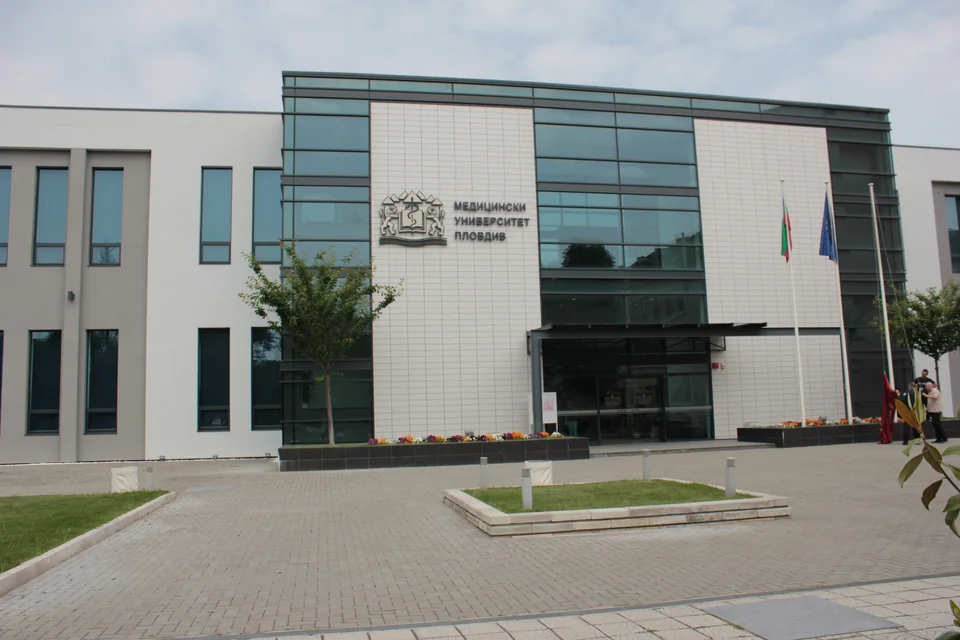
Where to study medicine in English
| University | City | English-taught programmes | Medicine, year 1, 2026/27 | Selection of non-EU applicants |
|---|---|---|---|---|
| Medical University of Sofia (MU-Sofia) | Sofia | medicine, dentistry, pharmacy | $11,300 (€9,950) | one remote exam in English, biology and chemistry in September–October |
| Medical University of Plovdiv | Plovdiv | medicine, dentistry, pharmacy, nursing | $11,360 (€10,000) | online tests from April to August plus a September resit |
| Medical University of Varna | Varna | medicine, dentistry, pharmacy | $11,360 (€10,000) | online tests from April to June |
| Medical University of Pleven | Pleven | medicine | $10,220 (€9,000) | entrance exams, $230 (€200) fee |
| Sofia University, Faculty of Medicine | Sofia | medicine; pharmacy at the Faculty of Chemistry and Pharmacy | $9,080 (€8,000) | under the university's admission rules |
Trakia University in Stara Zagora also has a medical faculty, but we could not find its 2026/27 non-EU fee on its English pages; confirm that option directly with its admissions office.
Sofia University's medical faculty is the cheapest at $9,080 (€8,000), against $11,300 (€9,950) at MU-Sofia in the same city. MU-Plovdiv and MU-Varna have the highest first-year fees.
English or Bulgarian track
For medicine, language hardly affects the price: MU-Sofia charges $11,300 (€9,950) a year for both tracks and Sofia University $9,080 (€8,000). Dentistry is different: at MU-Sofia it is $7,440 (€6,550) in Bulgarian and $11,360 (€10,000) in English.
A Bulgarian-taught programme requires a preparatory year unless you can prove your Bulgarian. The English track starts immediately, but patients in teaching hospitals speak Bulgarian, so you will need the language anyway. MU-Sofia even builds a compulsory Bulgarian course for everyday communication into its English preparatory year.
The Bulgarian track makes sense if you plan to practise in Bulgaria and can spend a year on the language. The English track suits you if a quick start and an international group matter more.
Entrance exams: format and preparation
Universities test biology and chemistry at secondary-school level, plus English. The details differ:
- MU-Varna. Biology and chemistry are tested on the same day, 90 minutes each. A paper mixes five task types (single-answer multiple choice, missing terms, matching, true or false, and brief definitions), and wrong answers cost nothing. The university sells a handbook of test items and a chemistry textbook, publishes sample tests and topic lists, and runs $680 (€600) online spring courses if at least 10 people sign up. English is proven by certificate (IELTS Academic 6.5, TOEFL iBT 90, PTE Academic 61 or higher) or by the university's own test.
- MU-Plovdiv. Online tests in biology, chemistry and English. The university publishes test books, sample answer sheets and a registration calendar; registration for each date closes a week before.
- MU-Sofia. The English, biology and chemistry exam is held remotely. A self-study manual for biology and chemistry costs $17 (€15.34) at the university cashier. Failing any one component means failing the exam, and written papers are not re-marked.
MU-Plovdiv and MU-Sofia build the competition score in the same way: biology and chemistry marks are multiplied by three and the English mark is added, giving a maximum of 42 on the Bulgarian 2-to-6 scale. At MU-Plovdiv an applicant missing any mark, or scoring below 3.00, is left out of the ranking.
Cut-off scores: how competition changes through the year
MU-Plovdiv publishes the lowest admitted score for each ranking round. The 2026 figures for non-EU applicants to English programmes:
| Ranking round | Medicine | Dentistry | Pharmacy |
|---|---|---|---|
| 23 April | 39.12 | 42.00 | 36.51 |
| 26 May | 34.14 | 42.00 | 28.14 |
| 23 June | 34.50 | 41.49 | 37.38 |
| 15 September | 29.01 | 42.00 | 29.64 |
| 24 September | 25.89 | full | full |
Three lessons follow. The spring cut-off for medicine leaves almost no room for error but falls by about a third by September. Dentistry required 41.49–42 out of 42 throughout the cycle, which means near-perfect tests. Waiting for a late date is risky: by the final 2026 round dentistry and pharmacy were full, and the dentistry preparatory course had no places left.
School grades and language requirements
Beyond the tests, universities check your school record:
- MU-Plovdiv: your average school mark in biology and chemistry must be at least 62% of the maximum on your national scale; elective courses do not count.
- MU-Varna: your average mark in the official language of the country where you finished school must be at least 65% of the maximum, again excluding electives.
- All medical universities: your certificate must give access to higher education in the issuing country, and ranking requires a NACID certificate recognising your secondary education.
If your English is not yet strong enough, MU-Varna and other universities offer a preparatory course instead of direct entry.
When to test and apply for 2027/28
Universities will announce 2027 dates in winter and spring, but the 2026 pattern shows what to expect:
| University | What happened in 2026 |
|---|---|
| MU-Varna | tests for non-EU applicants on 4 April, 16 May and 13 June; $390 (€340) fee due at least a week before the test |
| MU-Plovdiv | registration from 2 March; tests on 15 April, 15 May, 16 June, 17 July and 18 August, resit on 4 September; $340 (€300) per date |
| MU-Sofia | documents from 27 July to 31 August, exam on 9 September; admission then extended to 25 September with an exam on 2 October; English-taught classes start on 19 October |
For non-EU applicants, April to June is safest: it leaves time for NACID, the Ministry of Education certificate (up to a month, according to MU-Varna) and the D visa (for students the embassy states up to 15 calendar days from submission). The visa process is covered in our Bulgaria student visa guide.
The preparatory year: who needs it and what it gives
Two groups need a preparatory year: applicants who failed the tests or fell short on language, and those who chose the Bulgarian track. At medical universities it is more than a language course.
- MU-Sofia: a 1,000-hour course, with language in the autumn and then medical vocabulary with biology and chemistry in the spring. The course closes with an in-person written test covering the language, biology and chemistry, held no later than ten days after the summer semester; those who pass move on to the programme named in their application. The 2026/27 price is $4,200 (€3,700) in Bulgarian and $5,450 (€4,800) in English.
- MU-Plovdiv: English or Bulgarian, biology, chemistry, physics and Latin. Successful students receive a certificate allowing them to continue in the programme they listed first.
- MU-Varna: nine months in either language for $5,680 (€5,000).
- MU-Pleven: English, $4,540 (€4,000).
A preparatory year adds a seventh year of fees and living costs. Treat it as a fallback, not a saving.
What six years cost
At 2026/27 rates, six years of tuition cost $67,790 (€59,700) at MU-Sofia and $54,500 (€48,000) at Sofia University's Faculty of Medicine. Living costs of $570–1,020 (€500–900) a month, the European Commission's range, add $40,880–73,580 (€36,000–64,800) over 72 months. Universities approve fees for later years annually, so the total is an estimate. For a detailed first-year budget and one-off costs, see the cost of studying in Bulgaria.
Transferring from another medical school
Transferring to a Bulgarian medical university from a school abroad is possible under separate rules. In 2026 MU-Sofia accepted transcripts for transfers until 20 August; the transcript must show hours, grades and credits for each subject and be legalised with a certified Bulgarian translation. The transfer review fee is $120 (€110). The university decides which subjects are credited and which year you join.
Recognition of the medical degree
Graduates receive a master's degree in medicine. For practice in the EU, Directive 2005/36/EC is what matters: basic medical training meeting its minimum requirements is recognised automatically in other member states. Language requirements and registration with the professional chamber are set by the country where you plan to work.
To practise in Russia, Kazakhstan or other CIS countries, a Bulgarian diploma goes through national recognition and then professional admission. Those countries' authorities decide, and the outcome cannot be predicted in advance.
How to choose a university
| If your priority is | Look at |
|---|---|
| Lowest tuition | Sofia University's Faculty of Medicine, $9,080 (€8,000) a year |
| More attempts at the tests | MU-Plovdiv, five spring and summer dates plus a September resit |
| Certainty early in the year | MU-Varna, all non-EU dates by mid-June |
| The capital and the largest clinical base | MU-Sofia, though with one late-summer exam and in-person submission only |
| A small city and low living costs | MU-Pleven, $10,220 (€9,000) a year and living costs from $570 (€500) a month |
Common mistakes
- Holding out for late dates and lower cut-offs. By late September 2026 MU-Plovdiv had no dentistry or pharmacy places left.
- Not checking school grades. A biology and chemistry average below 62% rules out MU-Plovdiv before any test.
- Relying on English without a certificate. The university's own English test is a separate exam, and failing it means a preparatory course.
- Posting documents to MU-Sofia, which only accepts them in person or through a representative with power of attorney.
- Trusting intermediaries who claim to represent a university. MU-Sofia states that it has no representatives and signed no recruitment contracts for 2026/27.
FAQ
No. Every medical university runs its own biology and chemistry tests for non-EU applicants and checks English. Without an exam you can only join a preparatory course, and that course also ends with an exam.
Six years for medicine and dentistry and five for pharmacy, all leading to a master's degree. A preparatory year, if you need one, adds another year.
There is no single cut-off: each university ranks separately, and the threshold depends on the date. MU-Plovdiv's medicine threshold in 2026 ranged from 39.12 in the April round down to 25.89 in the late-September round, out of 42.
Not always. MU-Varna accepts certificates such as IELTS Academic 6.5 or TOEFL iBT 90, or runs its own English test. MU-Plovdiv and MU-Sofia assess English as part of the entrance exam.
Not on standard terms. Subsidised places exist for people of Bulgarian ethnic origin under Decree No. 103, but the number of medical places in that quota is set each year and filled through a separate competition. See who can study in Bulgaria for free or at lower fees.
In Bulgaria, English-taught medicine costs $9,080–11,360 (€8,000–10,000) a year in 2026/27, and the European Commission puts living costs at $570–1,020 (€500–900) a month. Compare it with our guides to medicine in Serbia, Hungary and Czechia, and see the medicine programme overview.
Sources
- MU-Sofia: admission of foreign citizens, exams, fees, preparatory year and transfers 2026/27 and admission extended to 25 Sept 2026; checked 29 Sept 2026
- MU-Plovdiv: English programmes, test dates, score formula, 2026 cut-offs, fees 2026/27; checked 29 Sept 2026
- MU-Varna: entry tests 2026, non-EU requirements, fees 2026/27; checked 29 Sept 2026
- MU-Pleven: fees 2026/27; checked 29 Sept 2026
- Sofia University: non-EU fees 2026/27, order RD-19-297; checked 29 Sept 2026
- European Commission: automatic recognition of doctors' qualifications and Study in Europe: Bulgaria; checked 29 Sept 2026
- ECB rate of 29.09.2026: €1 = $1.1355. Rounding step: $1 below $100, otherwise $10.
Choosing a medical university, planning test preparation and checking your documents are provided under an agreement with StudyU. The university sets your exam result and ranking, and recognition of the degree is decided by the authorities of the country where you will practise.
Next steps
- Free Education in Bulgaria for International Students: Who Qualifies for Lower Fees
- Applying to Bulgarian Universities: Documents, Recognition, Exams and Deadlines
- Cost of Studying in Bulgaria: Tuition, Living Costs and a First-Year Budget
- Bulgaria Student Visa: D Visa, Documents, Timing and Residence Permit
- Studying Medicine in Czechia: Free in Czech or Paid in English — Faculties, Exams, Fees and Degree Recognition
- Studying Medicine in Serbia: Faculties, Fees and Admission for International Students
