
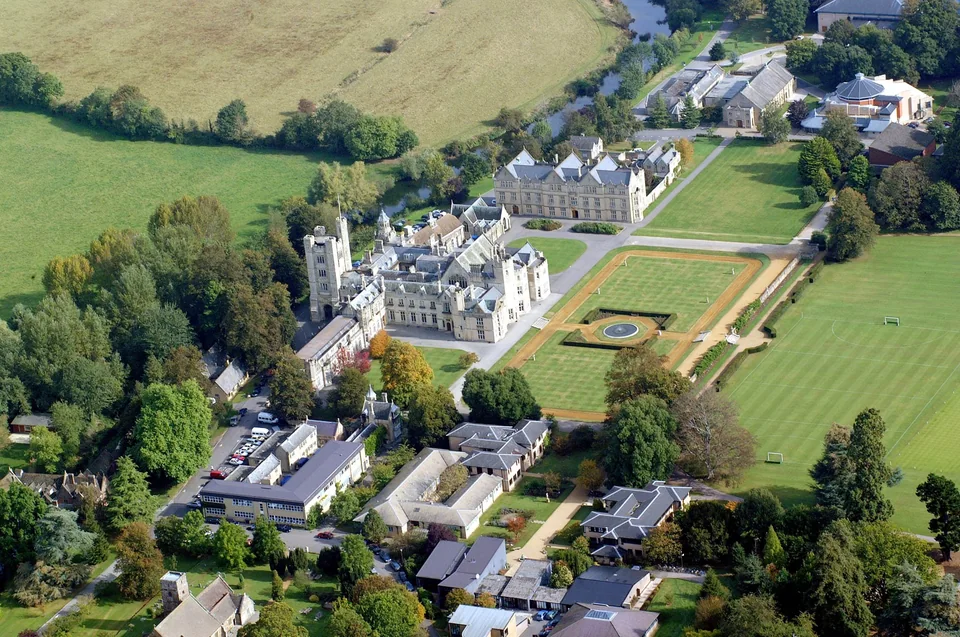
After 9th grade, students from Russia and other CIS countries go abroad not to university but to the final two or three years of school. The main routes are a private boarding school in the UK with A-levels, a private high school in the US, a school in Canada and — for citizens of Kazakhstan, Uzbekistan and most other CIS countries, but not Russia or Belarus — a free public school in the Czech Republic taught in Czech. Each route ends with a school qualification that opens universities in that country and beyond. It is expensive: a year at Oakham School, a British boarding school, costs about $77,420 (£58,446 including VAT) for 2026/27. A minor leaving Russia without their parents needs a notarised consent from one parent.
Below: the routes compared, visa rules for minors in the UK, the US and Canada, restrictions for Russian citizens, costs, documents and signs that a teenager should wait until 11th grade.
| In brief | Answer |
|---|---|
| Where students go after 9th grade | to upper secondary school: a UK boarding school, a US private school, a Canadian school; CIS citizens other than Russians and Belarusians can also choose a Czech school |
| Time until university | UK: 2 years of A-levels (sometimes after a preparatory year); US and Canada: usually 2–3 years |
| UK visa | Child Student for ages 4–17, fee $740 (£558), decision usually within 3 weeks |
| US public high school on an F-1 visa | no more than 12 months, and only after paying the full cost |
| Canada | under 17: only with a parent or a custodian in Canada |
| Leaving Russia without parents | a passport and notarised consent from one legal representative |
Routes after 9th grade compared
| Route | Starting age | Length | Final qualification | Where it leads |
|---|---|---|---|---|
| UK boarding school, A-levels | 15–16 | 2 years, sometimes with a preparatory year | A-levels | direct entry to UK universities and universities elsewhere |
| US private high school | 15–16 | 2–3 years | High School Diploma | US colleges and universities with the SAT or ACT |
| Canadian school | 15–16 | 2–3 years | provincial diploma | Canadian universities and colleges |
| Czech public school in Czech (CIS citizens other than Russians and Belarusians) | 15–16 | 4 years | maturita certificate | Czech universities, including tuition-free study in Czech |
| Stay in school at home until 11th grade | — | 2 years | national school certificate | abroad via a preparatory year, or directly where an 11-year certificate is accepted |
A note on words: in the UK and Canada, "college" often means a private school or sixth form rather than a vocational college. Students do not gain a trade there; they prepare for university entrance exams.
Many private schools also offer the International Baccalaureate Diploma. Note that the International Baccalaureate organisation was designated "undesirable" in Russia in 2025, which matters for Russian citizens; A-levels and national diplomas are the alternatives.
United Kingdom: boarding school and A-levels
British schools split the final years into two stages: GCSEs at 14–16 and A-levels at 16–18. A student finishing 9th grade usually joins either the last year before A-levels or, with good enough English and subject knowledge, the two-year A-level programme directly. A-level students take three or four subjects, and the choice shapes the future degree. With A-level grades, students enter UK universities without a foundation year; Goldsmiths, for example, lists A-levels as a basis for direct entry.
Study at a private school requires a Child Student visa. According to the UK government:
- the student must be aged 4 to 17 and hold an unconditional offer from an independent school;
- accommodation must be suitable: boarding at school, with a foster carer or close relative, with a parent, or independently from age 16;
- the student needs funds for fees and living costs and the consent of a parent or legal guardian to study and live in the UK;
- the fee is $740 (£558) plus the healthcare surcharge, which depends on visa length; you can apply up to 6 months before the course starts and usually get a decision within 3 weeks;
- students aged 16 or 17 when they apply get a visa for the course length (up to 3 years) plus 4 months.
A school may ask you to appoint a UK guardian who is responsible for the student at weekends and during holidays. This is a school requirement rather than a visa rule, so check the contract. Where Russian citizens apply is covered in our UK student visa guide.
United States: private school and the F-1 visa
International teenagers attend US high schools on an F-1 visa, but public schools are almost closed to them: under federal rules, an F-1 student may attend a public high school for no more than 12 months in total, and the family must first reimburse the school district for the full, unsubsidised cost of education. The realistic route is a private day or boarding school. After graduating, students apply to US colleges; see SAT or ACT for the admissions tests.
Russian citizens attend visa interviews in third countries, usually Astana or Warsaw; the procedure and fees are covered in our F-1 visa guide.
Canada: school and custodian
Studying at a Canadian school requires a study permit. A minor is anyone under their province's age of majority: 18 in Alberta, Ontario, Quebec and several others, 19 in British Columbia, Nova Scotia and others. Children under 17 must come with a parent or have a custodian in Canada — an adult Canadian citizen or permanent resident who signs a custodianship declaration. From 17 a custodian is optional, but an officer may request one. See our guides to the Canadian study permit and colleges in Canada.
Czech Republic: free school, but not for Russian citizens
Czech school law gives foreigners who are lawfully staying in the country access to secondary education on the same terms as EU citizens. Public schools teach in Czech free of charge, and after nine years of basic school students usually spend four more years before the maturita exam. Vocational secondary schools combine a trade with the maturita.
For Russian citizens this route is currently blocked at the visa stage: Czech Government Decree No. 55/2024 makes applications by Russian citizens for visas and residence permits at embassies inadmissible, with no exception for students. The same decree covers Belarusian citizens, with an exception only for certain scholarship holders. Citizens of Kazakhstan, Uzbekistan and most other CIS countries can use the route, though the first year usually goes on learning Czech. See our guide to the Czech student visa and residence permit.
If you want a vocation rather than university
Families searching for "study abroad after 9th grade with a vocational qualification" often expect a Russian-style college. UK boarding schools and private schools in the US and Canada do not teach a trade: their job is to prepare students for university. Vocational upper-secondary education exists where teaching is in the local language. In the Czech Republic, vocational secondary schools award a trade qualification together with the maturita; Germany and the Netherlands have their own vocational systems, also taught in German and Dutch.
The practical conclusion: at 15, a vocational route starts with one or two years of intensive language study, and for Russian citizens the Czech option is currently closed by visa rules. If learning the local language is not part of the plan, it is more realistic to gain a vocation after school, at a college or at a university with applied programmes.
Documents from Russia: leaving the country and the Russian certificate
Leaving Russia. Under Article 20 of the Russian law on exit and entry, a minor travelling without parents must carry a passport and notarised consent from one legal representative; the consent may state the travel period and countries. If the other parent has filed an objection to the child's departure, a court decides. Make the consent cover the whole school year and all transit countries to reduce questions at the border.
The Russian school certificate. If returning is possible, the student can continue Russian schooling in the form of family education: the Law on Education lets such students take interim and final assessments at a Russian school. It is a useful safety net, but it doubles the workload.
A foreign school certificate in Russia. For admission to a Russian university, a foreign school certificate is recognised under Article 107 of the Law on Education: through a treaty, a government list or Rosobrnadzor.
What school abroad costs
| Item | Example or guide | Worth knowing |
|---|---|---|
| UK boarding school, 2026/27 | Oakham School: $25,810 (£19,482 incl. VAT) per term, about $77,420 (£58,446) a year | the figure already includes the 20% VAT charged on UK private school fees |
| Child Student visa | $740 (£558) plus the healthcare surcharge | paid again on extension |
| US public high school on F-1 | the full cost set by the school district | no more than 12 months |
| Private school in the US or Canada | set by the school | boarding, meals and custodian are separate items |
| Czech public school | free, taught in Czech | only for lawful residents; currently unavailable to Russian citizens |
On top of school fees come holiday flights, uniform, trips, insurance, guardian services and pocket money.
Is your teenager ready to leave at 15?
Leaving after 9th grade makes sense when three things line up: the teenager genuinely wants to go rather than agreeing under pressure; their English is already good enough to study in; and the family can fund every year of school and university, not just the first. If any of these is missing, it is wiser to finish 11 years of school and go abroad via a preparatory year — see UK university after 11 years of school and US university after 11 years of school.
Plan for the year before departure
- September–October. Decide in which country your child will apply to university; that determines the school and programme.
- October–December. Shortlist four to six schools, take their English and maths tests and attend interviews. Many private schools select a year before entry.
- January–March. Receive offers, sign the contract and pay the deposit.
- April–June. Visa documents, notarised consent to travel, medical certificates and translated school records.
- July–August. Visa, tickets and contact with the guardian and school.
Common mistakes
- Confusing a foreign "college" with a vocational college. In the UK it is often a private school or sixth form; no trade is taught.
- Choosing a school country without a university plan. A-levels open British universities, a US diploma opens American ones; switching systems is possible but adds exams.
- Counting on a US public high school. On an F-1 visa it is limited to 12 months at full cost.
- Planning the Czech route with a Russian passport. Embassies currently do not accept study visa applications from Russian citizens.
- Getting a travel consent for one country or a short period. Study requires consent covering the whole period and every country on the route.
- Budgeting only for school fees. Guardians, flights and holidays add a noticeable sum every year.
FAQ
No: universities admit students after complete secondary education. After 9th grade students go to upper secondary school or school-level preparatory programmes and apply to university two or three years later with A-levels, a US diploma or another national qualification.
Czech public schools are free in Czech for foreigners lawfully living in the country, but Russian citizens cannot currently obtain a study visa there through an embassy. In the UK, the US and Canada, international teenagers attend private schools and pay full fees.
A passport and notarised consent from one legal representative if the child travels without parents; the consent may state the period and countries. Add the visa documents for the country of study: proof of enrolment and funds and, for the UK, parental consent to study and live there.
In Canada, a child under 17 travelling without a parent must have a custodian. In the UK, the visa allows boarding, living with a foster carer or, from 16, living independently, while the school itself often requires a guardian. In the US, the school sets the rules.
The main advantage is a local school qualification that opens that country's universities without a foundation year and with strong English. The downsides are cost, early independence and a harder return to the Russian system. After 11th grade, a similar result usually takes one preparatory year.
Yes, by studying in parallel under family education and taking assessments at a Russian school, as the Law on Education allows. It is a safety net in case of return, but combining two curricula is demanding, and the student will need to travel home for final exams.
Sources
- GOV.UK: Child Student visa — age, requirements, fee, timing
- Oakham School: fees for 2026/27
- Goldsmiths: entry requirements for applicants from Russia
- US Code of Federal Regulations, 8 CFR 214.2(f): F-1 students at public secondary schools
- Government of Canada: minor children studying in Canada
- Czech School Act No. 561/2004, section 20
- Russian Federal Law No. 114-FZ on exit and entry, Article 20 (Wikisource text)
- Russian Law on Education, Article 17: family education
- Russian Law on Education, Article 107: recognition of foreign education
- The Czech visa rule for Russian citizens and the F-1 interview locations come from our guides to the Czech student visa and the F-1 visa, which cite official sources.
Sterling amounts were converted using the ECB cross rate for 29.09.2026 (£1 ≈ $1.3247; the euro stood at $1.1355), with dollar figures rounded to tens.
Choosing a country and school with the future university in mind, checking visa and guardianship conditions, and preparing documents and applications are provided under an agreement with StudyU. The school decides on admission, the country's immigration authorities on the visa, and parents arrange the consent to travel with a notary.
Next steps
- UK Student Visa in 2026: CAS, 28-Day Funds, TB Test, Fees and Applying from Russia, Kazakhstan and Central Asia
- SAT or ACT: Which Test to Take for US Admission in 2026–27
- F-1 Student Visa for the USA in 2026: I-20, Fees, Where to Interview and the New Fixed Period of Stay
- Canada Study Permit in 2026: Documents, PAL, Proof of Funds and How to Apply
- Colleges in Canada for International Students: Programmes, Costs and Post-Graduation Work Rights
- Czech Student Visa and Residence Permit: Who Can Apply, Documents, Funds and Timing
