
You cannot enrol directly in a medical degree in France: every future doctor first completes one university year, either the PASS health-access pathway or a Licence with a health-access option (L.AS), and only the strongest students move on to the second year of medicine. Teaching is in French only, at B2 or above, and residents of Russia apply to the first year through Études en France, for 2027/28 by 15 December 2026. A general practitioner qualifies after 10 years and a specialist after 10 to 12. Public tuition for the first year in 2026/27 ranges from $200 (€178) at the national rate to $3,300 (€2,902) at the differentiated non-EU rate, but the real barrier is the selection after year one.
| At a glance | Medicine in France for non-EU students |
|---|---|
| Where | 38 public universities with a medical faculty |
| First year | PASS or L.AS, then selection into year two |
| Language | French only, B2 minimum |
| Time to qualify | 10 years for general practice, 10–12 for specialists |
| Applying from Russia for 2027/28 | Études en France, file by 15 December 2026, up to three universities |
| First-year tuition, 2026/27 | $3,300 (€2,902) differentiated rate or $200 (€178) if waived |
| Attempts at entering medicine | two at most over your studies |
| Who decides | admission to PASS or L.AS and entry to medicine: the university; visa: the French consulate |
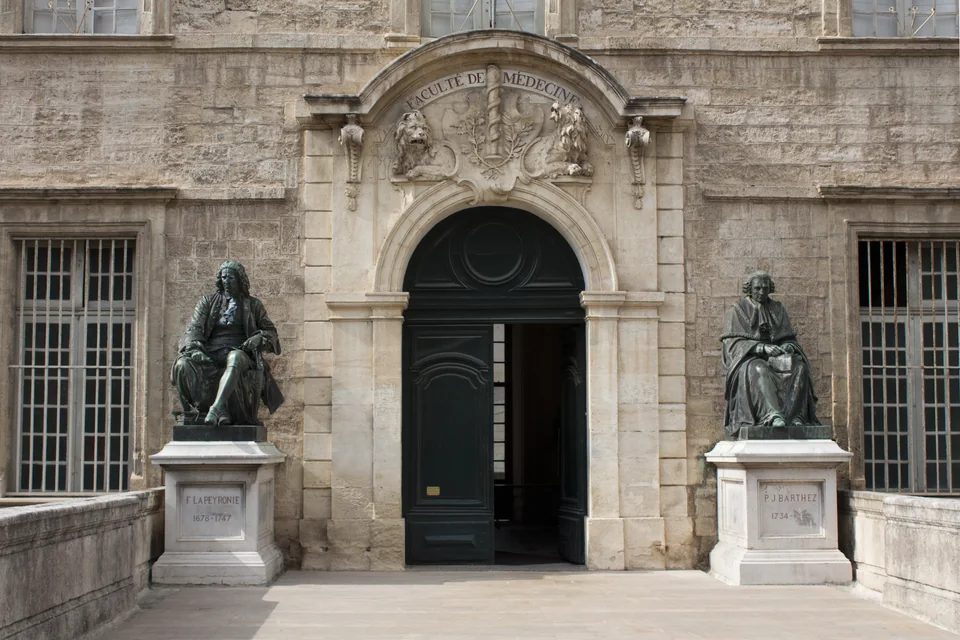
How medical training is structured
French medical education has three university cycles. The State diploma of Doctor of Medicine (Diplôme d'État de docteur en médecine) is awarded only at the end of the third.
| Stage | Years | What happens | Award |
|---|---|---|---|
| PASS or L.AS | 1 | foundation year and selection for the health professions | 60 ECTS and the right to apply |
| First cycle | 2–3 | anatomy, physiology, semiology; a 4-week nursing placement and at least 12 weeks in hospital | DFGSM, Licence level |
| Second cycle (externat) | 4–6 | half the time in hospital as a paid student, at least 25 on-call shifts | DFASM, Master level |
| National selection for residency | end of year 6 | written tests, the ECOS clinical exam and a review of the student's record | a specialty and city chosen by ranking |
| Third cycle (residency) | 4–6 years | hospital rotations, thesis, and a final phase as a "junior doctor" with supervised autonomy | Doctor of Medicine plus the specialty diploma (DES) |
Campus France's brochure for international students states that non-EU students must pass the residency exam for foreign candidates (Internat en médecine à titre étranger), run by the CNG, to enter the third cycle. Check how the move into residency works for your nationality with the medical faculty before you start PASS.
There are 44 specialties: 13 surgical, 30 medical and medical biology. Places vary enormously: ONISEP reports 36 residency places in paediatric surgery for 2025/26, 479 in anaesthesia and intensive care and 3,314 in general practice.
PASS or L.AS: choosing the first year
Both are first-year Licence programmes that let you apply to medicine, dentistry, pharmacy or midwifery, and at some universities to physiotherapy.
| PASS | L.AS | |
|---|---|---|
| What it is | a specific health-access pathway: mostly health subjects plus a minor of your choice | a Licence in another subject (law, biology, economics, languages) with a health option |
| Where offered | universities with a medical faculty | also universities without one |
| If you fail the year | PASS cannot be repeated; you move to another programme | you can repeat the Licence year, but without the health option |
| If you pass but are not admitted | move to L.AS year two and try again | continue the Licence and try again |
| Best for | students strong in biology and chemistry who are set on medicine | students with a strong subject outside biology or a fallback plan |
To be eligible you must validate all 60 credits, and some universities require a first-session pass without resits. Candidates are ranked on their grades across both semesters. Those above the university's threshold are admitted directly; the rest sit additional tests, usually oral and sometimes written, assessing reasoning, motivation and understanding of the profession. Each university sets second-year capacity with its regional health agency. You can apply to medicine twice at most during your studies.
Non-EU students go through the same end-of-first-year selection as French students. No one can estimate your odds in advance: they depend on the university, the number of places and how well you perform in French exams alongside graduates of French lycées. Universities run student tutoring groups (tutorats) with mock exams; ONISEP says two-thirds are free and the rest cost under $34 (€30) a year.
Applying from Russia: steps and dates for 2027/28
Campus France Russia states that medicine, pharmacy, dentistry and midwifery use the first-year (Licence 1) procedure at every level except continuing education and doctoral study. Even students already enrolled at a Russian medical school follow the first-year route, apart from the special transfer procedure described below.
- Before October 2026, pass your French test: DELF B2, DALF or the TCF TP with the written section. Campus France Russia must have your test result by 1 March 2027; proof that you have registered for the TCF is not enough.
- Between 1 October and 15 December 2026, create and submit your Études en France file, choosing PASS or L.AS at up to three universities.
- Once the office has checked the file, pay the procedure fee by 21 February 2027; in the 2026/27 cycle it was $95 (RUB 8,000).
- Complete the online interview with Campus France, held in Russian, by 1 March 2027. Expect questions on why France, why medicine and your career plans.
- Receive university answers by 30 April 2027 and confirm your choice by 31 May.
- Lodge the visa application within the three months before your course starts. Anyone still under 18 then must name a French-citizen guardian resident in the university town.
Other countries follow their own Campus France procedure and calendar, so check the office in your country of residence. Document and visa rules for Russian residents are covered in studying in France for Russian citizens.
Can you study medicine in France in English?
No. Campus France states that medical studies in France are taught only in French and require B2. Public universities offer no English-taught medical degree. If your English is stronger than your French, compare France with countries that teach medicine in English, such as Italy with the IMAT exam, Hungary or Serbia.
B2 is the threshold for applying, not a comfortable working level. Anatomy and biochemistry lectures, written exams and the second-stage oral all run in French at the same pace for everyone.
What medical school in France costs
| Item | Amount, 2026/27 | Note |
|---|---|---|
| PASS or L.AS, differentiated rate | $3,300 (€2,902) a year | Licence-level rate for non-EU nationals |
| PASS or L.AS if waived | $200 (€178) a year | national rate; the university grants waivers on request |
| Years 2–3 (DFGSM) | $3,300 (€2,902) a year at the differentiated rate or $200 (€178) if waived | the Licence-level differentiated rate applies here too |
| Years 4–6 (DFASM) | $4,490 (€3,950) a year at the differentiated rate or $290 (€255) if waived | Master-level rate |
| Residency (Doctor of Medicine and DES) | $600 (€526) a year | the third cycle is exempt from the differentiated rate for international students |
| CVEC contribution | $120 (€105) a year | compulsory for all students |
| Funds for the visa | $1,000 (€877.50) or more for each month | student residence requirement |
Without a waiver, the six years before residency (PASS or L.AS, DFGSM and DFASM) would cost about $23,340 (€20,556) in tuition alone at 2026/27 rates, before CVEC and living costs; rates are reset every year.
Since the decree of 19 May 2026, the differentiated rate is the default: waivers are granted on request according to income, and in 2026/27 they may cover no more than 30% of students on the differentiated rate, with the cap falling to 20% later. Universities still differ. Université Paris Cité kept the national Licence and Master rates for non-EU students in 2026/27, so PASS there cost $200 (€178); that decision covers the 2026/27 academic year only.
Add living costs: housing, food, transport and insurance. City-by-city figures are in the cost of studying in France, and housing options in student housing in France.
Where to study: universities with medical faculties
Universities award the medical degree, so choosing one means choosing a city, its teaching hospitals and the competition for places. Among the universities we profile:
- Sorbonne University, one of the largest medical faculties in Paris;
- Université Paris-Saclay, south of Paris, with the region's university hospitals;
- the University of Strasbourg and Aix-Marseille University, major regional faculties where living costs are lower than in Paris.
Rankings say little about PASS: selection depends on your grades and the number of places at that university. It is more useful to compare second-year capacity and whether the university offers an L.AS in your strongest subject. See also our overview of universities in France.
If you already study medicine in Russia
Students and graduates of Russian medical schools can use the "dispense d'études" procedure under the order of 13 December 2019. Successful candidates enter directly at year two and up to year five of medicine, or up to year four of pharmacy, dentistry or midwifery. The rules:
- you may apply to one university only, and no more than twice over your studies;
- files go by email to the cooperation department of the French Embassy in Russia, not to the university; direct applications are rejected;
- most universities require certified French at B2;
- Campus France Russia describes selection as extremely competitive, with criteria set by each university.
The DFMS and DFMSA training programmes for foreign doctors have been frozen for Russian candidates since 2022. Doctors with a non-EU diploma who want to practise in France go through the authorisation procedure, which starts with the knowledge verification exams (EVC) run by the National Management Centre (CNG).
After graduation: working in France or Russia
A French-trained graduate holds the Doctor of Medicine diploma with a specialty. Students already work in hospitals for pay during the externat, and residents are treated as professionals with prescribing authority under a senior doctor's supervision.
If you plan to return to Russia, working as a doctor with a foreign diploma requires recognition of the qualification and admission to medical practice through Roszdravnadzor, a two-stage procedure since 1 January 2023. Russia has no recognition treaty with France, so the degree is assessed unless the university is on the Government list under Order No. 186-r.
Who the French route suits
France makes sense if you can already study comfortably in French, accept a competitive first year with no automatic progression, and want a degree that opens French residency training. Without French, the plan grows by at least a year of language study, and it is worth comparing with countries offering English-taught medicine with an entrance exam. For the wider picture, see the France country page.
Common mistakes
- Applying with B1 French and hoping to catch up in September, when selection starts with the first semester exams.
- Choosing PASS with no fallback plan, even though it cannot be repeated.
- Assuming that passing year one means a place in year two: it only makes you eligible for selection.
- Looking for an English-taught medical degree at a public university.
- Sending Russian medical school documents straight to a university instead of through the Embassy procedure.
- Budgeting at the national rate before the university has confirmed a waiver in writing.
How StudyU helps
An assessment of whether the French route suits you or should be compared with other countries, a shortlist of universities offering PASS or L.AS, a language and timing plan, and preparation of the Études en France file and visa documents are provided under an agreement with StudyU, while first-year admission and entry into the second year of medicine are decided by the university; the visa is decided by the French consulate.
FAQ
A general practitioner trains for 10 years after school: one year of PASS or L.AS, five years in the first and second cycles and four years of residency. Surgeons, paediatricians and other specialists need 10 to 12 years depending on the specialty. The last phase of residency is spent as a junior doctor with supervised autonomy.
Yes, but not in medicine itself. A school leaver applies to PASS or L.AS at up to three universities and must prove French at B2. Entry into the second year of medicine depends on first-year grades and the additional tests, so no place is reserved in advance.
No. According to Campus France, medical studies in France are taught only in French and require B2, so an English-taught medical degree means looking at other countries. If your English is stronger, compare France with countries that teach medicine in English, such as Italy or Hungary.
In 2026/27 the first PASS or L.AS year costs $3,300 (€2,902) at the differentiated rate or $200 (€178) if the university waives it. Years 2–3 carry the same pair of rates, years 4–6 cost $4,490 (€3,950) or $290 (€255), and everyone pays $600 (€526) a year during residency. Add the $120 (€105) CVEC each year and living costs; the visa requires at least $1,000 (€877.50) a month.
There are no official statistics for international students, and no honest way to predict your odds. You compete with French students on two semesters of grades in French, and each university agrees its capacity with the regional health agency. You get two attempts in total, so plan a fallback from day one.
There is no direct transfer, but the dispense d'études procedure lets students and graduates of Russian medical schools enter years two to five of medicine. Files go to one university through the cooperation department of the French Embassy in Russia, usually with B2 French. Selection is very tight and criteria are set by the university.
Working as a doctor in Russia requires recognition of the qualification and admission to practice through Roszdravnadzor, in two stages since 2023. Russia has no recognition treaty with France, so the degree is assessed unless the university is on the list under Government Order No. 186-r.
Sources
- ONISEP: access routes to medicine, pharmacy, dentistry and midwifery (PASS, L.AS, selection) — checked 30.09.2026
- ONISEP: medical studies — cycles, 38 universities, 44 specialties — checked 30.09.2026
- Campus France: medicine in France — taught only in French, B2 — checked 30.09.2026
- Campus France Russia: medical applications and the 2027/28 calendar — checked 30.09.2026
- Campus France Russia: dispense d'études, DFMS/DFMSA, residency exam for foreign doctors — checked 30.09.2026
- etudiant.gouv.fr: 2026/27 rates for DFGSM, DFASM and the third cycle; waiver cap — checked 30.09.2026
- Campus France: 2026/27 differentiated rates and exemptions — checked 30.09.2026
- Université Paris Cité: national rate kept for non-EU students in 2026/27 — checked 30.09.2026
- CVEC platform: contribution amount for 2026/27 — checked 30.09.2026
- Service-Public: student visa, $1,000 (€877.50) a month — checked 30.09.2026
- CNG: knowledge verification exams (EVC) for doctors with foreign diplomas — checked 30.09.2026
- Roszdravnadzor: admission to medical practice with foreign education — checked 30.09.2026
- List of foreign institutions whose degrees Russia recognises (Order No. 186-r) — checked 30.09.2026
- Conversions: euros at the ECB reference rate of 29.09.2026 (EUR 1 = USD 1.1355), roubles at the Bank of Russia rate of 30.09.2026 (USD 1 = RUB 84.4283); dollars rounded to the nearest dollar below $100 and to the nearest $10 above.
Next steps
- Studying in France for Russian Citizens: How to Apply from Russia in 2027
- University of Strasbourg: Admission, Fees and Faculties
- Aix-Marseille University (AMU): Admission, Fees and Campuses
- Studying in France for international applicants
- Studying Medicine in Italy in English: IMAT, Non-EU Places and the 2026/27 Rules
- Studying medicine in Hungary: English-taught programmes, entrance exams and costs
