
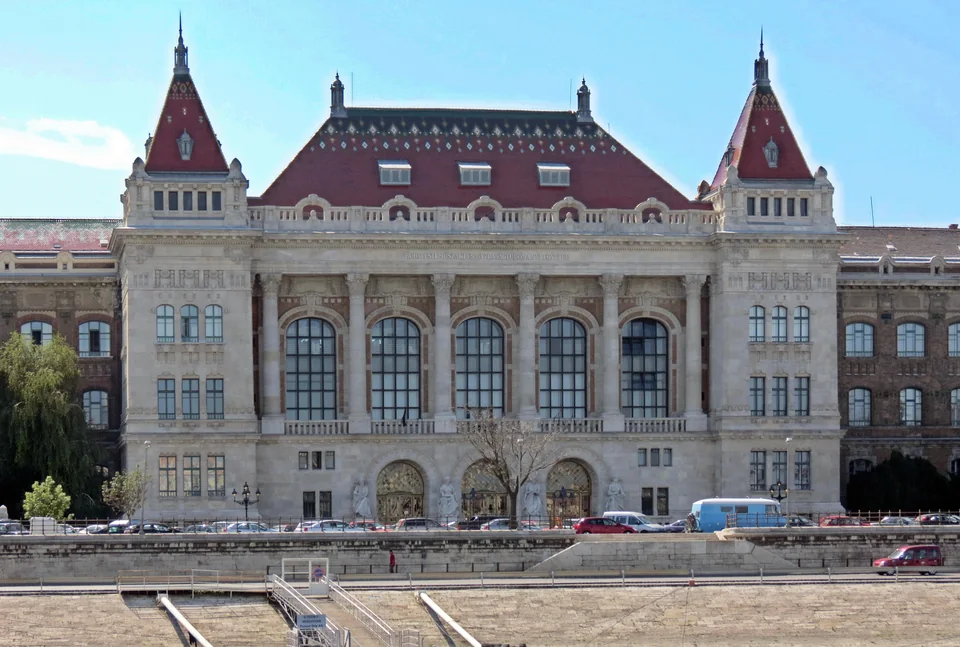
The Budapest University of Technology and Economics (Budapesti Műszaki és Gazdaságtudományi Egyetem, BME) is Hungary's leading engineering university. Its predecessor, the Institutum Geometrico-Hydrotechnicum, was founded in 1782 as the first institution in Europe to train engineers within a university structure. Today BME runs 8 faculties and offers over fifty programmes in English at every level from bachelor's to PhD, and international students make up over 12% of enrolment. Most bachelor's programmes cost non-EU students $3,630 (€3,200) a semester in 2026/27, and the application fee is $170 (€150). Admission runs through an online exam in the E-admission system; the next window, for programmes starting in February 2027, is open from 15 October to 15 November 2026.
| At a glance | Details |
|---|---|
| City | Budapest, central campus next to a science park |
| Founded | 1782 (Institutum Geometrico-Hydrotechnicum) |
| Faculties | 8: Civil Engineering, Mechanical Engineering, Architecture, Chemical Technology and Biotechnology, Electrical Engineering and Informatics, Transportation and Vehicle Engineering, Natural Sciences, Economic and Social Sciences |
| English-taught programmes | 50+ bachelor's, master's and doctoral |
| Bachelor's, 2026/27 | $3,630 (€3,200) a semester; mechanical engineering $3,970 (€3,500) |
| Master's, 2026/27 | $2,500–4,540 (€2,200–4,000) a semester |
| Application fee | $170 (€150) |
| English | B2: IELTS 5.5, TOEFL iBT 72, Duolingo 100 or equivalent |
| Bachelor's length | usually 7 semesters; civil engineering 8, mathematics and physics 6 |
| Next window | 15 October–15 November 2026 for a February 2027 start |
Who BME suits
BME is the right choice if you already know you want engineering, IT or the physical sciences and are ready for a heavy maths and physics load. It covers almost the full engineering spectrum: computer science engineering, electrical, mechanical, civil and chemical engineering, logistics and transportation, and architecture.
One practical point for applicants from Russia: in special cases — for example when international tests are unavailable because of sanctions or service suspension — BME allows an internal English test instead. You must request permission in advance.
Consider other options if:
- you want business, economics or international relations — compare Corvinus University and ELTE;
- budget matters more than the capital and you want engineering or IT outside Budapest — look at the University of Debrecen and the University of Pécs;
- you are counting on university housing — fee-paying students get dormitory places only in limited numbers.
English-taught programmes and 2026/27 fees
Bachelor's
| Programme | Semesters | Fee per semester (non-EU citizens) |
|---|---|---|
| Computer Science Engineering | 7 | $3,630 (€3,200) |
| Electrical Engineering | 7 | $3,630 (€3,200) |
| Mechanical Engineering | 7 | $3,970 (€3,500) |
| Civil Engineering | 8 | $3,630 (€3,200) |
| Chemical Engineering | 7 | $3,630 (€3,200) |
| Engineering Management | 7 | $3,630 (€3,200) |
| Vehicle Engineering, Logistics, Transportation | 7 | $1,250 (€1,100) base plus $79 (€70) per credit, about $3,630 (€3,200) for 30 credits |
| Mathematics, Physics | 6 | $3,630 (€3,200) |
| Physicist-Engineer | 7 | $3,630 (€3,200) |
| Architectural Engineering, one-tier | 10 | $3,630 (€3,200) |
On the transportation faculty the fee is a base amount plus a per-credit charge, so a lighter semester costs less and a heavier one more. Logistics and Transportation are marked as not yet launched in the 2026/27 fee table, so check the programme page for intake status.
Professional Pilot. The transportation faculty runs a pilot bachelor's with integrated flight training. Semesters one to six cost $16,640 (€14,650) each and later semesters $4,990 (€4,395). BME sets this fee in forints, so the euro figure moves with the exchange rate.
Master's
| Field | Fee per semester |
|---|---|
| Structural and Infrastructure Engineering, land surveying and GIS, Construction IT | $4,310 (€3,800) |
| Mechanical Engineering Modelling | $4,540 (€4,000) |
| Architecture, Engineering Management | $3,970 (€3,500) |
| Computer Science Engineering, Electrical Engineering, Chemical Engineering, Mathematics, Physics, Medical Physics | $3,630–3,970 (€3,200–3,500) |
| Autonomous Vehicle Control, Vehicle, Logistics, Transportation | $1,590 (€1,400) base plus $79 (€70) per credit, about $3,970 (€3,500) for 30 credits |
| Finance, Management and Leadership, Regional and Environmental Economics | $2,500 (€2,200) |
Most master's last 4 semesters; the civil engineering and GIS master's last 3. Doctoral programmes are mostly $5,110 (€4,500) a semester.
Preparatory programmes
The Pre-engineering Programme lasts two semesters and starts in September or February. The fee depends on the faculty: Natural Sciences $3,630 (€3,200), Architecture $3,970 (€3,500), Civil Engineering $4,310 (€3,800) a semester. Bachelor's graduates who need to fill gaps can take a Pre-MSc in architecture or structural engineering. For the preparatory year, B1-level English is enough and there is no entrance test.
How to apply
Documents
| Level | What to upload to E-admission |
|---|---|
| Preparatory | CV and motivation letter, passport, school certificate, B1 English proof, receipt for the $170 (€150) fee |
| Bachelor's and one-tier | CV and motivation letter, passport, school certificate, B2 English proof, fee receipt |
| Master's | CV and motivation letter, passport, bachelor's degree, transcript, two recommendation letters, B2 English, fee receipt |
| Transfer | as above plus current transcript and course descriptions |
English
Bachelor's and master's accept IELTS or IELTS Online 5.5, Cambridge B2 First 160, TOEFL iBT (including Home Edition) 72, PTE Academic 50, Duolingo English Test 100, Trinity ISE II, TOEIC with minimum scores in all four skills, or an official letter confirming that your previous studies were taught in English. For the preparatory programme: IELTS 4.5, TOEFL iBT 42, Duolingo 60, Cambridge B1 Preliminary 140, or a passed internal English test in E-admission. Faculties may set higher minimums, so check your programme page.
The online admission exam
Every applicant to a bachelor's, one-tier or master's programme completes an electronic admission exam or placement test in E-admission; preparatory programmes have no test. For transfer students, the faculty decides whether a test is needed. Some units add an oral exam or specific academic requirements, as stated in the programme description.
Application steps
- Create an E-admission account.
- Complete the form and upload documents.
- Pay the $170 (€150) fee (card payment is possible) and upload the receipt.
- Submit the application and take the online exam.
- Receive the decision; admitted students get help from the International Mentor Team with insurance, housing and settling in.
Deadlines. The window for February 2027 programmes is 15 October–15 November 2026, and not every programme is open for spring entry. BME announces the September intake dates separately on its Admission page; doctoral programmes have their own deadlines.
What a year at BME costs
| Item | Computer Science Engineering, year one | Mechanical Engineering, year one |
|---|---|---|
| Application fee | $170 (€150) | $170 (€150) |
| Tuition | $7,270 (€6,400) | $7,950 (€7,000) |
| Living in Budapest, 10 months | from $7,950 (€7,000) | from $7,950 (€7,000) |
| Total | from $15,390 (€13,550) | from $16,070 (€14,150) |
BME puts a student's monthly budget in Budapest at $790 (€700) or more, including housing, food and transport. A room in a shared flat costs roughly $280–510 (€250–450) a month and a studio $510–680 (€450–600). Compare other cities in our guide to the cost of studying in Hungary.
EU citizens pay lower fees — for example $1,250 (€1,100) a semester on the civil engineering faculty — but this does not apply to citizens of Russia or other CIS countries.
Scholarships
BME states in its FAQ that it does not currently offer merit-based scholarships of its own. The routes are government programmes:
- Stipendium Hungaricum — the deadline is 15 January each year. BME says it has the second-largest international student body in Hungary, largely thanks to this scholarship. In the 2026/27 round Russia was a sending partner for all fields, with applications routed through Interobrazovanie; Kazakhstan, Uzbekistan, Kyrgyzstan and other CIS states are also partners.
- Hungarian Diaspora Scholarship and Scholarship for Christian Young People — for specific groups of applicants.
Housing and campus
BME's campus is in central Budapest, next to a science park that hosts offices of major international companies. Dormitory places go first to scholarship holders, with a limited number for fee-paying students, so the university advises arranging accommodation early. The International Mentor Team helps with the search, but the lease is your own contract.
Visa and residence permit
A student from Russia or most CIS countries enrolling at BME for a full degree needs a residence permit for study. You apply at a Hungarian consulate before entry, and the immigration authority decides within 60 days. The file includes the admission letter, proof of payment, proof of funds and a Hungarian address. See the Hungary student visa guide for filing locations.
Degree and career
BME programmes follow the European ECTS credit system. The university lists four Nobel laureates in its history, and the science park next to campus houses offices of international companies. Russia and Hungary have an agreement on mutual recognition of education and qualifications dated 22 November 2018; if you plan to return, check the recognition procedure for your specific degree before enrolling.
Application timeline
| When | Step |
|---|---|
| Until 15 November 2026 | apply for February-start programmes if yours is open |
| Autumn–winter | take an English test or request permission for the internal test |
| When the September 2027 window opens | apply in E-admission, pay $170 (€150), take the online exam |
| After admission | pay the semester, receive documents for the consulate |
| 2–3 months before classes | residence permit and housing |
Mistakes to avoid
- Choosing a programme without checking the intake. Not every programme admits students for February.
- Overlooking credit-based fees. On the transportation faculty the fee depends on the number of credits taken.
- Counting on a dorm room. Fee-paying students get places only if any remain after scholarship holders.
- Submitting a B1 certificate for a degree programme. Bachelor's and master's require B2; B1 is enough only for preparatory study.
- Waiting for a university scholarship. BME has no merit awards of its own at present; funding comes from government schemes.
BME compared with other Hungarian universities
| Criterion | BME | Debrecen | Pécs |
|---|---|---|---|
| Engineering bachelor's, per year | $7,270–7,950 (€6,400–7,000), 2026/27 | $7,000–7,500, 2026/27 | $6,800, 2027/28 |
| City | Budapest | Debrecen, east | Pécs, south-west |
| Admission test | online exam in E-admission | written test in English and the subject, plus interview | exam or online interview per programme |
| Housing | dorms mainly for scholarship holders | hotel-style hostel and private rentals | three dormitories for international students |
See our overview of universities in Hungary and the guide to applying to Hungarian universities. If you are torn between engineering and business, compare BME with Corvinus University.
What StudyU does
Matching a programme to your maths and physics results, planning the English test or the internal-test request, preparing documents and submitting in E-admission are provided under an agreement with StudyU. BME decides on admission based on the exam, and the Hungarian immigration authority decides on the residence permit.
FAQ
How much does BME cost?
In 2026/27 most bachelor's programmes cost non-EU students $3,630 (€3,200) a semester and mechanical engineering $3,970 (€3,500). Master's programmes range from $2,500 (€2,200) to $4,540 (€4,000) a semester, and the application fee is $170 (€150).
What English level does BME require?
Bachelor's and master's programmes require B2, for example IELTS 5.5, TOEFL iBT 72 or Duolingo English Test 100. If international tests are unavailable to you, including because of sanctions, you can request permission in advance to take BME's internal test.
Is there an entrance exam?
Yes. Bachelor's, one-tier and master's applicants all take an online admission exam or placement test in E-admission. The preparatory programme has no test, and some faculties add an oral interview.
When should I apply to BME?
The window for February 2027 programmes runs from 15 October to 15 November 2026. September intake dates are published on the Admission page, and Stipendium Hungaricum applicants apply by 15 January.
Does BME offer scholarships to international students?
Not merit-based ones of its own at present. International students can study on the government's Stipendium Hungaricum, Hungarian Diaspora Scholarship or Scholarship for Christian Young People programmes.
Can fee-paying students get a dormitory place?
Dormitory places go first to scholarship holders, with limited availability for fee-paying students. BME recommends arranging housing early; a room in a shared Budapest flat costs about $280–510 (€250–450) a month.
Sources
- BME Xplore, 2026/27 fees: xplore.bme.hu/tuition-fees; admission, documents, English and deadlines: xplore.bme.hu/admission
- FAQ (programme length, scholarships, housing, living costs): xplore.bme.hu/frequently_asked_questions; programmes: xplore.bme.hu/available-programmes
- About BME and history: xplore.bme.hu/why-bme, bme.hu/en/history
- Stipendium Hungaricum partners: stipendiumhungaricum.hu/partners
- OIF study residence permit: oif.gov.hu/tajekoztatok/a-hallgato-tanulo-tartozkodasa
- Russia's recognition agreements, Ministry of Science and Higher Education: minobrnauki.gov.ru/action/foreign_scientists/contracts/
Dollar amounts use the ECB reference rate of 29 September 2026: EUR 1 = USD 1.1355. Information checked on 30 September 2026. Other Hungarian universities and cities are covered on studying in Hungary.
Choosing between BME engineering programmes and planning for the online exam are provided under an agreement with StudyU; the university makes the admission decision. To start, send us an application.
During the free initial consultation, we clarify your goal, profile, timing, and budget and identify the next realistic step.
Next steps
- Corvinus University of Budapest: Admission, Programmes and Fees
- University of Debrecen: Admission, Programmes and Fees
- University of Pécs: Admission, Programmes and Fees
- Studying in Hungary for international applicants
- Eötvös Loránd University (ELTE)
- Cost of studying in Hungary in 2026/27: tuition, housing and a student budget
