
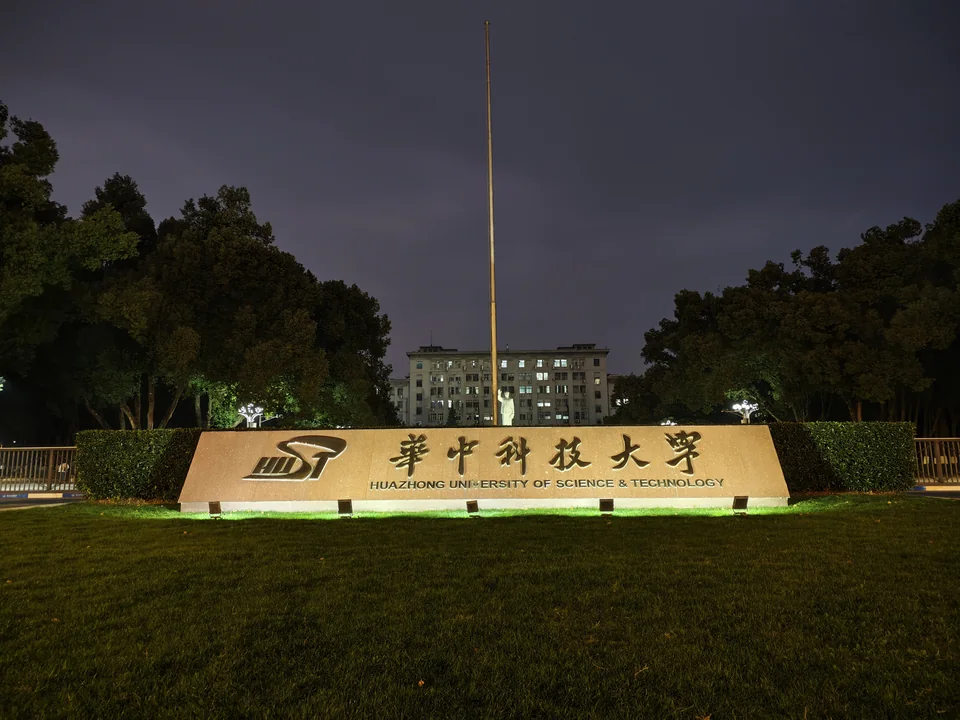
Huazhong University of Science and Technology (华中科技大学, HUST) is a research university in Wuhan under China's Ministry of Education and a member of Projects 211 and 985 and the Double First-Class initiative. It is joint 191st in the THE World University Rankings 2027 and joint 81st for engineering in the THE 2026 subject tables. What sets it apart for international applicants is that 85% of its international students study in English. For the 2026 intake, English-taught bachelor's tuition was $4,470–5,970 (CNY 30,000–40,000) a year, against $2,680–4,920 (CNY 18,000–33,000) for Chinese-taught degrees. Bachelor's applications closed on 15 June, but master's applications closed as early as 1 March.
| At a glance | Details |
|---|---|
| City | Wuhan, Hubei Province; main campus at 1037 Luoyu Road, language and foundation programmes on the Junshan campus |
| Status | Project 211, Project 985, Double First-Class; includes Tongji Medical College with Tongji and Union hospitals |
| Campus | 460 hectares with 72% green cover, hence the nickname "University in the Forest" |
| International alumni | more than 15,000 graduates from 160+ countries since the 1960s |
| Ranking | THE World University Rankings 2027: joint 191st |
| Bachelor's, per year | English-taught $4,470–5,970 (CNY 30,000–40,000); Chinese-taught $2,680–4,920 (CNY 18,000–33,000) |
| Master's, per year | English-taught $4,920–5,670 (CNY 33,000–38,000); Chinese-taught $3,730–5,970 (CNY 25,000–40,000) |
| Housing | $100–180 (CNY 700–1,200) a month |
HUST, Wuhan University and other Wuhan universities
Wuhan has several large universities with similar names, and search results often mix them up. Go by the Chinese characters.
| University | Chinese name | How it differs |
|---|---|---|
| Huazhong University of Science and Technology, HUST | 华中科技大学 | engineering, optoelectronics, Tongji medicine; this profile |
| Wuhan University, WHU | 武汉大学 | comprehensive classical university; see our Wuhan University profile |
| Wuhan University of Technology, WUT | 武汉理工大学 | a separate technical university |
| Central China Normal University | 华中师范大学 | the "Huazhong" teacher-training university, not HUST |
| Huazhong Agricultural University | 华中农业大学 | Wuhan's agricultural university |
Other Chinese universities are profiled on our study in China page.
Who HUST suits
HUST is one of the few strong Chinese universities where you can take an engineering or medical bachelor's in English, not just a business degree. Typical applicants include:
- school leavers with good mathematics and physics who want telecommunications, mechanical engineering or biomedical engineering in English;
- future doctors choosing an English-taught MBBS in the Tongji clinical environment;
- master's applicants in engineering, energy or computer science who can apply in winter;
- students with HSK 4 Chinese who want a technical degree for $3,730 (CNY 25,000) a year.
HUST suits you less if you want an English-taught humanities bachelor's (there are none) or decide late on a master's: the deadline is 1 March, months earlier than at many universities. Our guide to English-taught degrees in China compares options across universities.
Bachelor's programmes and fees
| Language | Programme | Length | Fee per year, 2026 intake |
|---|---|---|---|
| English | Clinical Medicine (MBBS) | 6 years | $5,970 (CNY 40,000) |
| English | Pharmacy | 4 years | $5,220 (CNY 35,000) |
| English | Telecommunication Engineering | 4 years | $4,470 (CNY 30,000) |
| English | Mechanical Design, Manufacturing and Automation | 4 years | $4,470 (CNY 30,000) |
| English | Biomedical Engineering | 4 years | $4,470 (CNY 30,000) |
| Chinese | engineering, science, arts, economics, management | 4–5 years | $3,730 (CNY 25,000) |
| Chinese | literature, education, law | 4 years | $2,680 (CNY 18,000) |
| Chinese | medicine | 4–5 years | $4,920 (CNY 33,000) |
The non-refundable application fee is $89 (CNY 600), or USD 100, payable within 15 days of submitting. Housing costs $100–180 (CNY 700–1,200) a month and insurance $120 (CNY 800) a year. Our guide to studying medicine in China covers English-taught medical degrees and practising after graduation.
Language and documents for bachelor's applicants
Chinese-taught programmes: HSK 4 with 180+ for engineering, science and medicine; HSK 5 with 180+ for economics, management, literature, education, philosophy, arts, law and the School of Artificial Intelligence and Automation. Applicants below the bar can study at HUST's Chinese language centre and apply once they reach it.
English-taught programmes: TOEFL 80, IELTS 5.5 or Duolingo 110, or an equivalent certificate; applicants schooled in English may be exempted after verification.
The application has two parts. First you upload the academic documents: the CSCA score report, your school-leaving certificate or pre-graduation certificate, transcripts, a personal statement on why you chose HUST, a self-introduction video of up to 60 seconds in English or Chinese, a language certificate and evidence of achievements such as competition awards or publications. Architecture and design applicants add at least five pieces of their own artwork. After pre-admission you add a passport valid until at least 15 October 2027, the physical examination form, a police clearance certificate and proof of funds of at least $5,000. Applicants under 18 on 1 September of the entry year need a guardian authorisation and a signed undertaking from a legal guardian in China.
Documents in other languages need official translations into Chinese or English. See applying to Chinese universities for a translation and certification checklist.
Timeline and selection
| Step | 2026 intake |
|---|---|
| admission.hust.edu.cn opens | 15 October 2025 |
| Bachelor's deadline | 15 June 2026 |
| Pre-admission results | from March, in the system |
| Confirming the place | pay first-year tuition within two weeks of the result |
| Admission notice and JW202 form | June 2026 |
Only some schools hold interviews; they are marked in the programme catalogue. Pre-admission is not the final decision: HUST's admission committee confirms admission after checking the second set of documents.
The 2026 intake opened on 15 October 2025; if HUST keeps the same calendar, the 2027 intake will open in mid-October 2026. Since 2026/27 a CSCA result is mandatory for bachelor's study at every Chinese university. This cycle's sittings fall on 14–15 November and 19–20 December 2026, then 23–24 January, 13–14 March, 24–25 April and 26–27 June 2027, with November registration on 15–21 October. With a 15 June deadline the June sitting is too late for HUST, and for early pre-admission it is better to sit the test by the end of January. See our CSCA exam guide.
Foundation programme and Chinese courses
For students who need stronger language or academic preparation before a degree, HUST runs a foundation programme on the Junshan campus.
| Programme | 2026 dates | Cost |
|---|---|---|
| Foundation programme, 21 weeks | 27 February to 15 July 2026; applications 15 October 2025 to 10 January 2026 | $2,610 (CNY 17,500); housing $100–180 (CNY 700–1,200) a month; insurance $60 (CNY 400) per semester |
| Semester or one-year Chinese course | spring: 1 March to 15 July, apply by 15 December; autumn: 1 September to 15 January, apply by 15 June | $1,120 (CNY 7,500) a semester, $2,240 (CNY 15,000) a year |
| "3+3": three months of Chinese and a three-month internship at a Chinese company | per announcement | $750 (CNY 5,000) |
| Short language and culture courses | 1–4 weeks | $220–670 (CNY 1,500–4,500) |
Chinese courses accept applicants aged 16–35 (on 1 September 2026) with a school-leaving certificate, across six levels from A to F. Completing the foundation programme does not lead to a degree place automatically; the degree application is separate. Our article on the foundation year in China explains how university foundation programmes differ from language courses.
Master's and doctoral programmes
HUST takes master's applicants under 35 who hold a bachelor's degree with a GPA of at least 3.0/4, 3.75/5 or 75%. PhD applicants must be under 40 and hold a master's. These are university minimums; schools can set higher bars.
- Language: English-taught programmes accept TOEFL 80, IELTS 6.0 or GRE 310; Chinese-taught programmes require HSK 4 with 180+ for engineering, science and medicine, HSK 5 with 180+ for economics, management, literature, law, education and Tongji Hospital, and HSK 5 with 200+ for Union Hospital.
- Selection: after submitting, applicants take an online multiple-choice language test, pay the $89 (CNY 600) fee and only then go to faculty review.
- Documents: a CV, a research proposal of at least 1,000 words, a writing sample (a term paper or article) and two recommendation letters from professors or associate professors; only some schools require a supervisor's acceptance letter.
- Window: 15 October 2025 to 1 March 2026.
| Programme | Length | Fee per year, 2026 intake |
|---|---|---|
| English-taught master's: engineering, science, economics, management | 2 years | $5,670 (CNY 38,000) |
| English-taught master's: literature, law, education | 2 years | $4,920 (CNY 33,000) |
| Chinese-taught master's: engineering, science, economics, management | 3 years | $4,470 (CNY 30,000) |
| Chinese-taught master's: literature, law, education / medicine | 3 years | $3,730 / $5,970 (CNY 25,000 / 40,000) |
| English-taught PhD: engineering and science / humanities | 4 years | $7,460 / $5,670 (CNY 50,000 / 38,000) |
| Chinese-taught PhD: engineering and science / humanities / medicine | 3–4 years | $6,260 / $4,470 / $7,460 (CNY 42,000 / 30,000 / 50,000) |
Master's study at the China-EU Institute for Clean and Renewable Energy costs $5,970 (CNY 40,000) a year. Graduate housing is $180–210 (CNY 1,200–1,400) a month for a single room or $100–130 (CNY 700–900) for a double. Our guide to a master's in China explains how to approach supervisors and write a proposal.
First-year budget
HUST lists other expenses for reference: textbooks $89 (CNY 600) a year, living costs $180–370 (CNY 1,200–2,500) a month, residence permit $60–120 (CNY 400–800) a year, medical check $75 (CNY 500), insurance $120 (CNY 800), and water, electricity and internet $150–450 (CNY 1,000–3,000) a year.
Example: an English-taught telecommunications student pays $4,470 (CNY 30,000) tuition, a $89 (CNY 600) application fee, $120 (CNY 800) insurance and the lowest housing rate for 12 months, $1,250 (CNY 8,400), about $5,940 (CNY 39,800) before food. Compare cities in our cost of studying in China guide; legal payment routes from Russia are covered in how to pay for studies abroad from Russia.
Scholarships
| Scholarship | Who | How to apply |
|---|---|---|
| Chinese Government Scholarship, bilateral (Type A) | bachelor's and master's applicants | through your country's dispatching authority, with HUST as host university |
| Chinese Government Scholarship, Chinese University Program (Type B) | master's and PhD applicants | after the pre-admission letter, apply on studyinchina.csc.edu.cn with HUST's agency number 10487 |
| International Chinese Language Teachers Scholarship | language students and future teachers of Chinese | through cis.chinese.cn |
| MOFCOM Scholarship | separate programmes of China's Ministry of Commerce | eligibility and country lists are set by the sponsor; HUST posts them in its scholarships section |
A full Type B award covers tuition, accommodation, a monthly stipend and medical insurance. Awards are made by the China Scholarship Council or the relevant sponsor, not by the university alone; our scholarships abroad 2026 overview explains how CSC competitions work.
Visa and degree recognition
With the admission letter and JW202 form you apply for an X1 study visa at a Chinese consulate and convert it into a student residence permit in China; see our China student visa guide.
For Russian citizens: Order No. 186-r of the Russian government, as amended in 2024, 2025 and 2026, does not include HUST, and it contains no Chinese universities at all. Chinese degrees are recognised on the basis of the 1995 Russia–China agreement on mutual recognition of education documents; our guide to studying in China for Russian citizens has the details. Medical graduates also need a Russian licence to practise after recognition. For Kazakhstan, see studying in China from Kazakhstan.
Common mistakes
- Missing the master's deadline. HUST closes on 1 March, not 30 June like many universities.
- Confusing HUST with Wuhan University. They are separate universities with separate portals.
- Not preparing financial documents. After pre-admission you must show at least $5,000, or the second document check will fail.
- Using a passport that expires too soon. It must be valid until at least 15 October 2027.
- Paying late. Places are confirmed by paying first-year tuition within two weeks of the result.
FAQ
Does HUST teach degrees in English?
Yes, 85% of HUST's international students study in English. At bachelor's level the options are MBBS, Pharmacy, Telecommunication Engineering, Mechanical Design and Automation and Biomedical Engineering, with TOEFL 80 or IELTS 5.5. The master's range is wider. The university's admission committee makes the admission decision.
How much does HUST cost?
In the 2026 intake, English-taught bachelor's degrees cost $4,470–5,970 (CNY 30,000–40,000) a year and Chinese-taught ones $2,680–4,920 (CNY 18,000–33,000). English-taught master's degrees cost $4,920–5,670 (CNY 33,000–38,000). Housing is $100–180 (CNY 700–1,200) a month and insurance $120 (CNY 800) a year.
What HSK level do Chinese-taught programmes require?
HSK 4 with 180+ for engineering, science and medicine, and HSK 5 with 180+ for economics, management, humanities, arts and law. Master's programmes at Union Hospital require HSK 5 with 200+. The university checks language readiness during admission.
When should I apply for a HUST master's?
In the 2026 intake the system was open from 15 October 2025 to 1 March 2026, and the fee had to be paid by the same date. That is earlier than at most Chinese universities, so start the research proposal and references in autumn. The Type B scholarship application follows pre-admission.
Can I get a scholarship at HUST?
Yes. Bachelor's and master's applicants can seek the bilateral Chinese Government Scholarship through their home country, master's and PhD applicants the university-nominated Type B programme, and language students the International Chinese Language Teachers Scholarship. The China Scholarship Council or the sponsor makes the award.
Is a HUST degree recognised in Russia?
HUST is not on the Order No. 186-r list, but Chinese degrees are covered by the 1995 Russia–China mutual recognition agreement. Medical graduates additionally need a Russian licence to practise, which is decided by Russian authorities.
Sources
- HUST: 2026 international admissions overview
- HUST: international undergraduate admission, 2026: requirements, documents, dates, fees
- HUST: international graduate admission, 2026
- HUST: foundation programme, 2026 and Chinese language programmes, 2026
- HUST: scholarships for international students
- CSCA: test and registration dates
- Times Higher Education: Huazhong University of Science and Technology
- Russian Government Order No. 186-r, amended by No. 103-r, No. 126-r and No. 298-r
Conversions use the ECB reference rate of 1 October 2026 (EUR 1 = USD 1.1298 = CNY 7.5748; CNY 1 ≈ $0.149). Amounts under $100 are rounded to the dollar, the rest to the nearest $10.
If you want to check your route to HUST, send a request: document preparation and submission are provided under an agreement with StudyU, and the university makes the admission decision.
During the free initial consultation, we clarify your goal, profile, timing, and budget and identify the next realistic step.
Next steps
- Studying in China as a Russian Citizen: X1 Visa, Scholarship Channels and Degree Recognition
- Studying in China for international applicants
- Wuhan University (WHU)
- English-Taught Degrees in China: Programmes, Universities, Fees and Requirements
- Studying Medicine in China: English-Taught MBBS, the Ministry of Education List and Recognising the Degree Back Home
- Applying to Chinese Universities: Documents Checklist for 2027
