
IE University is a private university recognised by the Spanish state, with two campuses: in Segovia, inside a 13th-century Dominican convent, and in Madrid, at the IE Tower. All bachelor's programmes are taught in English, so Spanish is not required for admission. IE runs its own selection in several rounds. For the 2027/28 intake, the first main round closes on 6 November 2026 and the last on 5 March 2027, after which applications are reviewed while places remain. First-year tuition for 2027/28 is $31,000–33,930 (€27,300–29,880) depending on the programme, plus a one-off $1,360 (€1,200) contribution to the IE Foundation. More than 80% of students are international, from over 140 countries.
| At a glance | Details |
|---|---|
| Status | private university; programmes officially recognised in Spain and the European Higher Education Area |
| Campuses | Segovia (Santa Cruz la Real convent, 25 minutes from Madrid by high-speed train) and Madrid (IE Tower) |
| Teaching language | English in every bachelor's programme |
| Selection | application, IE Admissions Test or SAT/ACT, online assessment with video answers, interview, committee decision |
| 2027/28 rounds | 18 September 2026 (Early Round, closed), 6 November 2026, 15 January 2027, 5 March 2027 |
| Tuition, 2027/28 | $31,000 (€27,300) for most programmes; $31,820 (€28,020) for Architecture and Design; $33,930 (€29,880) for Business Administration |
| One-off payments | $170 (€150) application fee; $1,360 (€1,200) IE Foundation contribution |
| Financial aid | merit-based: some awards are granted automatically at admission, others by application after admission |
How IE differs from Spain's public universities
| Criterion | IE University | Public university, e.g. UC3M or Complutense |
|---|---|---|
| Language | every bachelor's in English | mostly Spanish; English groups not everywhere |
| Selection | grades, test, online assessment, interview, decided by IE | score from school grades and exams through a regional admission system |
| PCE exams and UNEDasiss accreditation | not needed; IE test or SAT/ACT instead | nearly always needed for non-EU school leavers |
| Decision timing | five to seven weeks after each round deadline, from autumn | in summer (except some universities' early schemes) |
| Yearly cost for non-EU students | $31,000–33,930 (€27,300–29,880) | from $860 (€757.20) in Andalusia to $9,300 (€8,186.40) in Madrid |
| Recognition of the school certificate by the Ministry | required for official enrolment | required |
The price gap is several-fold, and the admission logic is entirely different. IE fits applicants who value English-taught study, fast decisions and project-based learning, and whose families can pay private fees. Other Spanish universities are listed on our Spain study page. If budget is a constraint, read our comparison of public and private universities in Spain and the overview of English-taught degrees in Spain.
Bachelor's programmes and campuses
Most programmes last four years, and many offer two formats: years one and two in Segovia followed by years three and four in Madrid, or all four years in Madrid. Architecture takes five years and is taught in Segovia.
| Field | Programmes | First-year tuition, 2027/28 |
|---|---|---|
| Business | Business Administration | $33,930 (€29,880) |
| Economics, politics, law | Economics, International Relations, Political Science, Laws (LL.B.), Philosophy, Politics, Law and Economics (PPLE) | $31,000 (€27,300) |
| Technology and data | Computer Science & Artificial Intelligence, Data & Business Analytics, Applied Mathematics, Environmental Sciences for Sustainability | $31,000 (€27,300) |
| Communication and society | Communication, Behavior and Social Sciences, Humanities | $31,000 (€27,300) |
| Architecture and design | Architectural Studies (Segovia, 5 years), Design, Fashion Design | $31,820 (€28,020); with the optional diploma $33,500 (€29,500) |
Fees shown are for the first year; IE states that tuition is adjusted annually over the degree. Besides single degrees, IE offers dual degrees and bachelor's-plus-master's combinations. IE Business School master's and MBA programmes have their own admissions; our guide to master's degrees in Spain covers choosing one.
For law, keep the degree separate from the right to practise: IE's LL.B. is officially recognised in Spain, but admission to the legal profession is regulated by each country.
The selection process
Application and documents
Apply online on IE's portal or through the Common App. The fee is $170 (€150), and applications are not reviewed until it is paid. Upload:
- transcripts for the last two school years plus current-year grades; documents in Russian need an English translation, which does not have to be official unless the admissions team asks;
- SAT, ACT or LNAT scores, if you have them;
- a CV covering studies, work experience and extracurricular activities;
- optionally, a portfolio, diplomas or awards.
The whole process is in English. IE does not count foundation years or pre-university courses in its assessment, and a school certificate earned through distance learning outside Spain is not recognised as equivalent to the Bachillerato under Spanish rules.
Test, online assessment and interview
The IE Admissions Test is in English only and measures verbal, logical and numerical reasoning rather than subject knowledge. Applicants to the School of Science and Technology also take a mathematics assessment. Instead of the IE test, you can submit SAT 1300 or above (700 in Math for science and technology programmes) or ACT 28 or above. Our comparison of SAT or ACT helps you choose.
After the application and test comes an online assessment with video and written answers, then an interview. The Admissions Committee decides and informs you in writing. Outcomes include definitive admission, conditional admission (subject to final grades), rejection, deferral to a later round or a suggestion to consider another programme.
English requirements
Non-native speakers need a certificate unless they have lived in an English-speaking country for over two years or studied in English for at least the last two years of school. Certificates are valid for two years and must be sent directly to IE by the testing body.
| Test | Minimum | Recommended |
|---|---|---|
| IELTS | 7.0 | 7.5 |
| TOEFL iBT | 100 (5.0 on the new 1–6 scale) | 105 |
| Cambridge | C1 Advanced or C2 Proficiency | — |
| Duolingo English Test | 130 | — |
2027/28 admission rounds
| Round | Apply by | Decision by |
|---|---|---|
| Early Round | 18 September 2026 | 23 October 2026 |
| Round 1 | 6 November 2026 | 11 December 2026 |
| Round 2 | 15 January 2027 | 19 February 2027 |
| Round 3 | 5 March 2027 | 23 April 2027 |
| After Round 3 | from May 2027, first come, first served | subject to availability |
IE recommends applying early: earlier rounds have more capacity, and an early decision leaves time for housing, recognition of your school certificate and the visa. Applicants who apply more than a year ahead are placed in the Early Round of their intake; for 2028/29 that means applying by 17 September 2027.
Recognition of your school certificate and enrolment
Because IE is state-recognised, official enrolment requires meeting Spain's Ministry of Education rules. School leavers from countries without an agreement with Spain, such as Russia or Kazakhstan, must have their certificate recognised (homologated) as equivalent to the Spanish Bachillerato. IE estimates the procedure takes three to six months. Documents for official enrolment must reach the admissions office in Madrid or Segovia by 15 October; students without them remain conditionally enrolled and may be refused entry for that year.
Enrolment has two steps: sign the enrolment contract and choose a payment plan (single payment, three or eight instalments), then pay the $1,360 (€1,200) IE Foundation contribution. A parent co-signs for applicants under 18. Payment is online through Flywire or by bank transfer; for legal payment routes from Russia see how to pay for studies abroad from Russia. Our guide to applying to Spanish universities explains recognition in more detail.
Total cost and how to reduce it
For four years of most programmes, budget at least $124,000 (€109,200) in tuition at first-year prices; annual adjustments push the total higher. Housing and living costs in Madrid or Segovia come on top, and IE's student services help with housing and practical matters.
IE's financial aid is merit-based. Every candidate is automatically considered for direct awards at admission, with no separate application. Other awards and scholarships can be requested after admission and before the programme starts. IE reports more than $9.1 million (€8 million) awarded to incoming undergraduates in 2025/26, and it also has student loan agreements. The amount is not known in advance: the financial aid committee decides. See our guide to scholarships in Spain for other sources.
Life in Segovia and Madrid
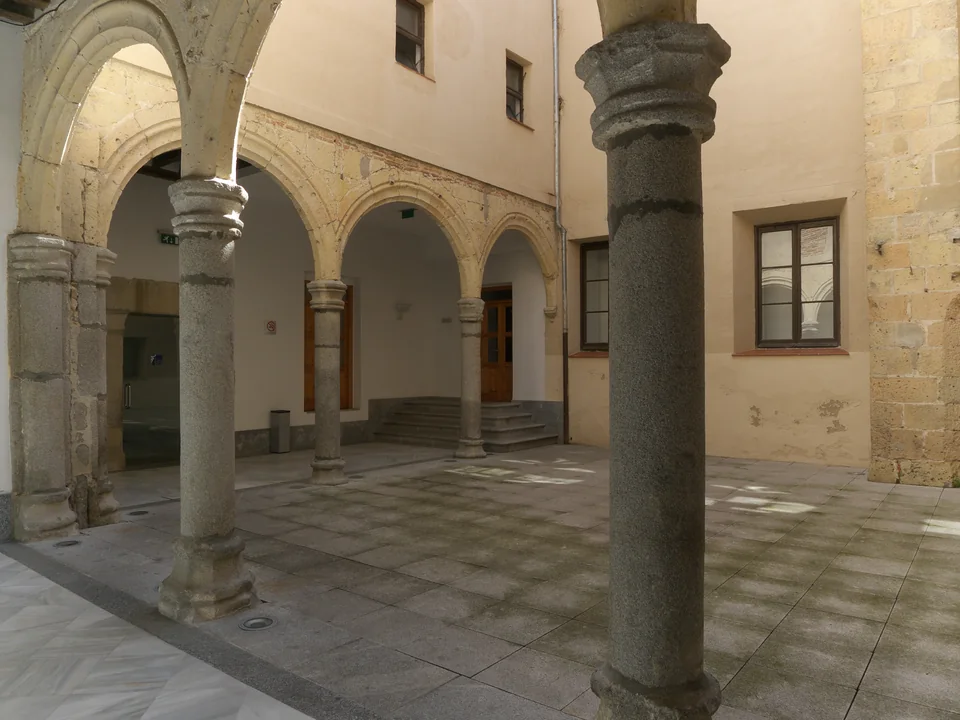
Segovia is a small UNESCO World Heritage city; the campus occupies Santa Cruz la Real, founded in 1218 and restored as a university campus in 2006. Madrid is 25 minutes away by high-speed train. The Madrid campus is the IE Tower. If you start in Segovia, you move to Madrid in year three and will need to find housing twice. Our student housing guide for Spain covers contracts and deposits.
Visa
A private university does not change visa rules: Russian citizens need a national student visa for studies longer than 90 days. Apply through BLS visa centres at least two months before classes; the consulate checks funds of $680 (€600) per month, health insurance and, for adults staying over 180 days, an apostilled criminal record certificate. IE advises non-EU applicants to confirm their place and start the visa process as early as possible. See the Spain student visa guide.
Common mistakes
- Waiting until spring. Places are filled round by round, and fewer remain by Round 3.
- Forgetting recognition of the school certificate. Official enrolment is impossible without it, and it takes three to six months.
- Aiming for the minimum English score. IE recommends IELTS 7.5 or TOEFL 105; the minimum only makes you eligible.
- Budgeting on the first-year price. Tuition is adjusted every year, so four years cost more than four times the first-year fee, before housing.
- Confusing IE University with IE Business School. Bachelor's degrees and master's or MBA programmes have separate admissions.
Step-by-step plan for 2027/28
- October 2026: choose the programme and format (Segovia plus Madrid, or Madrid only), book IELTS or TOEFL, start recognition of your school certificate.
- By 6 November 2026: apply in Round 1, pay the fee, take the IE test or send SAT/ACT scores.
- November–December 2026: online assessment and interview; decision by 11 December.
- Winter 2026/27: sign the contract, pay the IE Foundation contribution, apply for financial aid.
- Spring–summer 2027: obtain recognition, apply for the visa, find housing.
- By 15 October 2027: submit documents for official enrolment.
Programme choice, document preparation and application support are provided under an agreement with StudyU. Admission and financial aid decisions are made by IE University's committees, recognition by the Spanish Ministry of Education and visas by the consulate.
FAQ
How much does IE University cost?
For 2027/28, the first year of most bachelor's programmes costs $31,000 (€27,300), Architecture and Design $31,820 (€28,020) and Business Administration $33,930 (€29,880), plus a one-off $1,360 (€1,200) IE Foundation contribution and a $170 (€150) application fee.
Do I need Spanish to study at IE University?
No. Bachelor's programmes and the admissions process are fully in English. You need an English certificate, such as IELTS 7.0, TOEFL iBT 100, Cambridge C1/C2 or Duolingo 130, unless you qualify for an exemption.
Is the SAT required for IE University?
No. You can take IE's own English-language Admissions Test, which measures verbal, logical and numerical reasoning. If you already have scores, IE accepts SAT 1300 or above and ACT 28 or above.
When should I apply to IE University for 2027/28?
The rounds close on 6 November 2026, 15 January 2027 and 5 March 2027; the Early Round closed on 18 September 2026. After March, applications are considered from May while places remain, so Round 1 or 2 is safest.
Do IE students study in Segovia or Madrid?
It depends on the format: many programmes let you start in Segovia and move to Madrid in year three, or study all four years in Madrid. Architecture is taught in Segovia. The campuses are 25 minutes apart by high-speed train.
Can I get a scholarship at IE University?
Yes, IE grants merit-based awards: some are assigned automatically at admission, others require an application after admission. The amount is not known in advance; the university's committee decides.
Sources
- IE University: admissions and admission process — test, online assessment, interview, decision; checked 30.09.2026
- IE University: 2027/28 admission rounds — checked 30.09.2026
- IE University: freshman requirements — English, documents, recognition, 15 October; checked 30.09.2026
- IE University: application form and fee and Admissions Test — $170 (€150), SAT 1300/ACT 28; checked 30.09.2026
- IE University: enrolment — $1,360 (€1,200) contribution, payment options, 3–6 months for recognition; checked 30.09.2026
- 2027/28 tuition by programme: Business Administration, International Relations, Computer Science & AI, Architectural Studies, Design — checked 30.09.2026
- IE University: undergraduate financial aid — checked 30.09.2026
- IE University: Segovia campus — checked 30.09.2026
- Spanish Consulate General in Moscow: study visa requirements — checked 30.09.2026
- Euro prices are converted at the ECB reference rate for 29.09.2026: €1 = $1.1355 (ECB)
During the free initial consultation, we clarify your goal, profile, timing, and budget and identify the next realistic step. Apply
Next steps
- Universidad Carlos III de Madrid (UC3M): Admission, Fees and Campuses
- Studying in Spain for international applicants
- Complutense University of Madrid (Universidad Complutense de Madrid, UCM)
- Public or Private University in Spain? A 2027 Guide for International Students
- English-Taught Degrees in Spain: Where to Study Without Spanish and What It Costs in 2027
- Master's Degree in Spain: Admission with a Non-EU Degree and 2027 Costs
