
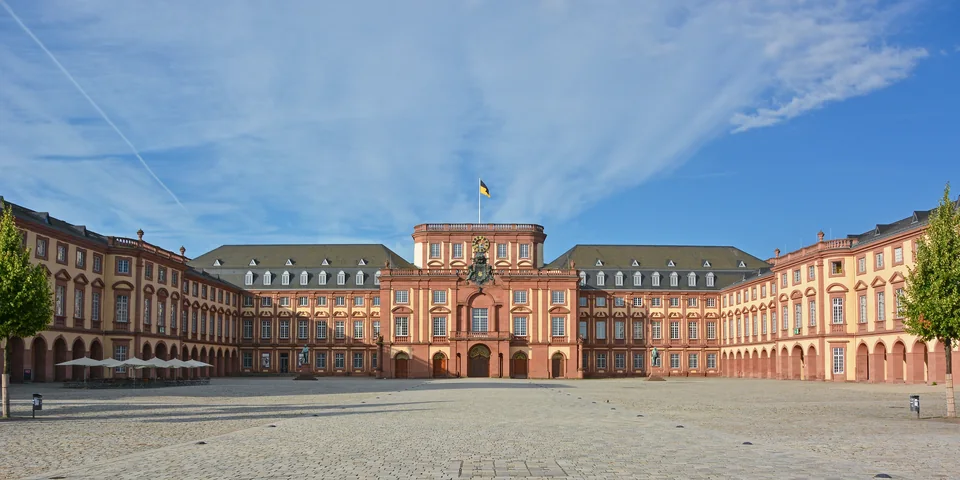
The University of Mannheim is a public university with one of Germany's strongest profiles in economics, business and the social sciences, according to subject rankings; its main building is the baroque electoral palace in the city centre. Non-EU students pay tuition, as everywhere in Baden-Württemberg: $1,700 (€1,500) per semester plus a semester contribution of $220 (€194) for fall 2026/27. Applications go directly to the university; Mannheim does not use uni-assist. Bachelor's programmes are taught only in German, and C1 proof is due by the application deadline. About ten master's programmes, including the Mannheim Master in Management (MMM), are taught in English, with an early 15 May deadline.
| At a glance | Details |
|---|---|
| Location | Mannheim, Baden-Württemberg; campus in Mannheim Palace |
| History | commercial college from 1907, university status since 1967 |
| Structure | Department of Law, Department of Economics, Business School, Schools of Social Sciences, Humanities, and Business Informatics and Mathematics |
| Students | about 12,000 (THE data) |
| Tuition fee for non-EU citizens | $1,700 (€1,500) per semester in 2026/27 |
| Semester contribution | $220 (€194), fall 2026/27 |
| How to apply | the university's own portal; no uni-assist |
| Bachelor's | German-taught, fall start only; C1 proof by the deadline |
| Rankings | THE World University Rankings 2027: joint 224th; MMM ranked 28th in the Financial Times Masters in Management Ranking 2025 |
What Mannheim is known for, and who it suits
Mannheim is a focused university: economics, business, finance, social sciences, psychology, law and business informatics. The university reports that it was Germany's top university for Business Administration and Economics in the QS subject rankings 2025, and second in Germany for Business and Economics and third for Social Sciences in the THE subject rankings 2026. Its MMM programme placed 28th worldwide and third in Germany in the Financial Times ranking 2025.
| Mannheim is a strong option if | Look at other universities if |
|---|---|
| you want economics, finance, management, data or social sciences | you need engineering, medicine or natural sciences |
| you can pay $3,410 (€3,000) a year in tuition | tuition-free study matters: North Rhine-Westphalia charges none |
| you have C1 German or are targeting an English-taught master's | you hope to start a bachelor's with B2 German |
| early master's deadlines work for you | you will only decide on a programme by summer |
For tuition-free economics, consider the University of Cologne; for economics and finance in the Rhine-Main region, Goethe University Frankfurt; and within Baden-Württemberg, Heidelberg University and the University of Stuttgart.
English-taught master's programmes and deadlines
| Programme | Fall 2026/27 (window now closed) | Spring intake |
|---|---|---|
| Mannheim Master in Management (MMM) | 1 April to 15 May | none |
| Mannheim Master in Finance, Accounting & Taxation | 1 April to 15 May | none |
| Mannheim Master in Operations & Supply Chain Management | 1 April to 15 May | none |
| Mannheim Master in Data Science | 1 April to 15 May | 15 October to 15 November |
| Mannheim Master in Social Data Science | 1 April to 15 May | none |
| Business Informatics | 1 April to 15 May | 15 October to 15 November |
| Economics | 1 April to 15 May | none |
| Political Science | 1 April to 15 May | none |
| Sociology | 1 April to 15 May | none |
| Master of Comparative Business Law | 1 April to 31 May | none |
German-taught master's programmes close on 15 May, 31 May or 15 July depending on the programme. The spring intake has run from 15 October to 15 November; confirm the spring 2027 dates on the deadlines page. English and subject requirements differ by programme. For similar programmes elsewhere, see English-taught master's degrees in Germany.
Bachelor's degrees: C1 German by the deadline
All bachelor's programmes are taught in German and start in the fall. For fall 2026/27 applications opened on 1 June and closed on 15 July for most programmes (business administration, economics, business informatics, law, psychology, political science, sociology) and on 31 August for several Culture and Economy tracks, Economic and Business Education and Romance studies. The university usually repeats this pattern.
Non-EU applicants without a German school-leaving certificate need:
- School certificate in the original language plus a sworn translation into German or English.
- C1 German by the deadline: TestDaF 4 in all parts, DSH-2, DSD II, telc Deutsch C1 Hochschule or a Feststellungsprüfung. Also accepted without these: Goethe-Zertifikat C2, ÖSD C1 or higher, or German as Language A in the IB with grade 6 or better. Goethe C1 is not on the university's list.
- CV and a motivation letter in German, at most one A4 page, explaining why you chose Mannheim.
- Further language proof for some programmes, including business administration, business informatics and English studies.
- Extracurricular activities on the university's form, where they count in selection.
- An orientation-test certificate when accepting your place, for example "Was studiere ich?" from the state science ministry, SIT or Check-U; psychology requires the OSA-Psych self-assessment.
You can submit up to three applications to selective bachelor's programmes. Foreign grades are converted with the modified Bavarian formula recommended by Germany's Central Office for Foreign Education. Unreadable documents that matter for admission lead to exclusion, so scan every page, including reverse sides.
After school abroad: Studienkolleg via your Mannheim application
An 11-year certificate from Russia, Belarus or Kazakhstan issued since 2015 is usually not equivalent to the German Abitur. At Mannheim you apply for your chosen bachelor's; the university checks your certificate and, if direct access is missing, enrols you at a Studienkolleg instead. You pass a German entrance test, study for a year, take the Feststellungsprüfung and then enrol at Mannheim.
The catch: Mannheim requires C1 German proof by the 15 July deadline even on this route, while most Studienkollegs start from B1 or B2. Alternatively, a successfully completed first year at a university at home in a related field gives direct access. See our guides to the Studienkolleg and German language tests.
Costs
Payments to the university in 2026/27
| Item | Per semester | Per year |
|---|---|---|
| Tuition fee (non-EU/EEA citizens) | $1,700 (€1,500) | $3,410 (€3,000) |
| Administrative fee | $91 (€80) | $180 (€160) |
| Studierendenwerk fee | $110 (€100) | $230 (€200) |
| Student body fee | $16 (€14) | $32 (€28) |
| Total | $1,920 (€1,694) | $3,850 (€3,388) |
Late re-registration adds $23 (€20), and the date the money reaches the university's account counts, not the transfer date. A second degree costs $740 (€650) per semester if the first degree was obtained in Germany.
Who is exempt from the tuition fee
EU/EEA citizens and holders of a German school-leaving certificate are exempt. The state fee law lists further cases, such as a settlement permit, recognised refugee status, five years of residence and employment in Germany, or a German bachelor's and master's degree. The fee is also waived during a leave of absence or placement semester and for disabilities that significantly affect studies. In exceptional cases, students who have already started and lose their funding suddenly through no fault of their own may obtain a deferral or waiver; contact the bursar's office before the re-registration deadline. The university decides on documented requests.
Living costs
The university estimates $1,080–1,140 (€950–1,000) a month: housing $360–680 (€320–600), health insurance $160–180 (€140–160), and the rest for food, clothing and other costs, with extra spending in the first months. With the visa benchmark and tuition, year one needs at least about $17,360 (€15,292), assuming rates stay the same. See our blocked account guide.
Housing
Studierendenwerk Mannheim offers about 3,000 furnished rooms in 17 residence halls. There are also private and church-run halls, shared flats and private apartments, and the Studierendenwerk runs a free private accommodation service. For the first days of a search, the university suggests the Mannheim International youth hostel. The city has about 300,000 inhabitants, and its districts are well connected by public transport. See our student housing guide.
Scholarships and funding
The International Office awards several scholarships to enrolled international students, including awards for particularly committed students, an equal-opportunity scholarship and a graduation scholarship, funded through DAAD. Because Russia's Ministry of Justice designated DAAD an undesirable organisation in February 2026, we do not recommend these programmes to Russian citizens; students from other CIS countries can apply as usual. Federal BAföG support is available to international students only in specific cases, such as permanent residence. See our overview of scholarships abroad.
Visa and payments for applicants from Russia
Residents of Russia apply for a study visa at the German Embassy in Moscow; the St Petersburg consulate closed on 18 September 2026. Russian bank statements are not accepted, so use a blocked account with a provider outside Russia or a formal declaration of commitment. Plan a lawful way to pay $1,920 (€1,694) per semester in advance; the university can issue a statement of fees due for a foreign bank and a payment confirmation for the visa appointment. See our student visa guide and how to pay for studies abroad from Russia.
Common mistakes
- Applying for a bachelor's with B2 German and planning to improve later: C1 is required by the deadline, even for the Studienkolleg route.
- Looking for Mannheim in uni-assist: the university does not use it.
- Researching master's programmes in summer: English-taught programmes close on 15 May.
- Writing the bachelor's motivation letter in English: it must be in German.
- Counting on a tuition exemption without a legal ground: the list of cases is limited.
FAQ
How much does it cost to study at the University of Mannheim?
In 2026/27 non-EU students pay $1,700 (€1,500) per semester plus a $220 (€194) semester contribution, or $3,850 (€3,388) a year. The university suggests $1,080–1,140 (€950–1,000) a month for living costs.
Does Mannheim offer bachelor's degrees in English?
No. All bachelor's programmes are taught in German, and non-EU applicants must prove C1 German by the application deadline. English-taught options are master's programmes such as MMM, Economics, Data Science and Finance, Accounting & Taxation.
When are the master's deadlines at Mannheim?
English-taught programmes accept fall applications from 1 April to 15 May, and the Master of Comparative Business Law until 31 May. Some programmes, including Data Science and Business Informatics, also admit students in spring, with applications from 15 October to 15 November.
Do I need uni-assist for the University of Mannheim?
No. Mannheim does not work with uni-assist, and all international applicants apply directly through the university's portal, uploading their school certificate in the original language with a sworn translation.
Can I go to Mannheim straight after school in Russia or Kazakhstan?
Usually not directly. You apply for a bachelor's, and if your certificate gives only indirect access the university places you in a Studienkolleg, but C1 German is still required by 15 July. Alternatively, complete a first year at a university at home in a related field.
What housing is available to Mannheim students?
Studierendenwerk Mannheim offers about 3,000 furnished rooms in 17 halls, and there are private and church-run halls and shared flats. Housing typically costs $360–680 (€320–600) a month.
How can StudyU help with Mannheim?
Programme selection, requirement checks, document and motivation letter preparation and budgeting are provided under an agreement with StudyU. Admission and tuition exemptions are decided by the university under state law, and visas by the German embassy.
Sources
- University of Mannheim: history and rankings
- Application deadlines for bachelor's and master's programmes
- Bachelor's applicants from outside the EU/EEA: documents, German, Studienkolleg, uni-assist
- Tuition fees for international students and exemptions
- Semester and tuition fees
- Financing your studies and cost of living
- Housing in Mannheim
- Baden-Württemberg Ministry of Science: fees for international students
- THE World University Rankings 2027: University of Mannheim
- German Embassy Moscow: four steps to a national visa and study visa memo (PDF)
The conversion rate is the ECB reference rate for 29 September 2026, €1 = $1.1355; figures were verified on 30 September 2026. For other universities, see studying in Germany. To decide whether Mannheim is worth its fee for your goals, send us a request.
Next steps
- University of Cologne (Universität zu Köln)
- University of Stuttgart (Universität Stuttgart)
- Studying in Germany for international applicants
- Blocked Account in Germany 2026: Amount, Opening Steps and Alternatives
- German Language Tests for German Universities: TestDaF, DSH, Goethe and telc Compared (2026–2027)
- Scholarships abroad 2026: where international students study for free
