
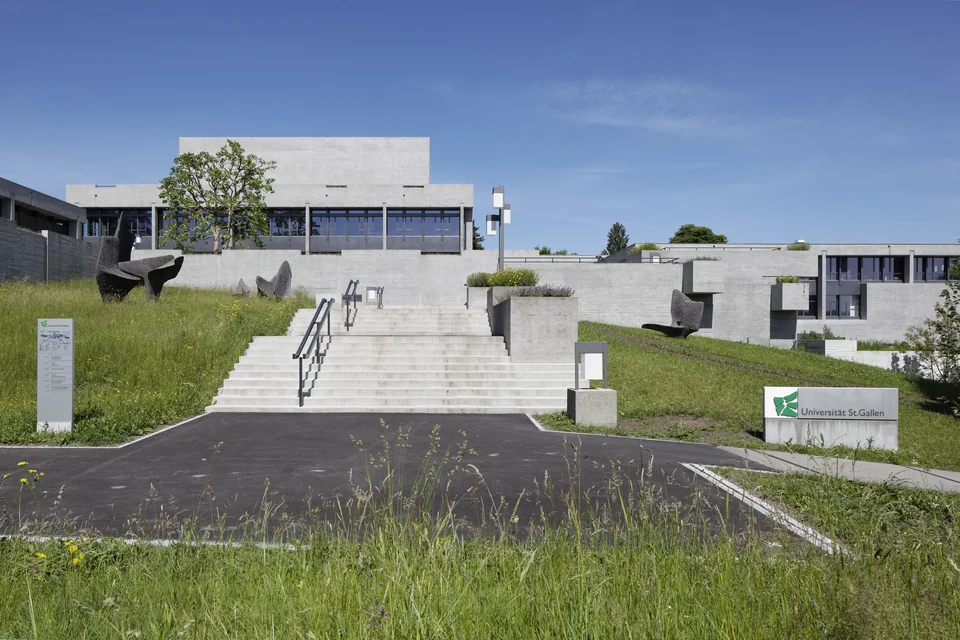
The University of St. Gallen (Universität St. Gallen, HSG) is the public university of the Canton of St. Gallen, focused on business, economics, law, international affairs and computer science. Places for foreign applicants are capped by law, so even with eligible documents an international applicant must pass HSG's own selection procedure: an online aptitude test and a video interview. The first bachelor's year in economic sciences can be taken entirely in English. Holders of a Russian or Kazakh school certificate need two years of university study at home in the chosen subject. From autumn 2026, an international student pays $4,010 (CHF 3,343.50) per bachelor's semester and $4,260 (CHF 3,557.50) per master's semester.
| At a glance | From autumn semester 2026 |
|---|---|
| Status | public university of the Canton of St. Gallen |
| Fee for foreign nationals, per semester | bachelor's $4,010 (CHF 3,343.50), master's $4,260 (CHF 3,557.50) |
| Fee for Swiss nationals, per semester | bachelor's $1,570 (CHF 1,310.50), master's $1,830 (CHF 1,524.50) |
| Application fee | $320 (CHF 268), non-refundable |
| First-year bachelor's language | economic sciences: English or German; law and computer science: German only |
| Russian or Kazakh school certificate | plus two university years in the chosen subject, an admission certificate and HSG selection |
| Selection for foreign applicants | online test on 16 February or 8 June 2027, then a video interview |
| Application window | 1 October – 30 April |
| HSG's annual budget estimate | $29,950–35,940 (CHF 25,000–30,000) |
Who HSG suits
HSG is a specialised university with five schools: management, finance, law, humanities and social sciences, and economics and political science, plus computer science. It has no engineering or classic natural sciences, and its joint medical master's is aimed at Swiss students.
HSG makes sense if you:
- want business, economics, finance or international affairs and are ready for competitive selection;
- already study economics or management at a home university and can finish two years;
- hold a strong business or economics bachelor's, are aiming for a master's and can take the GMAT or GRE;
- accept a higher semester fee than in Geneva or Lausanne.
Look elsewhere if:
- you are leaving school and do not want two home university years: Swiss public universities offer no such shortcut, and only ETH Zürich and EPFL run entrance exams;
- you want a bachelor's in law or computer science in English: the first year of both is German-only;
- you plan to work from the first semester: study is full time and attendance is expected in many courses.
Bachelor's conditions for Russian and Kazakh certificates
HSG requires a certificate essentially equivalent to the Swiss Matura. For Russia and Kazakhstan, the swissuniversities table for 2026/27 is stricter for St. Gallen than for other cantonal universities:
| Condition | What it means |
|---|---|
| General-education certificate | six general subjects across the last three school years |
| Two university years | recognised by HSG, at a home university |
| Admission certificate | to a recognised home university in the chosen field |
| HSG selection | mandatory for every foreign applicant with a recognised foreign certificate |
No language certificate is required at application. HSG recommends at least C1 in the language of your first year. If swissuniversities assigns the ECUS exam to your certificate, you need at least B2 German whatever your study language, because ECUS is held only in German and includes a C1 German test. ECUS does not apply to Russia or Kazakhstan.
Only Swiss and Liechtenstein citizens, holders of a C permit, and holders of a Swiss Matura or Swiss university degree are exempt from selection.
Documents for the online application:
- digital photo, passport and the signed enrolment agreement;
- CV on the HSG template;
- the foreign school certificate (upload it once issued, no later than the start of studies);
- reports from the last three school years in one file;
- a certified German or English translation for documents not in German, French, Italian or English.
You present the original certificate in person during StartWeek. Do not post originals.
How HSG selection works
Selection has two stages, and only its results count, not your school grades.
| Stage | Content | Format |
|---|---|---|
| Online aptitude test | 70 minutes, two parts: quantitative problem-solving, and interpreting diagrams and tables | at home on a computer with camera and microphone; no phones or tablets; a simple calculator is allowed |
| Video interview | 4–6 pre-recorded questions on motivation and interests, about 10 minutes | by invitation after the test; may be recorded on a phone |
Dates for the 2027 intake (choose one):
- week 7: test on Tuesday 16 February 2027, 14:00–17:00 CET; interview on Thursday 18 February;
- week 23: test on Tuesday 8 June 2027; interview on Thursday 10 June.
The February date is open only to applicants who submit a complete application by 10 January and register by 31 January. Everyone else sits in June. The test is taken in the language of the first year you chose. Your status after the test updates on the Thursday of the same week, and the final result comes no later than 21 days after the interview. You can retry only the following year.
For visa-required applicants, the February date is effectively essential. A June result arrives at the end of June, and the visa process takes 8–12 weeks, which leaves almost no margin before mid-September.
The test measures aptitude, not knowledge. Practise with HSG's sample test and any chart-reading and quantitative reasoning tasks. Prepare your motivation for the interview: why HSG, why this field, and what experience you bring.
How the bachelor's works
The first year, the Assessment Year, is common to each track. Economic sciences (business administration, economics, international affairs, law and economics) can be completed entirely in English or entirely in German. Law and computer science are German-only in the first year.
After the first year, the standard length is four semesters, though students take 5.7 semesters on average, with a maximum of ten. There is no mandatory internship except in the international affairs bachelor's, and you can take a semester's leave at a much-reduced fee to do one.
HSG works in two languages: German for administration and daily life, English for business and research. Even if you study in English, German will help in the city and in part-time jobs.
Master's programmes
HSG offers 14 master's programmes, many in English. Some run selection for all applicants, others only for foreign applicants.
| Programme | Language | Selection | Window |
|---|---|---|---|
| Strategy and International Management (SIM) | English | all applicants | 1 October – 30 April, four rounds |
| Banking and Finance (MBF) | English | all applicants | 1 October – 30 April |
| International Affairs and Governance (MIA) | English | all applicants | 1 October – 30 April |
| Quantitative Economics and Finance | English | all applicants | 1 October – 30 April |
| Marketing Management, Economics, Business Innovation, General Management, Accounting and Corporate Finance | English, or German and English | foreign applicants | 1 October – 31 March |
| Computer Science, International Law | English | foreign applicants | 1 October – 30 April |
| Law, Law and Economics | German | no selection | 1 October – 30 April (law also in spring) |
Taking SIM as an example: you need a bachelor's in business administration or economics (180 ECTS) with an average of at least 5.0 on the Swiss scale. Degrees in hospitality management, tourism, business informatics or communication do not count as business administration. A GMAT or GRE score (no older than five years) makes up 20% of the assessment, and there is a video interview. Decisions are made in four rounds between October and April. Every master's student completes two foreign-language courses and must show accounting knowledge.
In the Financial Times Masters in Management ranking published on 7 September 2026, SIM ranked first for a record fifteenth time. That is a ranking of the programme, not of the university as a whole.
Requirements differ by programme. For the wider process see Master's in Switzerland.
Fees and cost of living
HSG charges foreign nationals considerably more than Swiss students, explaining that the cantons fund places for domestic students.
| Item | Foreign nationals | Swiss nationals |
|---|---|---|
| Application fee | $320 (CHF 268) | $320 (CHF 268) |
| Bachelor's, per semester | $4,010 (CHF 3,343.50) | $1,570 (CHF 1,310.50) |
| Master's, per semester | $4,260 (CHF 3,557.50) | $1,830 (CHF 1,524.50) |
| Bachelor's, 6 semesters | about $24,030 (CHF 20,061) | about $9,420 (CHF 7,863) |
St. Gallen is cheaper than Zurich or Geneva. Using the Federal Statistical Office's 2024 student survey, HSG puts a bachelor's student's spending at about $2,610 (CHF 2,175) a month:
| Item | Per month |
|---|---|
| Rent and utilities | $950 (CHF 795) |
| Food | $530 (CHF 440) |
| Transport | $230 (CHF 195) |
| Health and insurance | $230 (CHF 190) |
| Leisure | $250 (CHF 210) |
| Clothing | $160 (CHF 130) |
| Other and communication | $260 (CHF 215) |
HSG advises budgeting $29,950–35,940 (CHF 25,000–30,000) a year including fees. Comparisons: Cost of studying in Switzerland.
Visa, funds and work
Russian residents apply for a D visa at the Swiss Embassy in Moscow (appointments via moscow.visa@eda.admin.ch, fee RUB 8,700), which also serves residents of Belarus and Uzbekistan. Residents of Kazakhstan and Tajikistan apply in Astana. The St. Gallen cantonal migration office decides. HSG says the visa file generally needs proof of at least $28,750 (CHF 24,000): a statement for an account in your name at a Swiss bank or at a bank with a branch or representative office in Switzerland. The migration office may also ask for a written pledge to leave after your studies. The general procedure is in Swiss student visa.
Russian citizens opening a bank account should note Swiss sanctions: Article 20 of Ordinance SR 946.231.176.72 bars banks from accepting deposits above $119,800 (CHF 100,000) from Russian nationals and residents, unless they hold a Swiss, EEA or UK residence permit. Legal payment routes: How to pay for studies abroad from Russia.
Students on a B permit may work up to 15 hours a week during term; internships follow separate rules. HSG runs an on-campus job portal and a study-funding advice centre.
HSG, University of Zurich or Geneva for economics
| Criterion | HSG | University of Zurich | University of Geneva |
|---|---|---|---|
| Economics bachelor's language | English or German | German | French |
| Selection for foreign applicants | test + video interview | none beyond certificate rules | none beyond certificate rules |
| Fee for internationals, per semester | $4,010 (CHF 3,343.50) | $1,530 (CHF 1,279) | $600 (CHF 500) |
| Route with a Russian certificate | two university years + admission certificate + selection | two university years + admission certificate | two university years + admission certificate + French |
| English-taught master's | most programmes | some programmes | some programmes |
Bachelor's application timeline
- Two years ahead: study economics, business or your chosen field at a home university.
- September–December: reach C1 in English or German and try HSG's sample test.
- 1 October – 10 January: submit a complete application and pay $320 (CHF 268).
- By 31 January: register for the February selection.
- 16 and 18 February 2027: test and video interview.
- March: decision, housing search, visa documents.
- April–July: D visa application with bank statement.
- September: StartWeek, original certificate check, first year begins.
Common mistakes
- Applying in April and ending up with only the June selection date while needing a visa.
- Relying on a strong school average: HSG counts only the selection results.
- Choosing law or computer science without German: the first year of both is German-only.
- Budgeting with Geneva or Lausanne fees in mind. A foreign student at HSG pays five to six times more per semester.
- Applying to SIM with a tourism or hospitality management degree, which does not count as business administration.
FAQ
How much does the University of St. Gallen cost for international students?
From autumn 2026, a bachelor's semester costs $4,010 (CHF 3,343.50) and a master's semester $4,260 (CHF 3,557.50). The application fee is $320 (CHF 268). Including living costs, HSG recommends budgeting $29,950–35,940 (CHF 25,000–30,000) a year.
Can I enter HSG straight after secondary school?
Not with a Russian or Kazakh certificate. You need two years at a recognised home university, an admission certificate in your chosen field and a successful HSG selection. The decision rests only on the test and video interview results.
What is the HSG selection procedure and how do I prepare?
It is a 70-minute online test on quantitative problems and diagram interpretation, followed by a video interview of 4–6 motivation questions. It measures aptitude rather than knowledge. Prepare with HSG's sample test and chart and logic exercises.
Can I study at HSG in English?
The first bachelor's year in economic sciences is available entirely in English; law and computer science are German-only. Most master's programmes, including SIM, MBF and MIA, are taught in English. C1 is the recommended level.
Do I need the GMAT for an HSG master's?
For several programmes, yes. In SIM, the GMAT or GRE score counts for 20% of the assessment and must be no older than five years. Other programmes list their requirements on their admission pages.
When should visa-required applicants apply?
The window runs from 1 October to 30 April, but for the bachelor's, apply by 10 January to reach the February selection. The decision then arrives in March, leaving time for the visa.
How can StudyU help with an HSG application?
Checking your route, and preparing the application, the HSG-template CV, your video-interview motivation and the visa file are provided under an agreement with StudyU. The University of St. Gallen decides on admission based on selection results, and the St. Gallen cantonal migration office decides on the permit.
Sources
- HSG: tuition fees from autumn 2026 and student budget
- HSG: bachelor's admission, foreign certificates and documents
- HSG: selection procedure for foreign applicants, 2027 dates
- HSG: bachelor's FAQ
- HSG: master's programmes and selection, deadlines, SIM admission
- HSG: SIM ranked first in the FT Masters in Management ranking 2026
- HSG: admitted, what next (visa, proof of funds, work)
- swissuniversities: foreign certificates by country, 2026/27
- Swiss Embassy in Russia: where to apply for a D visa, fees; Swiss Embassy in Kazakhstan
- Fedlex: Ordinance SR 946.231.176.72, Article 20, consolidated version of 21.09.2026
- Dollar amounts use the ECB reference rate of 30.09.2026 (€1 = $1.1355 = CHF 0.9478, so CHF 1 ≈ $1.1980), rounded to $10. Facts checked on 01.10.2026.
For an overview, see Study in Switzerland, Universities in Switzerland and Bachelor's in Switzerland. If you are deciding between an HSG bachelor's and going straight to a master's, send us a request.
During the free initial consultation, we clarify your goal, profile, timing, and budget and identify the next realistic step.
Next steps
- University of Geneva (UNIGE): Admission, Fees and Requirements for International Students
- Studying in Switzerland for international applicants
- Bachelor's Degrees in Switzerland: Entry Routes, Language and Costs for International Students
- How to Pay for Studies Abroad from Russia: What Works in 2026
- Master's Degrees in Switzerland: 2026/27 Deadlines, Requirements, Costs and Scholarships
- Cost of Studying in Switzerland in 2026/27: Tuition, Living Costs and a Full Student Budget
