
International students can study medicine in Greece entirely in English at five public universities: the National and Kapodistrian University of Athens (NKUA), Aristotle University of Thessaloniki (AUTh), and the universities of Crete, Thessaly and Patras. Each runs a six-year, 360-ECTS degree reserved for foreign nationals. Annual tuition ranges from $13,630 (€12,000) in Thessaloniki, Larissa and Patras to $19,300 (€17,000) in Athens. A tuition-free alternative exists — Greek-taught medicine through the Ministry of Education's quota for foreign applicants — but it requires a B2 Greek language certificate.
The detail most guides miss is that a standard national school-leaving certificate is treated very differently across the five schools. Thessaloniki and Larissa add an online biology-and-chemistry test, Crete looks at your subject grades, Patras scores you on a points scale, and NKUA does not consider a national diploma on its own at all. This guide sets out what each programme asks for, what you pay and when, and where applicants most often lose their place. US dollar figures use the ECB reference rate of 29 September 2026; the rounding rule is given with the sources. For the wider picture, see our overview of studying in Greece.
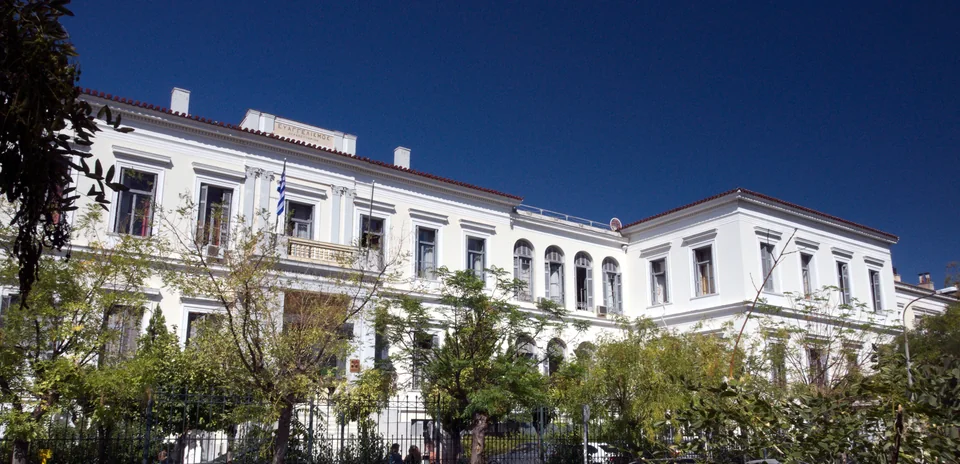
The five English-taught medical programmes at a glance
All five appear in the official catalogue of English-taught bachelor's degrees on Study in Greece, the portal run with the Greek Ministry of Education. Study in Greece lists one fee for each, with no separate non-EU rate, and NKUA states outright that EU and non-EU students pay the same $19,300 (€17,000).
| University, city | Annual fee | Six years at today's rate | Intake | Beyond a school diploma and English |
|---|---|---|---|---|
| NKUA, Athens | $19,300 (€17,000), 2026/27 | ≈ $115,820 (€102,000) | not published | IB, A-levels, French or European Baccalaureate, UCAT, MCAT, AP + SAT, a related BSc or a pre-med programme |
| Aristotle University (AUTh), Thessaloniki | $13,630 (€12,000) | ≈ $81,760 (€72,000) | 60 | online test, or MediTest-EU / A-levels AAB; interview |
| University of Thessaly, Larissa | $13,630 (€12,000) | ≈ $81,760 (€72,000) | 50 | online test, or BMAT / MediTest-EU / A-levels AAB; interview |
| University of Crete, Heraklion | $17,030 (€15,000) | ≈ $102,200 (€90,000) | 30 | 80%+ in biology and two of chemistry, maths, physics — or an international qualification; interview |
| University of Patras | $13,630 (€12,000) | ≈ $81,760 (€72,000) | 50 | points-based selection: diploma, CV, English, interview |
The six-year column is simple multiplication, not a cap. NKUA raised its fee from $14,760 (€13,000) in 2025/26 to $19,300 (€17,000) in 2026/27, so budget for increases.
Two routes: Greek-taught medicine via the quota, or an English-taught degree
| Greek-taught medicine via the foreign-applicant quota | English-taught programme | |
|---|---|---|
| Tuition | none — Greek-taught undergraduate study at public universities is free | $13,630–19,300 (€12,000–17,000) a year |
| Who selects | the Ministry of Education, centrally | the programme's own committee |
| Criterion | overall school-leaving grade converted to the Greek 0–20 scale; no entrance exam | documents, test or international qualification, interview |
| Language | Greek B2 certificate by enrolment | English at B2 or above |
| Application | one week in July on the ministry portal | winter to spring, programme by programme |
| Time to degree | usually six years, plus a year of Greek if you start from zero | six years |
The quota route is explained step by step in our guide to applying to Greek universities, and tuition-free options are covered in free education in Greece. In short: the 2026/27 window ran from 2 to 9 July 2026, selection is by school grade alone, and only that year's application form shows which departments are open to foreign applicants. Without a B2 certificate, an admitted candidate can only enrol the following academic year, provided the certificate has been obtained by then.
For medicine, the quota route has a practical catch: lectures, exams and clinical work are in Greek from the first semester. Anyone starting the language from scratch should ask honestly whether eight months of Greek will carry them through anatomy and biochemistry.
What your school diploma is worth at each programme
All five programmes are designed for foreign nationals who completed their last two school years abroad or at a legally operating foreign school in Greece. After that, the requirements diverge.
Aristotle University, Thessaloniki. A school-leaving certificate or IB, an English certificate, a personal statement and an interview. The fixed element is a 60-question online multiple-choice test covering school biology, chemistry and general reasoning. MediTest-EU, or final (not predicted) A-level grades of at least AAB in chemistry, biology and one further subject other than English, exempts you.
University of Thessaly, Larissa. The same structure: diploma, English, statement, interview and, where needed, a 60-question test on biology and chemistry. BMAT, MediTest-EU or A-levels at AAB give an exemption.
University of Crete, Heraklion. A national certificate is accepted if it shows at least 80% overall including biology plus two of chemistry, mathematics or physics, each averaging above 80%. How the committee converts a five-point or other national scale is its own decision, so send your final-year transcript before applying and ask for a preliminary view. IB, A-levels, MCAT, UCAT, SAT, three of four science APs, a related BSc or pre-med are the alternatives.
University of Patras. Selection is by points: the school diploma counts for up to 20, the CV up to 25, the language certificate up to 30 and the interview up to 30. The top 50 are admitted if they reach at least 80 out of 105 — which means a strong English certificate can outweigh school grades.
NKUA, Athens. A national school certificate alone does not qualify. You need at least one of: IB with at least 36 points, including three subjects at Higher Level, of which at least two must be physics, chemistry or biology; A-levels at AAA or better in chemistry, biology and another science; French Baccalaureate at 16/20; European Baccalaureate at 85%; UCAT; MCAT; four or more science APs with a high SAT; a related BSc averaging 65%+; or a pre-med programme with a year each of biology, general chemistry, organic chemistry and physics with labs. For the 2026/27 intake, UCAT results from the 2024 and 2025 sittings and MCAT results from 2024–2026 were accepted. For most national-school graduates, UCAT is the realistic way in.
English requirements in numbers
| Programme | TOEFL iBT | IELTS | Other |
|---|---|---|---|
| NKUA | 80+ | 7.5 overall, 6.5 in each part | Cambridge First (FCE) at B2 |
| Aristotle University | 79+ | 6.0+ | B2 |
| University of Thessaly | 79+ | 6.0+ | B2 |
| University of Crete | 79+ | 6.5+ | B2 |
| University of Patras | 79+ | — | B2 |
Graduates of English-medium schools usually do not need a certificate. NKUA's older FAQ page still shows IELTS 6.5 and a $14,760 (€13,000) fee; rely on its current "Admission Requirements" and "Tuition fees" pages, which state IELTS 7.5 and $19,300 (€17,000).
When to apply: the admission calendar
All five programmes start in the autumn; there is no spring intake.
| Programme | 2026/27 cycle | What follows |
|---|---|---|
| NKUA | platform open 18 December 2025 – 30 April 2026 | file review, shortlist for an online interview, conditional or unconditional offer; unsuccessful and waitlisted applicants hear by June |
| University of Thessaly | applications by 15 May 2026, written exam on 30 May 2026 | interview and online test, then deposit |
| University of Crete | early round closing in November, regular round in March | roughly four times as many candidates as places are interviewed |
| University of Patras | window 8 April – 8 June 2026, later extended to 29 July | points assessment and interview |
| Aristotle University | online form; an admissions adviser contacts you within three working days | video interview and test |
For 2027/28, Aristotle University has already published two application cycles: 9 November 2026 to 29 January 2027, and 22 March to 31 May 2027. The other programmes post their calendars on their own sites; in the last cycle the first windows opened in November and December. Aim to have your English score and any international test done by autumn of your final school year, and get the diploma apostilled and translated as soon as it is issued.
Money before enrolment: deposits, instalments and refunds
| Programme | Paid up front | Balance | Refunded when |
|---|---|---|---|
| NKUA | $5,680 (€5,000) by the date in the offer letter | $13,630 (€12,000) in two instalments, early September and mid-January | predicted grades are not met on a conditional offer, or a visa problem prevents enrolment |
| Aristotle University | exempt from the test: $6,810 (€6,000); sitting the test: $1,360 (€1,200) beforehand and $5,450 (€4,800) after | second instalment at the end of the winter semester | the $1,360 (€1,200) is refunded in full if you are rejected after the test; once admitted, nothing is refundable and the place cannot be deferred |
| University of Thessaly | $230 (€200) processing fee before the interview and exam; after admission, $6,810 (€6,000) (half the annual fee) within 15 days | second instalment on 15 January | the first instalment is non-refundable |
| University of Crete | $3,410 (€3,000) within 10 days of the offer; $6,810 (€6,000) for the first semester by the end of June | half the annual fee before each later semester | the $6,810 (€6,000) is refunded if you withdraw in writing by 31 August |
| University of Patras | application fee of $110 (€100) | $13,630 (€12,000) a year | refund terms are not published on the programme's page |
Aristotle University does not defer places. Delays caused by visa processing, military service or personal matters are not accepted, and a student who fails to arrive loses the offer. If Thessaloniki is your choice, start the visa step immediately after paying — the process is explained in our Greece student visa guide.
Scholarships are limited. Crete reduces tuition by $2,270 (€2,000) for the three best students in each year and runs a teaching-assistant scheme; Patras announces five scholarships a year based on merit and financial need. No English-taught programme offers fully funded places.
What the degree looks like: classroom and clinic
At NKUA, semesters 1–5 cover pre-clinical subjects, 6–9 clinical courses, and 10–12 full-time placements in university departments across 16 Athens hospitals. Final-year students shadow residents from 8:00 to 16:00 on working days and take night shifts at least once a week during each two-to-three-month rotation in internal medicine, surgery, paediatrics, obstetrics and gynaecology, psychiatry and one elective specialty. Graduation requires 48 compulsory and 12 elective courses. NKUA does not accept transfer credits from other medical schools.
In Patras, clinical training takes place at the University General Hospital of Patras and the University Health Centre, and Greek language classes run through the first three years. Crete keeps its cohort at 30 students, with small-group and case-based teaching.
Greek still matters on an English-taught degree. Patients in public hospitals speak Greek, and according to NKUA's Modern Greek Language Teaching Center, a B2 Greek certificate is required to practise any medical profession in Greece.
Recognition and the right to practise
NKUA states that its degree lets graduates pursue medical training and licensing in the EU and worldwide, subject to each country's regulatory requirements. That caveat is the key point: the right to practise is granted by the regulator of the country where you intend to work, not by the university.
- In Greece, practice requires Greek at B2 and registration under Greek rules.
- Elsewhere in the EU, the conditions for a graduate without EU citizenship are set by the national regulator; a Greek degree does not by itself confer the right to work.
- In Russia and other CIS countries, graduates of foreign medical schools must have their education recognised and pass admission to the profession under the rules in force at the time; for doctors this includes specialist accreditation. Check the procedure before you enrol.
What a year costs: tuition plus living
For a student residence permit, Greece requires proof of at least $740 (€650) a month for living costs — $8,860 (€7,800) a year. Adding that minimum to tuition gives first-year benchmarks before flights and insurance:
- Athens, NKUA: about $28,160 (€24,800);
- Heraklion, Crete: about $25,890 (€22,800);
- Thessaloniki, Larissa or Patras: about $22,480 (€19,800).
Real spending runs higher: Study in Greece puts rent alone at $280–680 (€250–600) a month, plus $91–140 (€80–120) for utilities. The residence permit fee is $170 (€150). Our guide to the cost of studying in Greece shows where the minimum is realistic and where it is not. Students paying from Russia should plan a lawful payment route early — see how to pay for studies abroad from Russia.
Who Greece suits — and when to compare other countries
Greek English-taught medicine is a good fit if:
- your English is already B2–C1 and biology and chemistry are strong subjects;
- you can sustain roughly $22,710–28,390 (€20,000–25,000) a year for six years;
- you are prepared to learn Greek alongside medicine;
- you want a public university programme with training in university hospitals.
Look at alternatives if you need a lower-cost option without learning Greek, or if your science results are still average: compare medicine in Czechia, medicine in Slovakia and medicine in Italy via IMAT. Our medicine programme page explains the wider choice.
Common mistakes
- Assuming a national diploma is enough everywhere. Without UCAT, IB, A-levels or a related degree, an NKUA application fails the formal check.
- Relying on outdated figures. $14,760 (€13,000) and IELTS 6.5 for NKUA still circulate, including on an old official FAQ page; the current figures are $19,300 (€17,000) and IELTS 7.5.
- Paying the deposit and postponing the visa. In Thessaloniki a visa delay does not protect your place, and the $6,810 (€6,000) deposit is non-refundable.
- Not testing your grades against the criteria. Crete's "80% in science subjects" rule and other conversions are worth confirming by email before you apply.
- Confusing programmes. Before paying anything, check that the programme is listed in the Study in Greece catalogue of English-taught degrees and is run by a public university.
FAQ
At four of the five programmes, yes. Aristotle University and the University of Thessaly accept a school-leaving certificate together with an online biology and chemistry test, Crete accepts a certificate with high science grades, and Patras admits on points. NKUA requires an additional qualification such as UCAT, MCAT, IB or A-levels.
For 2026/27, English-taught medicine costs $13,630 (€12,000) a year in Thessaloniki, Larissa and Patras, $17,030 (€15,000) in Crete and $19,300 (€17,000) in Athens. Greek-taught medicine through the foreign-applicant quota charges no tuition but requires a B2 Greek certificate.
Not for admission. You will need it for clinical years and for any future practice in Greece, where a B2 certificate is required. NKUA and Patras offer Greek classes during the degree.
Aristotle University and the University of Thessaly run a 60-question online test unless you hold MediTest-EU, BMAT (Thessaly) or A-levels at AAB. Every programme interviews shortlisted candidates, usually online. The Greek-taught quota route has no exam; selection is by school grade.
It depends on the school. NKUA does not accept credits from other medical programmes, so every student takes all 60 courses from the first semester. The University of Crete can admit students straight into year two if at least two-thirds of its compulsory first-year courses are recognised; recognition requests are accepted until the end of June. The other programmes do not describe such a route.
No. Recognition and the right to practise depend on the regulator of the country where you intend to work. In Russia and the CIS this means formal recognition of foreign education and, for doctors, specialist accreditation.
Sources
- NKUA Medical Degree English Program: home page with the recognition statement — checked 29.09.2026
- NKUA Medical Degree English Program: overview, tuition fees, admission requirements, application process, important dates — checked 29.09.2026
- Aristotle University School of Medicine: Admission & Fees and 2027/28 application cycles — checked 29.09.2026
- University of Thessaly Medical Degree English Program: Admission & Fees — checked 29.09.2026
- University of Crete International Program in Medicine: Admissions – Fees — checked 29.09.2026
- University of Patras English Medical Studies Program: Application and programme description on Study in Greece — checked 29.09.2026
- Study in Greece: English-taught bachelor's degrees and the foreign-applicant quota — checked 29.09.2026
- Ministry of Education 2026 instructions: quota admission of foreign candidates (PDF) — checked 29.09.2026
- NKUA Modern Greek Language Teaching Center: B2 certificate examinations — checked 29.09.2026
- Joint Ministerial Decision 225679/2024 on sufficient resources (Government Gazette B' 5223/17.09.2024, PDF) and Migration Code, Law 5038/2023 (PDF) — checked 29.09.2026
- ECB rate of 29.09.2026: €1 = $1.1355. Rounding step: $1 below $100, otherwise $10.
Checking your qualifications against a specific programme's requirements, preparing documents, submitting the application and support through to the visa are provided under an agreement with StudyU. Admission decisions are made by the university; visa and residence decisions by the Greek consulate and migration authorities.
Next steps
- Free Education in Greece: Who Studies Tuition-Free and What the "Free" Route Really Costs
- Applying to Greek Universities in 2026–2027: The Foreign-Applicant Quota, English-Taught Programmes and a Step-by-Step Plan
- Cost of Studying in Greece: Tuition, Living Costs and Mandatory Fees for 2026/27
- Greece Student Visa: National D Visa, Documents and Study Residence Permit in 2026
- How to Pay for Studies Abroad from Russia: What Works in 2026
- Studying Medicine in Czechia: Free in Czech or Paid in English — Faculties, Exams, Fees and Degree Recognition
