
International relations (IR) is taught abroad as a bachelor's (usually three years in Europe) and a master's (one year in the UK, two on the continent), most often within political science or social science faculties. There is no subject entrance exam: universities look at grades, written statements, language and, at some schools, an interview. In 2026–2028 a year costs from $9,580 (CHF 8,000) on a master's at the Geneva Graduate Institute to $16,690 (€14,700) at Leiden, $16,920 (€14,900) at Sciences Po and $44,910 (£33,800) at LSE.
| At a glance | What to know |
|---|---|
| Levels | Bachelor's 3–4 years; master's 1 year (UK) or 2 years (continental Europe, Switzerland) |
| Selection | Grades, statements, sometimes an interview; LSE's standard offer is AAA at A-level |
| Language | Mostly English; French opens more options in France and Switzerland |
| Cost per year | Graduate Institute $9,580 (CHF 8,000); Leiden $16,690 (€14,700, 2027/28); Sciences Po $16,920 (€14,900, 2026/27); LSE $44,910 (£33,800, 2027/28) |
| 11-year school certificates | UK bachelor's entry usually via a foundation year |
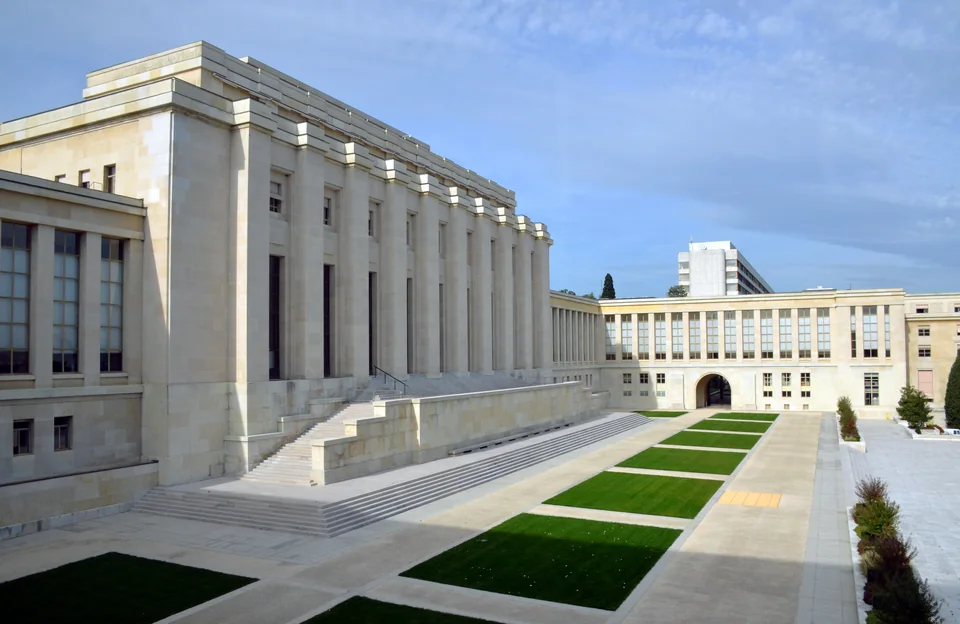
What an IR degree actually covers
The label International Relations covers programmes with different depth and emphasis. Compare curricula, not titles.
| Field | Core of the programme | Who it suits |
|---|---|---|
| International Relations | IR theory, foreign policy, security, international organisations | future analysts, researchers, staff of international bodies |
| Political Science with an IR track | comparative politics, methods, institutions | students who want a broad base and quantitative methods |
| Global or International Studies | history, economics and regional culture combined | students still choosing a specialism |
| International law and economics | EU and public international law, trade, finance | future lawyers and economists |
A good programme gives you three things: methods (statistics and data analysis), a region or language, and practice through placements, simulations or client projects. A curriculum made only of theory makes it hard to explain your skills to employers three years later. If international law is your main interest, compare with our guide to studying law abroad.
Where to study: sample programmes
| University | Programme | Language and length | Fee | Notes |
|---|---|---|---|---|
| LSE, London | BSc International Relations | English, 3 years | $44,910 (£33,800) a year, 2027/28 entry | standard offer AAA; apply via UCAS |
| Sciences Po, Paris | bachelor's and IR master's | English and French | $16,920 (€14,900) bachelor's and $23,440 (€20,640) master's per year for families outside the EEA, 2026/27 | own application platform, essays, interview; see our Sciences Po profile |
| Leiden University | BSc International Relations and Organisations | English, 3 years | $16,690 (€14,700) a year for non-EEA nationals, 2027/28 | apply through Studielink and the university portal |
| Geneva Graduate Institute | master's in IR and political science | English and French, 2 years | $9,580 (CHF 8,000) a year | aid based on need and merit |
| Turkey | IR programmes at private and public universities | English or Turkish | see international relations in Turkey | admission on school results; also compare political science and IR |
How admission works
There is no IR entrance test. The panel checks whether you can read and write analytical texts in the language of instruction.
- UK bachelor's. Apply through UCAS; the equal-consideration deadline for 2027 entry is 13 January 2027, 18:00 UK time. LSE's standard offer is AAA, and the school warns that competition is high and meeting the offer does not by itself lead to a place. Applicants with an 11-year school certificate usually need a foundation year; Manchester, for example, requires one for Russian applicants. See the UK foundation year guide.
- France. Sciences Po admits international applicants through its own platform with a file, essays and an interview.
- The Netherlands. Studielink plus the university portal, a motivation letter and proof of English. Leiden publishes its requirements for foreign school diplomas on the programme page.
- Master's. A bachelor's (often in any field, ideally with economics, politics or history modules), a statement, references and IELTS or TOEFL; two-year programmes often ask for a writing sample.
A strong IR application shows interest in a specific region or problem, not in "diplomacy" in general. Model UN and olympiads help when you can say what you personally did.
Bachelor's or master's?
An IR bachelor's abroad makes sense if you are ready for three years in English and want an international career from the start. A master's is often better value: many strong professionals first study economics, law, languages or history and then add a one-year UK or two-year European IR master's.
What it costs
| Programme | Year | Fee | Not included |
|---|---|---|---|
| LSE, BSc International Relations | 2027/28 | $44,910 (£33,800) a year | London housing, visa, health surcharge |
| Sciences Po, bachelor's / master's | 2026/27 | $16,920 (€14,900) / $23,440 (€20,640) a year | housing, application fee |
| Leiden, International Relations and Organisations | 2027/28 | $16,690 (€14,700) a year | housing, residence permit |
| Graduate Institute, master's | current rate | $9,580 (CHF 8,000) a year | living costs in Geneva, among the highest in Europe |
Living costs in London, Paris and Geneva can rival tuition. Look for scholarships at the schools themselves and in our overview of scholarships abroad in 2026. Applicants paying from Russia can read about legal routes in how to pay for studies abroad from Russia.
Careers after an IR degree
Realistic first roles include analyst in consulting or banking, government relations, roles in international companies, research and international news desks. Diplomatic services almost everywhere require citizenship of the country, so a foreign degree alone does not open another state's foreign ministry. International organisations recruit through their own competitions, where language, specialism and experience decide.
Employers value methods and languages more than programme titles. Statistics, a second foreign language and regional expertise give graduates a concrete edge.
A note for Russian citizens
IR overlaps more than most fields with organisations designated "undesirable" in Russia. The schools applicants most often meet in IR shortlists include the Fletcher School of Law and Diplomacy and Tufts University, Harvard Kennedy School, George Washington University, the Munk School of Global Affairs & Public Policy, the Norman Paterson School of International Affairs and Central European University; some think tanks that take interns, such as Chatham House and the Carnegie Endowment for International Peace, are also listed. Under Russian law, participating in a listed organisation's activities is an administrative offence (Article 20.33 of the Administrative Code); doing so again after an administrative penalty, or funding or organising such activities, is a criminal offence (Article 284.1 of the Criminal Code). We therefore do not support applications from Russian citizens to these institutions. LSE, Sciences Po, Leiden and the Geneva Graduate Institute were not on the list as of 1 October 2026, but the list grows regularly and should be re-checked before applying. These Russian rules do not apply to citizens of Kazakhstan or other countries, although anyone planning to work in Russia should keep them in mind.
Timeline for 2027 entry
| When | What to do |
|---|---|
| Now to November 2026 | Choose level and country; list the requirements of five to seven programmes |
| By January 2027 | Take IELTS or TOEFL; UK bachelor's applicants submit via UCAS by 13 January 2027 |
| January to April 2027 | Essays and applications for France, the Netherlands and Switzerland; interviews |
| Spring 2027 | Compare offers and scholarships |
| Summer 2027 | Deposit, visa, housing |
Common mistakes
- Choosing a school for its name without checking legal restrictions that apply to your citizenship.
- Writing about a love of "diplomacy" without a concrete topic, region or problem.
- Underestimating methods: IR graduates without statistics struggle to compete.
- Expecting a foreign degree to open another country's diplomatic service.
- Counting tuition only and forgetting housing in capital cities.
FAQ
Usually not. The university's admissions panel decides on grades, a written statement and language level; Sciences Po and some other schools add an interview.
Usually not. UK universities expect A-levels or an equivalent, so applicants typically complete a foundation year first. Manchester explicitly requires one for holders of the Russian certificate.
The cheapest example here is a Geneva master's at CHF 8,000 a year; Leiden and Sciences Po charge roughly $16,700–16,900 for a bachelor's year, and LSE almost $45,000. Housing in these cities is extra.
Political science studies political institutions and processes in general; IR focuses on relations between states and organisations. At many European universities IR is a track within political science, so read the curriculum.
Yes. Many programmes accept economists, lawyers, linguists and historians. The admissions panel looks at relevant modules, motivation and a writing sample and makes the decision.
Sources
- LSE: 2027/28 fee table (PDF), BSc International Relations — entry requirements
- Sciences Po: tuition fees 2026/27
- Leiden University: International Relations and Organisations — 2027/28 tuition
- Geneva Graduate Institute: tuition fees and financial aid
- University of Manchester: entry requirements for applicants from Russia
- UCL: example UCAS deadline for 2027 entry
- Russian Ministry of Justice: list of undesirable organisations (in Russian)
All sources checked on 1 October 2026. ECB reference rate of 30 September 2026: €1 = $1.1355, €1 = £0.85463 and €1 = CHF 0.9478 (£1 ≈ $1.3287, CHF 1 ≈ $1.1980). Amounts are rounded to $10.
If you want to work through your route, send a request: document preparation and submission are provided under an agreement with StudyU, and the university makes the admission decision.
Next steps
- International Relations in Turkey
- Political Science and International Relations in Turkey
- Sciences Po (Paris Institute of Political Studies): Admission, Fees and Scholarships
- Foundation Year in the UK: Types, Entry Requirements, Costs and Progression
- Scholarships abroad 2026: where international students study for free
- Studying Law Abroad: Degrees, Qualifying to Practise and Costs
