
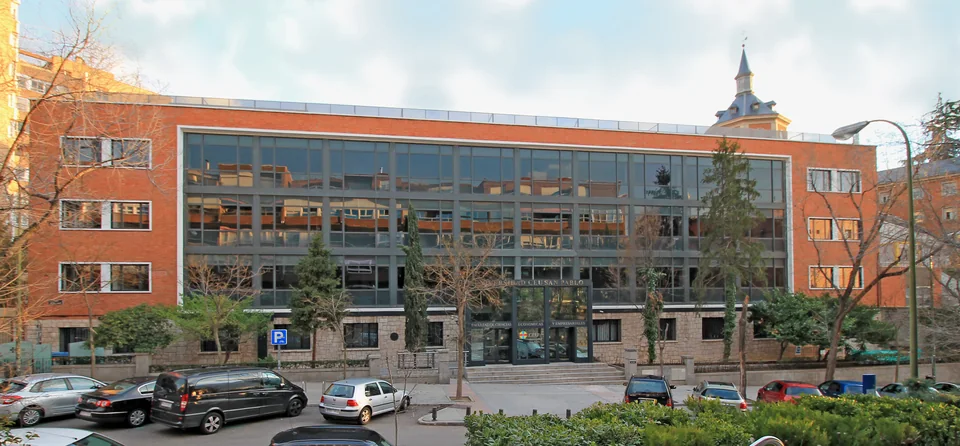
Universidad CEU San Pablo is a private Catholic university in Madrid, part of the education network of the Fundación Universitaria San Pablo CEU, and it awards official Spanish degrees. Law, economics and the humanities are taught in the Moncloa district of Madrid, while medicine, pharmacy and the engineering school are on the Montepríncipe campus in Alcorcón. International applicants are admitted without Spanish entrance exams, on the basis of grades, a motivation letter and an interview, with applications opening in November. Programmes run in Spanish, in English or bilingually. The first year of the English-taught Business Administration degree costs $15,330 (€13,500) in tuition for 2026/27, or about $18,790 (€16,550) with the one-off charges.
| At a glance | Data checked on 01.10.2026 |
|---|---|
| Status | Private Catholic university; official Spanish degrees |
| Campuses | Moncloa (Madrid) and Montepríncipe (Alcorcón, Madrid suburbs) |
| Language | Spanish, English or bilingual (International Bilingual Program) |
| Selection | Grades, motivation letter, interview; medicine has its own exam |
| Bachelor's 2026/27 | $5,450 (€4,800) to $26,230 (€23,100) tuition per year |
| One-off charges | Reservation $1,080–3,750 (€950–3,300), enrolment $1,700–2,270 (€1,500–2,000), Hospitality package for international students $681 (€600) |
| Admission | From November; medicine for 2027/28 has exams on 16 October 2026, 16 January and 10 April 2027 |
| English for graduation | A B2 certificate is required to receive the degree |
Who CEU San Pablo suits
The university suits students who want to study in Madrid itself rather than in a suburb and who accept private fees in exchange for an interview instead of exams. Its strengths include law, journalism and communication, pharmacy, medicine and options with a period abroad: international double degrees with partner universities (for example law with Dublin Business School) and certificates from US institutions such as Boston University Metropolitan College for a semester or a year.
It suits three situations less well. There is no English-taught medicine, only Spanish and bilingual groups, and the exam requires strong biology and chemistry. The university has a Catholic mission; whichever way that matters to you, read the curriculum of your programme first. With a tuition budget below $10,000 a year, Madrid's public universities such as Complutense are more realistic.
The CEU network also includes CEU Cardenal Herrera in Valencia and Abat Oliba CEU in Barcelona. They are separate universities with their own fees and admission and are not covered on this page.
Programmes and language of instruction
| Faculty | Example programmes | Language | Campus |
|---|---|---|---|
| Law | Law, Criminology, International Relations and the EU, double degrees | Spanish, bilingual; International Relations in English | Moncloa |
| Economics and Business | Business Administration, Economics, Marketing, Business Intelligence, Financial Markets and Data Analysis | Spanish, English, bilingual | Moncloa |
| Humanities and Communication | Journalism, Audiovisual and Digital Communication, Advertising, History | Spanish, English | Moncloa |
| Polytechnic School | Architecture, Data Engineering, Biomedical Engineering, Information Systems, Design | Spanish, English, bilingual | Montepríncipe |
| Medicine and Health | Medicine, Dentistry, Psychology, Nursing, Genetics, Physiotherapy | Spanish, bilingual; Dentistry and Physiotherapy in English | Montepríncipe |
| Pharmacy | Pharmacy, Biotechnology, Nutrition, Optics | Spanish, bilingual | Montepríncipe |
Bilingual programmes form the International Bilingual Program, with some courses in Spanish and some in English. Students in English or bilingual groups must certify B2 English by the end of the second year; Spanish-group students must do so before graduation.
How to apply for a bachelor's degree
- Complete the online application form; it opens in November. You receive access to the applicant portal (Portal del Futuro Alumno).
- Upload your passport, a motivation letter and grades for the second-to-last school year; you do not need to wait for graduation.
- Attend an interview with a lecturer, online or in person. It covers your academic record, motivation and the language you plan to study in. You can reschedule up to 48 hours in advance.
- Receive the admission decision and pay the place reservation.
- Take online level tests: English, Spanish for non-native speakers, maths for economics and engineering, chemistry and biology for dentistry. The university may suggest bridging courses based on the results.
- Enrol: upload your proof of legal access, pay the enrolment fee and sign the direct-debit mandate.
A language certificate is not required to apply, because the interview checks your level. The exception is the International Bilingual Program, where applicants without a certificate take an internal test.
Medicine: a separate exam
For the 2027/28 medicine intake the university holds three exam sessions, online or at Montepríncipe: 16 October 2026 (applications 9 September to 8 October, results on 28 October), 16 January 2027 (applications 20 October to 8 January) and 10 April 2027 (applications 19 January to 1 April). The exam combines a biology and chemistry test with an English test, and wrong answers do not lose points. The final score is 60% grades from the second-to-last school year and 40% the two tests. You may sit all three sessions and the best result counts; each session costs $284 (€250).
Documents from Russia, Kazakhstan and other CIS countries
For a school-leaver from outside the EU and outside countries with education agreements there is one route: homologation of the school certificate by the Spanish Ministry of Education. You can enrol with the volante, the receipt showing the request has been filed, but enrolment stays conditional until the ministry decides. Access documents must be submitted by the deadline in the enrolment rules (16 November 2026 for 2026/27), or the university may withdraw the student without refunding payments made. Apostille, translation and grade conversion are explained in Spanish university admission after 11 years of school. An international graduate also needs a NIE number for the degree certificate to be issued.
Fees for 2026/27
Annual tuition is the credit price times the number of credits, usually 60. It is billed in nine monthly instalments from October to June, with a 3% discount for paying the whole year in one go in September. The reservation and enrolment fee are paid on admission, and the credit price may change in later years.
| Programme | Credit price | Annual tuition | Reservation | Enrolment |
|---|---|---|---|---|
| Business Administration (Spanish) | $233 (€205) | $13,970 (€12,300) | $1,080 (€950) | $1,700 (€1,500) |
| Business Administration (English) | $255 (€225) | $15,330 (€13,500) | $1,080 (€950) | $1,700 (€1,500) |
| Law (Spanish) | $204 (€180) | $12,260 (€10,800) | $1,080 (€950) | $1,700 (€1,500) |
| International Relations and the EU (English) | $250 (€220) | $14,990 (€13,200) | $1,080 (€950) | $1,700 (€1,500) |
| Architecture (English) | $278 (€245) | $16,690 (€14,700) | $1,080 (€950) | $1,700 (€1,500) |
| Pharmacy (bilingual) | $284 (€250) | $17,030 (€15,000) | $1,080 (€950) | $1,700 (€1,500) |
| Medicine (Spanish or bilingual) | $369 (€325) | $22,140 (€19,500) | $3,750 (€3,300) | $1,930 (€1,700) |
| Dentistry (English) | $437 (€385) | $26,230 (€23,100) | $1,700 (€1,500) | $1,700 (€1,500) |
In medicine the enrolment fee varies by year: $4,770 (€4,200) in the second year and $3,750 (€3,300) from the third, while the credit price stays at €325 throughout under the current table. International students without completed homologation also pay the compulsory $681 (€600) Hospitality package, which covers support with certificate recognition, NIE and TIE, a bank account, housing information and intensive Spanish courses; a personal housing search and visa advice are not included.
The reservation is non-refundable except as provided by consumer law: a 14-day withdrawal period after payment. University scholarships mainly target specific areas: Becas Marqués de Lozoya reduce fees for education and humanities programmes, and Becas Barcia Goyanes for some life-science programmes. The university decides on awards. Other options are in scholarships in Spain.
Housing
The Hospitality service provides a list of residences and colegios mayores in Madrid and, for an extra fee, a tailored housing search. The university does not publish housing prices; each residence or landlord sets its own. For price levels, see student housing in Spain.
Visa
A non-EU student needs a national study visa. The Consulate General of Spain in Moscow accepts applications through BLS visa centres no later than two months before classes: the admission letter, funds of at least 100% of IPREM ($680, or €600, a month), health insurance meeting Spanish requirements and an apostilled criminal record certificate for stays over 180 days. The university issues the admission letter for the visa through the Hospitality app. Citizens of Kazakhstan follow the Spanish Embassy in Astana. The consulate decides. More detail is in the Spanish student visa guide; legal payment routes from Russia are in how to pay for studies abroad from Russia.
CEU San Pablo compared with other Madrid options
| Criterion | CEU San Pablo | Universidad Europea de Madrid | Public university in Madrid |
|---|---|---|---|
| Location | Moncloa in the city; medicine in Alcorcón | Mainly the Villaviciosa de Odón suburb | City campuses |
| Selection | Interview and grades | Test and interview | UNEDasiss/PCE and competition |
| Business in English, first year | $15,330 (€13,500) tuition only | $15,940 (€14,040) tuition only | No direct equivalent |
| Medicine | Spanish and bilingual groups, own exam | Spanish only | Spanish, high cut-off |
| Compulsory charges for international students | Hospitality package $681 (€600) | Registration file $910 (€800) | Public university fees |
More in the Universidad Europea de Madrid profile and the overview of universities in Madrid. All Spanish profiles are in the Spain catalogue.
Timeline for a September 2027 start
- September–October 2026: choose the programme and language; for medicine, apply by 8 October for the 16 October exam.
- November 2026 to March 2027: apply to other programmes, attend the interview, pay the reservation.
- Spring 2027: level tests and any bridging courses; start looking for housing.
- June–July: school certificate, apostille, translation, homologation request.
- July: visa, no later than two months before the start.
- September–November: enrol, arrive, apply for the TIE and submit access documents by the deadline in the enrolment rules.
Common mistakes
- Mixing up CEU San Pablo with other CEU universities. Cardenal Herrera and Abat Oliba are separate institutions.
- Leaving out one-off charges. The reservation, enrolment and Hospitality package add $3,460 to $6,360 to the first year.
- Ignoring the campus. Medicine, pharmacy and engineering are in Alcorcón, not Moncloa.
- Missing the autumn deadline for access documents. Without them the university may withdraw you with no refund.
- Forgetting B2 English. Without the certificate the degree is not issued, even for Spanish-taught programmes.
FAQ
How much does CEU San Pablo cost?
In 2026/27 a bachelor's year costs from $5,450 (€4,800) for education degrees to $26,230 (€23,100) for English-taught dentistry. English-taught Business Administration costs $15,330 (€13,500) and medicine $22,140 (€19,500). The first year adds the reservation, enrolment and, for international students, the $681 (€600) Hospitality package.
Do I need to take entrance exams?
Most programmes have no exam: decisions rest on grades, the motivation letter and the interview. Medicine applicants sit a biology, chemistry and English test in one of three sessions. School-leavers from Russia or Kazakhstan also need their certificate homologated to enrol.
Can I study at CEU San Pablo in English?
Yes. Business Administration, International Relations, Architecture, Journalism, Dentistry, Physiotherapy and other programmes are taught in English, and several more are bilingual. The language of each group is listed in the university's fee table.
When should I apply?
Admission for most programmes opens in November and runs until places are filled. For the 2027/28 medicine intake the first exam session is on 16 October 2026, followed by 16 January and 10 April 2027.
How is CEU San Pablo different from CEU Cardenal Herrera?
Both belong to the San Pablo CEU foundation network, but they are different universities: San Pablo is in Madrid, Cardenal Herrera in Valencia and its region. Each has its own programmes, fees and admissions office.
How does StudyU help with CEU San Pablo applications?
Choosing the programme and language, preparing for the interview or the medicine exam, the motivation letter, document checks, homologation and the visa file are provided under an agreement with StudyU. Admission is decided by the university's admissions office, homologation by the Spanish Ministry of Education, and the visa by the Spanish consulate.
Sources
- CEU San Pablo: fees 2026/27
- CEU San Pablo: admission process
- CEU San Pablo: access routes
- CEU San Pablo: admission and enrolment rules 2026/27
- CEU San Pablo: medicine admission
- CEU San Pablo: admission FAQ
- CEU San Pablo: Hospitality service
- CEU San Pablo: contacts and campuses
- Consulate General of Spain in Moscow: study visa
Fees and rules checked on 30.09–01.10.2026. ECB reference rate of 30.09.2026: €1 = $1.1355; amounts rounded to $10, amounts under $1,000 to $1.
You can request a call with an adviser through the application form.
During the free initial consultation, we clarify your goal, profile, timing, and budget and identify the next realistic step.
Next steps
- Universidad Europea de Madrid: Admission, Fees and Medicine for International Students
- Studying in Spain for international applicants
- Complutense University of Madrid (Universidad Complutense de Madrid, UCM)
- Studying in Spain After 11 Years of School: How to Apply with a Russian Certificate in 2027
- Scholarships in Spain for International Students in 2026: What Is Actually Open to Non-EU Applicants
- Student Housing in Spain in 2026: Colegio Mayor, Residence or Shared Flat, City Prices and Local Registration
