
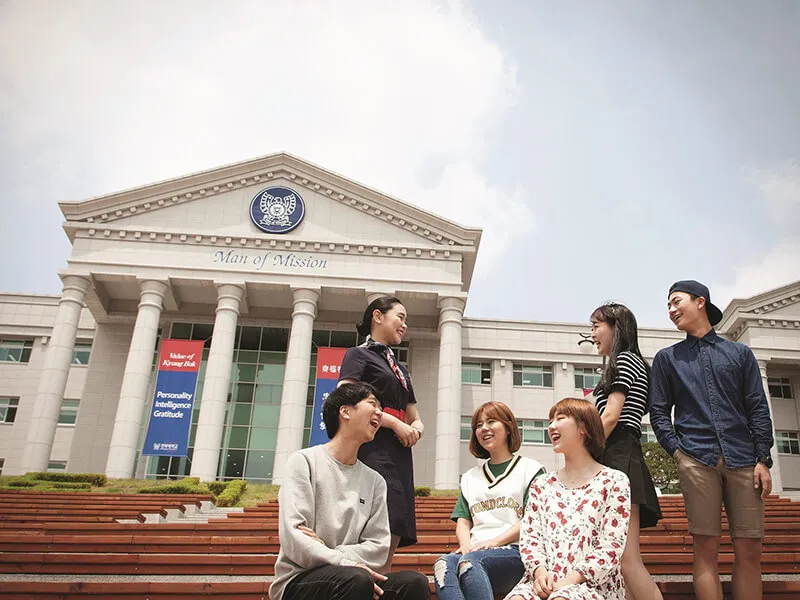
Kyungbok University
What Kyungbok University is
Kyungbok University (경복대학교) is a private vocational college in Gyeonggi Province, with its main campus in Namyangju east of Seoul, a second campus in Pocheon and a Seoul education centre. It opened in 1992 and celebrated its 34th founding anniversary in June 2026.
Despite "University" in its English name, Korea classifies it as a junior college (전문대학): most programmes last two or three years and award an associate degree (전문학사). Teaching is in Korean and aimed at jobs in health care, services, design and IT.
- Typical entry for foreigners: the Korean Education Center first, then a Korean-taught department once your Korean is strong enough.
- Next Korean course starts: 1 December 2026 (apply by 30 September), 11 January 2027 (by 10 November) and 2 March 2027 (by 1 January).
- Not for: students who need English teaching or a research-university bachelor's.
Junior college, associate degree, bachelor's later
The distinction matters for visas, further study and employers. An associate degree from a Korean junior college is a recognised higher-education qualification, but it is not a bachelor's degree.
| Track | Length | Result |
|---|---|---|
| Nursing | 4 years | Bachelor's degree |
| Most departments | 3 years (3+1) | Associate degree, then a 1-year in-depth course for a bachelor's |
| Some departments | 2 years (2+2) | Associate degree, then a 2-year in-depth course for a bachelor's |
| Beauty programmes | 2 years | Associate degree |
The bachelor's-conferring in-depth course (전공심화) is Kyungbok's own route: its graduates enter without a transfer exam, get the admission fee waived and 30% off tuition every semester, and the resulting bachelor's qualifies for graduate school.
Campuses
Namyangju is the main campus; Pocheon is further north and the only campus where the in-depth course offers dormitory places; the Seoul Industry-University Cooperation Center hosts a Korean language branch. A free shuttle bus runs for students of the in-depth course.
In 2021 the Ministry of Education selected Kyungbok as a "General Financial Support University" in its basic competency diagnosis, and in 2025 its institutional accreditation for junior colleges was confirmed as satisfactory at follow-up review.
Departments open to applicants
Health care is the core: nursing, dental hygiene, physical therapy, occupational therapy and biomedical laboratory science. Service and business departments include hotel tourism, aviation service and service management, and the creative and tech side covers software convergence, eco-friendly architecture, architectural space design, visual design, practical music and performing arts.
Health professions such as nursing or dental hygiene lead to Korean national licensing exams taken in Korean, so these tracks demand a very high language level and are the hardest route for foreigners.
At graduate level the Creative Convergence Design Graduate School offers a two-year professional master's in AI-based XR simulation content.
The usual route for international students
- Korean Education Center (KEC): start at level 1–3 on a D-4 general training visa; a minimum of two terms (six months) is required for the visa.
- TOPIK: sit the Test of Proficiency in Korean while studying; the KEC prepares students for it.
- Department application: apply to an associate programme through the college's online application for undergraduate courses; the department and admission rules set the language level.
- Student visa: change to the degree-student visa once admitted; the immigration office decides.
Mistakes to avoid
- Reading "University" in the name as a four-year research university.
- Applying for a health-profession department before your Korean is ready for clinical training and licensing exams.
- Missing a KEC deadline: applications close about two months before each term starts.
- Budgeting from agency price lists; the English site publishes Korean course fees but not degree tuition for foreigners, so request the current figure.
Korean course details
The Korean Education Center has taught Korean as a second language since March 2018. The intensive programme has six levels; at Namyangju each 10-week term has 200 class hours, four hours a day, five days a week, in classes of 15–20. The Seoul centre runs 160 hours per term over four days a week.
| Term | Apply by | Classes |
|---|---|---|
| Winter 1 | 30 Sep 2026 | 1 Dec 2026 – 12 Feb 2027 |
| Winter 2 | 10 Nov 2026 | 11 Jan – 24 Mar 2027 |
| Spring 1 | 1 Jan 2027 | 2 Mar – 12 May 2027 |
| Spring 2 | 11 Feb 2027 | 12 Apr – 23 Jun 2027 |
| Summer 1 | 31 Mar 2027 | 1 Jun – 10 Aug 2027 |
- High-school enrolment or graduation proof
- Passport
- Bank statement showing more than USD 8,000
- Online application for Korean language courses
Costs of the Korean course and living
| Item | Amount | Note |
|---|---|---|
| Tuition, Namyangju or Seoul | $961 (₩1,300,000) | per 10-week term |
| Tuition, Pocheon | $813 (₩1,100,000) | per 10-week term |
| Application fee | $37 (₩50,000) | non-refundable |
| Materials | $58 (₩78,000) | per term |
| Dormitory, Namyangju | $140 (₩190,000) triple / $192 (₩260,000) twin | per month, fee-page figures |
| Dormitory, Pocheon | $170 (₩230,000) twin | per month |
Two terms at Namyangju, the minimum for a D-4 visa, cost about $1,922 (₩2,600,000) in tuition. Fees for the first six months are non-refundable if you leave for personal reasons; they are refunded, minus the application fee, if admission or the visa is refused.
Dormitory and visa rules
Rooms have an en-suite shower and toilet, bed, desk, wardrobe and fridge but no kitchenette; a shared kitchen is available. The dormitory page lists slightly lower monthly rates than the fee page, so confirm the price when booking with the dormitory office.
The college's visa page states that foreign students may work up to 25 hours a week after passing TOPIK level 2 and 10 hours without it, and that visa extensions require paying tuition and the visa fee, with other papers issued by the Office of International Affairs. The immigration office decides every visa. See our guides to Korean language programmes and the GKS scholarship.
Who Kyungbok suits
Kyungbok suits students who want to live near Seoul, learn Korean properly and move into a practical two- or three-year programme, with the option to top up to a bachelor's later. It also works as a structured language year before applying elsewhere.
It does not suit applicants who need English teaching, want a research university from day one, or plan a health profession without years of Korean ahead. For research universities, compare Seoul National University or KAIST.
Course and campus choice, the Korean course application, department application and visa-stage support are provided under an agreement with StudyU; Kyungbok decides admission and the Korean immigration authorities decide the visa.
FAQ
It is an accredited Korean junior college (전문대학). Most programmes give an associate degree; nursing is a four-year bachelor's, and graduates can take an in-depth course for a bachelor's.
$961 (₩1,300,000) per 10-week term at Namyangju or Seoul and $813 (₩1,100,000) at Pocheon, plus a $37 (₩50,000) application fee and $58 (₩78,000) for materials.
Winter 1 starts on 1 December 2026 (apply by 30 September), Winter 2 on 11 January 2027 (by 10 November) and Spring 1 on 2 March 2027 (by 1 January).
No. Degree programmes are taught in Korean, which is why most foreign students begin at the Korean Education Center.
The Korean course application asks for a bank statement of more than USD 8,000.
According to the college's visa page, up to 25 hours a week with TOPIK level 2 and 10 hours without it.
Programme choice, the Korean course and department applications and visa-stage support are provided under an agreement with StudyU. Kyungbok decides admission and Korean immigration decides the visa.
Kyungbok official pages and exchange rate
Won amounts are converted at ECB reference rates for 29 September 2026 (€1 = $1.1355, €1 = ₩1,536.74, so ₩1,000 ≈ $0.74) and rounded.
Want to study at Kyungbok University?
During the free initial consultation, we clarify your goal, profile, timing, and budget and identify the next realistic step. A personal strategy, requirement checks, selection of agreed options, document preparation, applications, and support are provided under an agreement with StudyU.
For four-year research universities in Korea, compare Seoul National University and KAIST. All options: studying in South Korea.
Get a free consultation
During the free initial consultation, we clarify your goal, profile, timing, and budget and identify the next realistic step. A personal strategy, requirement checks, selection of agreed options, document preparation, applications, and support are provided under an agreement with StudyU.
- Discuss your study goal and academic profile
- Clarify budget, timing and destination constraints
- Identify a realistic next step and what to verify before applying
Write to us
Leave a request - and we'll get in touch.
StudyU is ICEF Accredited Trusted Agency #7302. One consistent point of contact with first-hand study-abroad experience. About StudyU
Similar universities - studying in South Korea
Compare your options - we'll help you check the requirements and prepare an agreed route.
Updated:
