
Toronto Metropolitan University (TMU) is a public university in downtown Toronto that was called Ryerson University until 2022. It accepts the Russian attestat (11-year school certificate) and similar CIS certificates for direct entry to a bachelor's degree, so no foundation year is needed if your grades in the programme's prerequisite subjects and your overall average are strong. International tuition for 2026/27 ranges from $27,160 to $31,360 (CAD 38,693–44,675) a year depending on the faculty. If your English score falls short, TMU runs its own language pathway programmes that lead into a degree without a retake of the test.
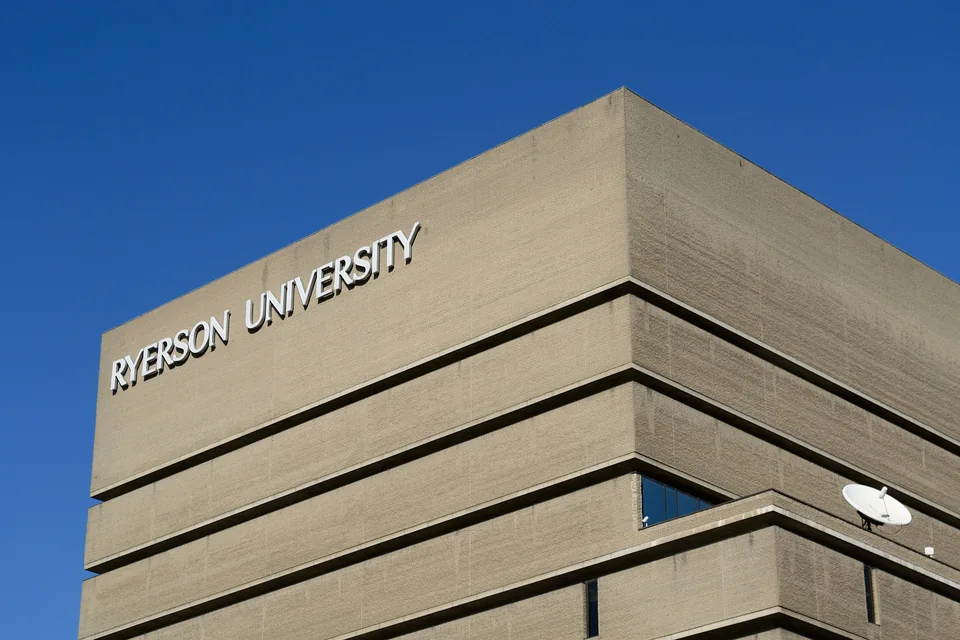
TMU is not the University of Toronto (see our University of Toronto profile) and not York University, which is also in Toronto.
| At a glance | 2026/27 details |
|---|---|
| Type and location | Public university, downtown Toronto, Ontario |
| Former name | Ryerson University (renamed in 2022) |
| International students | More than 4,450 (university figure) |
| Russian school certificate | Accepted for direct entry to bachelor's programmes |
| English | IELTS Academic 6.5, TOEFL iBT 4.5 on the new scale, Duolingo 120, PTE 60 |
| Fall 2027 application | TMU International Application (CAD 150) or OUAC; complete files received by 1 February 2027 get equal consideration |
| Bachelor's tuition | $27,160–31,360 (CAD 38,693–44,675) a year |
| Awards open to international students | ISLA $7,020 (CAD 10,000) one-off; President's Entrance $7,020 (CAD 10,000) a year |
| Residence | Rent $6,310–10,630 (CAD 8,986–15,145) for 33 weeks, plus a mandatory meal plan |
| Study permit | Ontario PAL needed for bachelor's students; not needed for master's students at public institutions since 2026 |
Who TMU suits
TMU's appeal is applied learning in the middle of the city. The campus wraps around Yonge-Dundas Square, close to the financial district, media companies and hospitals. Its best-known schools are the Ted Rogers School of Management, The Creative School (media, journalism, design), engineering and architectural science, and computer science. Many programmes offer co-op, meaning paid work terms built into the degree.
It is a good match if you:
- want an English-taught degree in Toronto without the entry bar of the University of Toronto;
- plan to study business, media, engineering or IT with work experience;
- are applying straight from school and can reach IELTS 6.5.
Look at other options if:
- you have top grades and want a research-intensive university — compare with the University of Toronto;
- budget comes first: applied programmes at Toronto colleges such as George Brown or Humber cost roughly half as much;
- you prefer a quieter city with lower rent — see the University of Ottawa.
Our overview of universities in Toronto compares the city's options side by side, and studying in Canada covers the wider choice.
Entry with a Russian or CIS school certificate
TMU's country table lists, for Russia, the Attestat o Srednem Obrazovanii after Year 11 with high standing in the programme's prerequisite subjects and overall. The 11-year certificate is also listed for Kazakhstan, Uzbekistan and Kyrgyzstan. TMU does not publish a fixed minimum average for these countries; your standing is judged against that year's competition.
Before you apply, check three things:
- Prerequisites. Each programme has its own list. A senior-level English course is required for everyone. Calculus is required for all engineering programmes, Accounting & Finance and some science programmes.
- Non-academic requirements. Grades-Plus programmes add a portfolio, essay, interview or audition, with deadlines on the programme page.
- Documents. At the application stage, a school-issued copy of your transcript or a printout from the school system is enough. Documents in another language are uploaded in the original with a certified literal English translation. Official documents are requested after an offer.
If you are in your final school year, apply with Year 10 and first-semester Year 11 grades; the offer will be conditional on your final certificate. Our guide to Canada after 11 years of school explains the wider options.
English requirements and English Language Institute pathways
You need a test unless you completed four years of full-time high school in an English-speaking country or in an English-medium school. For fall 2027 the score must reach TMU by 1 April 2027; without it the file is incomplete.
| Test | Bachelor's minimum |
|---|---|
| IELTS Academic (One Skill Retake and IELTS Online accepted) | 6.5 overall, no band minimums |
| TOEFL iBT taken on or after 21 January 2026 | 4.5 |
| TOEFL iBT taken before 21 January 2026 | 92 (83 for engineering programmes and Faculty of Science programmes except Computer Science and Architectural Science) |
| Duolingo English Test | 120 |
| PTE Academic | 60 |
| CAEL | 70 (60 for the same programmes) |
| Cambridge C1 Advanced / C2 Proficiency | 180 |
Scores must be sent electronically by the testing organisation.
If your score is lower. The English Language Institute is part of TMU itself. Its pathways are for applicants who meet the academic requirements but not the English score:
| Programme | Entry score | Length | Cost |
|---|---|---|---|
| English Boost | IELTS 6.0 | 8 weeks | $6,950 (CAD 9,895), fall 2027 rate |
| Pre-English Boost + English Boost | IELTS 5.5 | 16 weeks | $10,500 (CAD 14,954) |
| ESL Foundation | IELTS 5.0–6.0 | 1–2 terms | $11,860–23,100 (CAD 16,900–32,900), includes up to three degree-credit courses |
| Pre-ESL Foundation + ESL Foundation | IELTS 4.5 | 40 weeks | $26,320 (CAD 37,499), winter 2027 rate |
Fees include tuition, textbooks, ancillary fees and health cover. For a September 2027 degree start, options include ESL Foundation or Pre-English Boost + English Boost running from 11 January to 30 April 2027. Pathway students also need a PAL and a study permit.
How and when to apply for fall 2027
International applicants can choose between two routes:
| Route | When to use it | Fee |
|---|---|---|
| TMU International Application | Applying to TMU only, for September or January | CAD 150 ($110) |
| OUAC | Applying to several Ontario universities, September only | OUAC rates; the base fee covers three choices |
Students at Ontario high schools must use OUAC. Our guide to bachelor's degrees in Canada explains how Canadian application portals work.
Key dates:
- 1 February 2027 — complete fall 2027 applications received by this date are considered equally; later, programmes may close as seats fill.
- 1 April 2027 — last date for English test scores for fall 2027.
- 15 October 2026 — the equivalent date for January 2027 (international applicants only, limited programme list), with test scores due by 3 November 2026.
After you apply, TMU emails your student number. You use it to activate your account and the ChooseTMU portal, where you upload documents, see requests and receive the decision. An optional Supplementary Form lets you explain your academic history.
Tuition fees in 2026/27
International tuition for one academic year (September–April) by faculty:
| Faculty | CAD | US dollars |
|---|---|---|
| Arts | 38,706–38,731 | $27,170–27,190 |
| Community Services | 38,693–41,506 | $27,160–29,140 |
| Science (including Computer Science) | 38,702–38,762 | $27,170–27,210 |
| The Creative School (media, design, journalism) | 38,733–39,209 | $27,190–27,530 |
| Ted Rogers School of Management | 44,476–44,532 | $31,220–31,260 |
| Engineering and Architectural Science | 44,375–44,675 | $31,150–31,360 |
TMU updates programme-level fees every July, and fees are due by the start of classes.
Other costs estimated by TMU: books and supplies $1,050–4,700 (CAD 1,500–6,700) a year, personal expenses $2,250–3,930 (CAD 3,200–5,600), and a TTC transit pass from $90 (CAD 128) a month. To compare budgets, see the cost of studying in Canada.
Scholarships for international students
TMU's renewable entrance awards of CAD 750–3,000 a year for averages of 86% and above go only to students enrolled at Canadian secondary schools. Applicants from schools in Russia or Kazakhstan are not eligible for them.
International applicants can apply for separate awards through AwardSpring. For fall 2027 the window runs from 2 November 2026 to 16 February 2027, and you can apply before receiving an offer once you have a student number.
| Award | Value | Conditions |
|---|---|---|
| International Student Leadership Award (ISLA) | $7,020 (CAD 10,000), one-off, up to 53 recipients | First-year, full-time, paying international fees, average of 86% (A) or higher, personal statement, gap after school of no more than one year |
| President's Entrance Scholarship | $7,020 (CAD 10,000) a year, up to $28,080 (CAD 40,000) over four years, 12 recipients | Average of 90%+, essay or project summary (max 500 words), two reference letters, leadership in the last two school years |
President's Entrance recipients have a residence room reserved (rent still payable). TMU decides who receives each award. More funding sources are covered in scholarships in Canada.
Residence and renting
TMU has three first-year residences on campus. 2026/27 rates cover a 33-week term, and rent includes internet, laundry and insurance:
| Building and room | Rent for the year | Meals |
|---|---|---|
| Pitman Hall, double / single | $6,310 / $7,630 (CAD 8,986 / 10,867) | Mandatory 7-day plan, $5,310 (CAD 7,570) |
| International Living/Learning Centre, double / single with private bathroom | $6,960 / $9,280 (CAD 9,914 / 13,218) | Mandatory 7-day plan, $5,310 (CAD 7,570) |
| Daphne Cockwell Complex, 4-bedroom / 2-bedroom apartment | $10,130 / $10,630 (CAD 14,435 / 15,145) | 5- or 7-day plan, $3,910 or $5,310 (CAD 5,565 or 7,570) |
You apply through the residence portal with a CAD 50 fee. In the 2026 cycle, first-round offers went to applications submitted by 4 June; later applications join the end of the queue. TMU estimates off-campus rent at $10,530–14,740 (CAD 15,000–21,000) for 12 months, depending on whether you share. Housing tips are part of our guide to studying in Canada as a Russian citizen.
Study permit, PAL and points for Russian citizens
A bachelor's degree lasts longer than six months, so you need a study permit from Immigration, Refugees and Citizenship Canada (IRCC). At TMU the sequence is:
- Accept the offer, pay the deposit and complete one of TMU's pre-PAL engagement steps, such as a study permit webinar.
- TMU requests your PAL — the Ontario letter confirming a place under the provincial cap. When it is ready it appears in ChooseTMU and is downloaded from MyServiceHub.
- Only then submit your IRCC application. Bachelor's and pathway applications without a PAL are refused.
On the cap: for 2026 IRCC gave Ontario 104,780 application spaces for PAL-required applicants. A PAL is valid until the end of the year it was issued, so a student starting in September 2027 will receive one under the 2027 cap, which IRCC sets in fall 2026 alongside the immigration levels plan. Master's and doctoral students at public institutions have not needed a PAL since 1 January 2026.
Points for applicants from Russia and Kazakhstan:
- Funds. For applications submitted from 1 September 2026, IRCC expects first-year tuition, travel and $16,460 (CAD 23,448) for living costs outside Quebec. If your country has foreign exchange controls, you must show you can move the money out. Do not plan around a GIC as a Russian resident: TD's student GIC programme does not list Russia.
- Passport and biometrics. Since 28 January 2026, Canada's visa application centres in Russia no longer accept passports or documents, according to IRCC's list of visa application centres. When IRCC asks for your passport, you submit it at a centre outside Russia that accepts documents, for example in Yerevan, Tbilisi, Almaty or Astana. Biometrics are given after IRCC's instruction letter; before booking, check on the chosen centre's website which services it currently offers.
- Medical exam. Residents of Russia and Kazakhstan need an exam by an IRCC panel physician for stays over six months.
- Fees. Study permit $110 (CAD 150), biometrics $60 (CAD 85).
- Work. Up to 24 hours a week off campus during academic terms.
Step-by-step details are in our Canada study permit guide, and legal payment routes from Russia in how to pay for studies abroad from Russia.
Working after graduation (PGWP)
Bachelor's and master's graduates are exempt from the PGWP field-of-study list, which applies only to non-degree programmes. The language rule applies to everyone: degree graduates need CLB 7 in all four skills. For the PGWP, IRCC accepts IELTS General Training (6.0 in each band for CLB 7), not the Academic test you used for admission, as well as CELPIP, PTE Core, TEF Canada and TCF Canada. See working while studying and the PGWP.
Master's degrees at TMU
Graduate programmes are run by the Yeates School of Graduate and Postdoctoral Studies; each programme sets its own requirements and deadlines. 2026/27 international fees cover the full academic year (fall, winter and spring terms) including ancillary fees and insurance: for example, $20,360 (CAD 29,006) for the MSc in Computer Science or in Data Science and Analytics, and $23,150 (CAD 32,971) for the MA in Fashion. MBA fees are calculated separately in the programme's fee sheet. Master's students at a public institution do not need a PAL. For the wider process, see master's degrees in Canada.
Is a TMU degree recognised in Russia?
TMU is not on Russia's list of foreign institutions whose degrees are recognised automatically (Government Order No. 186-r as amended on 19 February 2026). If you need the degree for work or study in Russia, it goes through recognition by Rosobrnadzor. Canadian institutions on the list include the University of Toronto, Carleton University and York University.
TMU compared with other Toronto options
| Criterion | TMU | University of Toronto | York University | Centennial College |
|---|---|---|---|---|
| Type | University | Research university | University | College |
| Location | Downtown | Downtown plus two suburban campuses | North Toronto | Scarborough, east Toronto |
| International tuition, 2026/27 | $27,160–31,360 (CAD 38,693–44,675) | $46,410 (CAD 66,110) in Arts & Science, $51,150 (CAD 72,860) in engineering | About $26,680–32,990 (CAD 38,000–47,000) | $12,640 (CAD 18,005) for the first diploma year |
| What you get | Bachelor's degree with co-op options | Degree with a research reputation | Degree; Glendon campus offers French-language programmes | College diploma; a few degree programmes |
| Note for international applicants | In-house English pathways into the degree | Highest competition and price in the city | Approximate figures, supplementary fees extra | PGWP eligibility depends on the programme |
Timeline for a September 2027 start
- October–December 2026. Choose a programme, check prerequisites and Grades-Plus requirements, book IELTS.
- November 2026 – 16 February 2027. Apply to TMU, get your student number and submit ISLA or President's Entrance applications in AwardSpring.
- By 1 February 2027. Upload grades and translations in ChooseTMU so your file is considered on an equal footing.
- By 1 April 2027. Send the English score; if it is short, apply to an English Language Institute pathway.
- Spring 2027. Receive the decision, pay the deposit, wait for the PAL and apply for residence.
- Right after the PAL. Do the medical exam, apply for the study permit and give biometrics after IRCC's instruction letter. The passport goes to a visa centre outside Russia once IRCC requests it.
Common mistakes
- Confusing TMU with the University of Toronto. They are separate universities with different requirements and fees.
- Expecting an automatic award. Renewable average-based awards go to Canadian high school students; international applicants must apply through AwardSpring.
- Leaving the test late. For fall 2027 the score must arrive by 1 April, and popular programmes fill earlier.
- Applying for the permit without a PAL. IRCC will refuse it, and resubmitting costs weeks.
- Planning to reuse IELTS Academic for the PGWP. The work permit needs IELTS General Training or another IRCC-approved test.
FAQ
Can I enter TMU straight after Year 11 in Russia?
Yes. TMU accepts the Russian 11-year certificate for direct entry to a bachelor's degree when grades in prerequisite subjects and overall standing are high. TMU's admissions office decides each case against that year's competition and does not publish a minimum average for Russia.
How much does Toronto Metropolitan University cost per year?
In 2026/27 international students pay $27,160–31,360 (CAD 38,693–44,675) in tuition per academic year: arts and science programmes are at the lower end, engineering and business at the top. Housing, meals, books and health cover are extra.
Is TMU the same as Ryerson University?
Yes. Ryerson University changed its name to Toronto Metropolitan University in 2022. Degrees are now issued under the new name, but older agency pages may still call it Ryerson.
What if my IELTS is below 6.5?
TMU's own English Language Institute offers pathways: the 8-week English Boost with IELTS 6.0, longer programmes with 5.0–5.5 and a 40-week route from 4.5. Completing one leads into the degree without a new test; TMU also decides admission to the pathway.
Does TMU offer scholarships to international students?
Yes, by application: ISLA worth CAD 10,000 for first-year students with an 86%+ average, and the President's Entrance Scholarship worth CAD 10,000 a year for 12 students with 90%+. TMU selects recipients; the fall 2027 window runs from 2 November 2026 to 16 February 2027.
Do I need a PAL to study at TMU?
For bachelor's degrees and English Language Institute pathways, yes — TMU requests it after your deposit. Master's and doctoral students at a public institution have been exempt since 1 January 2026. IRCC, not the university, issues the study permit.
Sources
- TMU: requirements by country, international secondary school students, English requirements — checked 2 October 2026
- TMU: how to apply as an international student, application forms, international application dates
- TMU: tuition and costs 2026/27, graduate fees
- TMU English Language Institute: pathway programmes
- TMU: scholarships and awards
- TMU: residence fees 2026/27, important dates
- TMU: study permits and PAL
- IRCC: proof of financial support, PAL/TAL, 2026 cap allocations, visa application centres, fees, PGWP eligibility, medical exams by country
- Russian Government Order No. 186-r of 30 January 2023, as amended on 19 February 2026
- University of Toronto: 2026-27 Tuition Fee Report, York University: tuition, Centennial College: 2026/27 fees
US dollar figures use the ECB reference rate of 1 October 2026 (CAD 1 = $0.7020), rounded to $10. All data checked on 2 October 2026.
If you want to work through your route, send a request: document preparation and submission are provided under an agreement with StudyU, and the university makes the admission decision.
During the free initial consultation, we clarify your goal, profile, timing, and budget and identify the next realistic step.
Next steps
- Centennial College Toronto: Admission, Fees and PGWP for International Students
- Studying in Canada for international applicants
- University of Toronto: Admission, Fees and Scholarships for International Students
- George Brown College
- Humber Polytechnic
- University of Ottawa (uOttawa): Admission and Fees for International Students
