
Higher education in Canada at a glance

Canada is one of the most international-student-friendly destinations: quality education, safety and clear opportunities to stay and work after graduation. Education is split between colleges (applied programs, diplomas) and universities (bachelor's, master's, PhD).
Some programmes include co-op or another work placement. Payment, placement arrangements and eligibility depend on the programme. A post-graduation work permit is subject to immigration and programme requirements.
Advantages of studying in Canada
- A post-graduation work permit (PGWP) may be available to eligible graduates of eligible programmes.
- Some programmes include co-op or another work placement; availability and payment vary.
- A high level of safety and quality of life.
- Instruction in English or French.
- Globally recognized degrees.
Canada: college, university and first-year funding
Compare the qualification and its full duration. A college diploma and a university degree serve different goals; a low first-year fee does not show the cost of the complete route.
| Scenario | Approximate USD |
|---|---|
| College diploma: EduCanada annual range for international students | $11,400–$17,800 |
For study-permit applications from September 1, 2026, IRCC requires $16,540 (CAD 23,448) in first-year living funds for one applicant outside Quebec, beyond tuition and transport. This is an accessible-funds requirement; actual spending, especially rent, may be higher.
The stated college-diploma range plus that funds benchmark gives about $28,100–$34,500 for year one before transport and additional costs. This does not cap living expenses in Toronto or another city.
EduCanada’s college range includes mandatory college charges, including the stated insurance; check books separately. University bachelor’s, master’s and short Pathway programmes need their own fees and payment periods.
If your budget is limited
Compare the full diploma cost and rents outside the most expensive districts. Keep prospective work income or an assumed scholarship out of essential funding until financing is confirmed.
What to prepare next
Name the intended credential, subject, city and current qualification. If considering several institutions, include programme links and the total budget.
USD amounts are rounded for comparison. College figures use the Bank of Canada reference rate on September 22, 2026 (1 USD = 1.4064 CAD); the IRCC requirement is set in CAD and converted at the ECB reference rate of 29 September 2026 (CAD 1 = $0.7052). The programme and its provider’s terms determine the final fee. The combined range is approximate. Count housing and other categories once. Check what the university calculation includes; add only missing expenses and StudyU fees separately. A deposit can require funds before studies start. Do not add proof of funds again to expenses those same funds cover.
EduCanada · IRCC · Bank of Canada FX · Ontario college credentials · IRCC PGWP rules
Institutions featured on this page
| Institution | What to compare |
|---|---|
| George Brown College | Toronto: design, business, hospitality, health and IT; check the programme credential. |
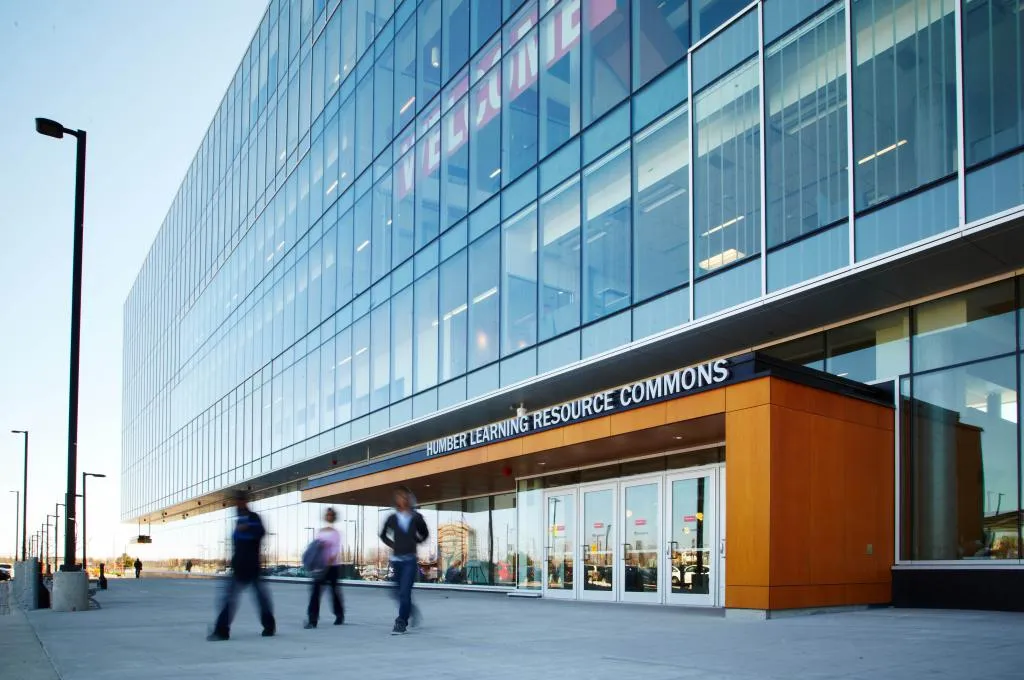
| Humber Polytechnic | Toronto: IT, media, arts and business; placement conditions depend on the course. |
| Sheridan College | Oakville, Brampton, Mississauga: creative and applied programmes; check campus and portfolio requirements. |
How admission works
Admission is based on your diploma and an IELTS/TOEFL certificate. Colleges are known for clear, fast admission for international students.
Under an agreement with StudyU, we help compare programmes and prepare admission and study-permit documents. The institution decides admission; IRCC decides the permit.
Step by step:
- College or university. Ontario colleges offer certificates, diplomas, advanced diplomas, graduate certificates and some degrees. Compare each programme’s duration, fees and any transfer agreement with university options.
- Documents. School certificate with translated transcript, IELTS or TOEFL; for bachelor's many universities add an essay and references.
- Check entry requirements. Each programme decides how it assesses an 11-year school certificate and whether prerequisites, preparation or a portfolio is needed.
- Letter of Acceptance → study permit. After admission you apply for the permit with proof of funds for a year of tuition and living.
- Co-op programs. A work placement can be required or optional, paid or unpaid. Do not rely on possible wages to meet IRCC’s proof-of-funds requirement.
- PGWP after graduation. Before applying, check whether the institution, programme and your circumstances meet IRCC’s PGWP rules; graduation does not guarantee a work permit or permanent residence.
Applying after an 11-year school programme
The specific programme sets entry requirements after school. Check how the institution assesses your certificate, grades, prerequisite subjects and language evidence, and whether a portfolio or additional documents are needed. Preparation, transfer credits and admission are not automatic; the institution decides admission.
Further reading: EduCanada: programmes and costs · guide
Master's degrees in Canada
For a master’s or graduate certificate, check the required prior degree, subject background and language result. These qualifications serve different goals and use different fee structures. Funding and post-graduation work eligibility require separate confirmation.
How to check the final budget
Compare the same academic year, fee status and programme duration. Check the tenancy period, compulsory charges and pre-arrival payments. Financial evidence and the living expenses it covers are counted once.
FAQ
Some graduates may qualify for a PGWP. Eligibility depends on the institution, programme, qualification and applicable immigration rules; admission alone does not establish eligibility.
Co-op is a work-placement component of a programme. It can be paid or unpaid; check the programme’s placement arrangements and applicable rules.
Compare the qualification, curriculum and full duration of individual programmes. Colleges offer different applied diplomas and certificates; some also award degrees. Co-op availability, payment, transfer credits and total cost depend on the programme. A college is not necessarily cheaper than a university; the receiving institution sets transfer conditions.
In English or French, depending on the province and program.
It depends on how the institution assesses your certificate, grades and prerequisite subjects. Preparation or transfer credits are never automatic, and the institution decides admission.
A PGWP is a post-graduation work permit for eligible graduates. Its availability and duration depend on the applicable rules and the completed programme; it does not guarantee permanent residence.
EduCanada’s college-diploma guide is about $11,400–$17,800 a year. For applications from September 1, 2026, IRCC requires $16,540 (CAD 23,448) in first-year living funds for one applicant outside Quebec, beyond tuition and transport. The two categories total about $27,900–$34,300; this is not a complete budget for every city.
Thinking about studying in Canada?
During the free initial consultation, we clarify your goal, profile, timing, and budget and identify the next realistic step.
Colleges in Canada
Compare programmes, costs and entry requirements at three Ontario colleges. We will expand the list.
University and college catalogue
- McGill University: Admission, Fees and Quebec Requirements for International Students
- University of Toronto: Admission, Fees and Scholarships for International Students
- University of Waterloo: Admission, Co-op, Fees and Scholarships for International Students
- University of Alberta: Admission, Fixed Tuition and Fees for International Students
- Concordia University (Montreal): Admission, Fees and the CAQ
- Université de Montréal (UdeM): Admission, French Requirement and Fees
- University of Ottawa (uOttawa): Admission and Fees for International Students
- Queen's University at Kingston: Admission and Fees for International Students
- Western University (University of Western Ontario): Admission and Fees
- Carleton University: Admission and Fees for International Students
- Centennial College Toronto: Admission, Fees and PGWP for International Students
- Durham College (Oshawa, Canada): Admission and Fees — Not Durham University
- Fanshawe College (Canada): Admission, Fees and PGWP for International Students
- Toronto Metropolitan University (TMU): Admission and Fees for International Students
Guides
- Bachelor's Degree in Canada: Entry After School, Costs and 2026–2027 Rules
- Colleges in Canada for International Students: Programmes, Costs and Post-Graduation Work Rights
- Master's Degree in Canada: Admission, Costs and Funding for International Students
- Studying in Canada After 11 Years of School: Five Routes, Requirements and Budget
- Universities in Canada for International Students: Types, Costs and How to Choose
- Working While Studying in Canada and the PGWP: 2026 Rules During and After Your Program
- Scholarships in Canada for International Students: What Is Available in 2026/27 and How to Apply
- Cost of Studying in Canada in 2026/27: Tuition, Living Costs and Study Permit Funds
- Canada Study Permit in 2026: Documents, PAL, Proof of Funds and How to Apply
- Universities in Toronto for International Students: 2026/27 Fees, Colleges and Admission
- Studying in Canada as a Russian Citizen: Biometrics in Russia, Passport Abroad, the Attestat and Payments
- English Language Courses in Canada: Schools, 2026 Prices and Visa Rules
Get a free consultation
During the free initial consultation, we clarify your goal, profile, timing, and budget and identify the next realistic step. A personal strategy, requirement checks, selection of agreed options, document preparation, applications, and support are provided under an agreement with StudyU.
- Discuss your study goal and academic profile
- Clarify budget, timing and destination constraints
- Identify a realistic next step and what to verify before applying
Write to us
Leave a request - and we'll get in touch.
StudyU is ICEF Accredited Trusted Agency #7302. One consistent point of contact with first-hand study-abroad experience. About StudyU
Prepare and compare destinations
Updated:
