
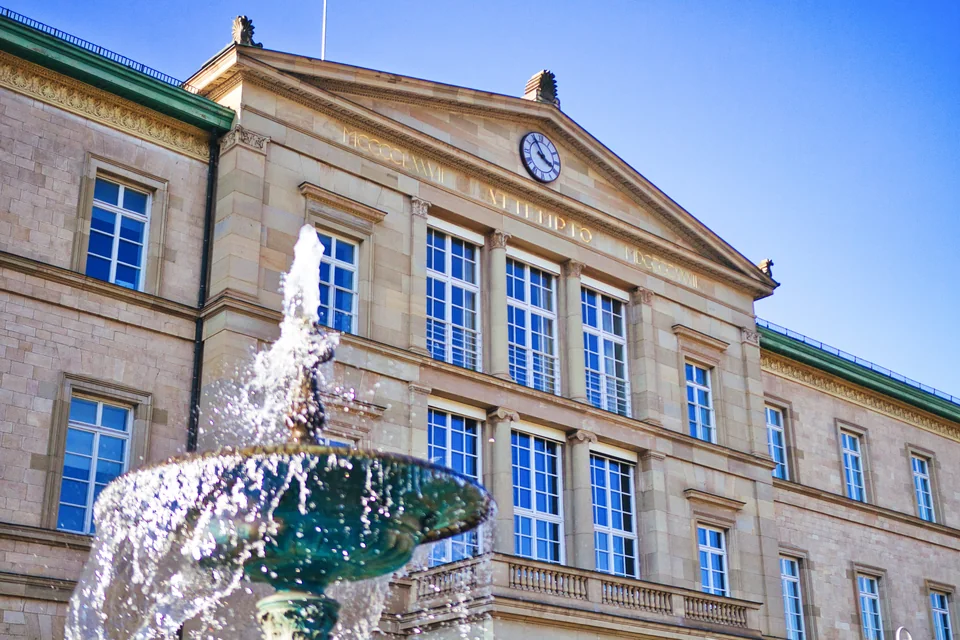
The University of Tübingen (Eberhard Karls Universität Tübingen) was founded in 1477 and had 28,046 students in winter semester 2025/26, 4,495 of them international. It is a public university in Baden-Württemberg, the German state that charges non-EU students $1,700 (€1,500) per semester on top of the regular semester fee of $220 (€194.80). International applicants apply directly through the ALMA portal rather than uni-assist. German-taught programmes require C1-level German at the time of application, and students whose school certificate does not give direct university access are referred to the Studienkolleg in Heidelberg.
If you are comparing Baden-Württemberg universities, Heidelberg University and the University of Freiburg follow the same non-EU fee rule.
| At a glance | Details |
|---|---|
| Location | Tübingen, Baden-Württemberg |
| Founded | 1477 |
| Students (winter 2025/26) | 28,046, including 4,495 international |
| Degree programmes | more than 200 |
| THE World University Rankings 2027 | =101 |
| Non-EU tuition | $1,700 (€1,500) per semester since 2017/18 |
| Semester fee, winter 2026/27 | $220 (€194.80) |
| How to apply | ALMA portal, up to three programmes at once |
| Restricted bachelor's deadlines | 15 July (winter), 15 January (summer) |
| German for German-taught degrees | DSH-2, TestDaF 4 in all parts, telc C1 Hochschule — with the application |
| Foundation route | Studienkolleg Heidelberg, assigned by Tübingen |
Is Tübingen a good fit?
| Consider Tübingen if you | Compare other options if you |
|---|---|
| want medicine, neuroscience, machine learning, archaeology or theology | cannot budget $3,410 (€3,000) a year in tuition |
| can reach C1 German before you apply | plan to finish German after admission |
| are looking at English-taught master's degrees — there are more than thirty | need an English-taught bachelor's in business or engineering |
| like a small town where the university shapes daily life | want a large city with a deep part-time job market |
The university lists six Clusters of Excellence, including Machine Learning, CMFI (microbial infection research), iFIT (cancer immunotherapy) and HUMAN ORIGINS. For master's and PhD applicants this signals where research groups and student projects are concentrated.
If tuition is a deal-breaker, states such as Saxony charge no tuition to non-EU students; see our Leipzig University profile and the guide to free university education in Germany.
Non-EU tuition in Baden-Württemberg
Since winter semester 2017/18, public universities in Baden-Württemberg have charged citizens of non-EU/EEA countries $1,700 (€1,500) per semester under the state's Landeshochschulgebührengesetz. As of 1 October 2026, both the state science ministry and the university confirm the same amount.
Fees are waived automatically for EU/EEA citizens, doctoral students, exchange students (for example Erasmus) and double-degree students where the inter-university agreement waives fees. Other exemptions require documents, including for:
- non-Germans with a German university entrance qualification;
- family members of EU/EEA citizens;
- holders of a settlement permit or permanent EU residence permit;
- people with a long period of lawful residence in Germany (15 months under certain permits, or five years with lawful employment);
- applicants with a parent who lived and worked in Germany for three of the six years before their studies;
- Baden-Württemberg Stiftung scholarship holders.
After enrolment you can also apply for exemption during an internship semester that is part of the curriculum, an approved leave of absence, or a severe disability. Most first-time applicants from outside the EU qualify for none of these, so budget $3,410 (€3,000) a year. Graduates who already hold a German bachelor's and master's are exempt from the international fee but pay the separate second-degree fee instead.
Without direct university access: Studienkolleg Heidelberg
Tübingen evaluates foreign school certificates itself. If yours does not give direct access to German universities, the university assigns you to the Studienkolleg at Heidelberg University, a one-year foundation course ending with the Feststellungsprüfung.
- You apply to Tübingen for your intended degree. The assignment entitles you to sit Heidelberg's German entrance test; a place in the course depends on the result.
- Since December 2025, applying for the Studienkolleg through Tübingen requires German at C1 level, using certificates recognised by BAMF.
- The written placement test usually takes place in October (winter intake) and April (summer intake).
- Medicine, dentistry and pharmacy cannot be applied for while a Studienkolleg is still required.
- After the Feststellungsprüfung, you apply to the university again.
Tübingen generally accepts the assessment exam from other colleges, but some colleges limit graduates to one state or university. Our Studienkolleg guide explains how the colleges and entrance tests work.
Bachelor's and state examination: deadlines and documents
| Programme type | Winter semester (October start) | Summer semester (April start) |
|---|---|---|
| Restricted admission | 15 July | 15 January |
| Open admission | 30 September | 31 March |
ALMA opens for undergraduate applications in mid-June (winter) and mid-December (summer). Non-EU applicants use ALMA for everything, including medicine, dentistry and pharmacy, without registering on Hochschulstart.
Restricted undergraduate programmes reserve 5–10% of places for non-EU citizens. Within this quota, an above-average TestAS can improve your converted grade by 0.1–1.0, and strong German or a year of relevant work or internship can add further points (up to 0.2 for each type of experience). Published cut-off grades apply to EU applicants only.
Upload your school-leaving certificate, any university transcripts and entrance-exam results, your language certificate, and sworn translations into German or English alongside scans of the originals. Late documents are not accepted, and admission cannot be deferred: you would reapply for the next semester.
Master's degrees and English-taught options
Master's applications also go through ALMA. If you have not graduated yet, a transcript showing at least 80% of credits is enough; the final certificate is due during the first semester. There is no international quota at master's level, and each programme sets its own deadline.
Three bachelor's degrees (Interdisciplinary American Studies, English and American Studies, Computational Linguistics) and more than thirty master's degrees are taught fully in English, for example:
- neuroscience: Cellular and Molecular Neuroscience, Neural and Behavioral Sciences, Computational Neuroscience;
- sciences and data: Machine Learning, Physics, Advanced Quantum Physics, Biochemistry, Bioinformatics, Medical Informatics, Geosciences;
- medicine: Molecular Medicine, Biomedical Technologies, Population Based Medicine;
- economics and society: Economics, Economics and Finance, Management and Economics, Quantitative Data Science and Methods, Peace Research and International Relations, Public Policy and Social Change.
No German is required for these programmes; each programme page states its English requirement. Our overview of English-taught master's degrees in Germany helps compare them with other universities.
German language requirements
For German-taught programmes, proof of German must be part of the application; without it the application is rejected, and Tübingen offers no conditional admission while you learn German. Accepted proof includes DSH-2 or DSH-3, TestDaF with at least 4 in every part (a 5 cannot offset a 3), the German component of the Feststellungsprüfung, telc Deutsch C1 Hochschule, DSD II at C1 and Goethe-Zertifikat C2. Compare the exams in our guide to TestDaF, DSH and Goethe certificates.
First-year costs
| Item | Amount |
|---|---|
| Non-EU tuition, two semesters | $3,410 (€3,000) |
| Semester fees, 2 × $220 (€194.80) | $440 (€389.60) |
| Living-cost proof for the visa | $13,520 (€11,904) |
| Minimum first-year total | about $17,370 (€15,294) |
The winter 2026/27 semester fee combines the Studierendenwerk contribution of $120 (€107.80), which includes the solidarity charge for the regional naldo transport pass, a $91 (€80) administration fee and an $8 (€7) student union fee. Re-registration payments are due 1 June–15 August (winter) and 15 January–15 February (summer), with a $11 (€10) late surcharge. Fees are paid by bank transfer only, one semester at a time.
Housing
Student halls are run by Studierendenwerk Tübingen-Hohenheim. Applications are online only and create no entitlement to a room; offers depend on vacancies, and demand is higher for winter. First-year students can usually stay up to six semesters, while master's contracts may be shorter. In September 2026 the Studierendenwerk and local universities publicly appealed to private landlords because of a housing shortage, so apply right after admission and look for a shared flat (WG) at the same time. See our guide to student housing in Germany.
Visa and funding notes
- Apply for a national study visa at the German mission responsible for your place of residence as soon as you are admitted. Tübingen warns that in some countries visa appointments can take up to 24 months.
- Applicants resident in Russia can apply only at the German Embassy in Moscow: the Consulate General in St Petersburg closed on 18 September 2026. Funds are shown through a blocked account, a formal declaration of commitment from Germany or a scholarship. You choose the blocked-account provider yourself: the German Foreign Office no longer publishes a provider list, and according to the embassy no Russian bank can open a qualifying account. A biometric passport has been required since 1 January 2026.
- The living-cost proof is $13,520 (€11,904) a year, or $1,130 (€992) a month. Details are in our blocked account guide and German student visa guide.
- DAAD scholarships are open to many nationalities; note that Russia designated DAAD an "undesirable organisation" in February 2026, which matters for Russian citizens.
The embassy or consulate decides on the visa; the university has no influence on it.
Common mistakes
- Applying to a German-taught programme with B2 and planning to add C1 later — Tübingen rejects such applications.
- Forgetting that the €1,500 is charged every semester, including the final one.
- Mixing up deadlines: 15 July is for restricted programmes, 30 September for open ones, and master's degrees have their own dates.
- Waiting for the start of term before booking a visa appointment.
- Applying for medicine before completing a required Studienkolleg.
FAQ
How much does the University of Tübingen cost for non-EU students?
Non-EU students pay $1,700 (€1,500) per semester plus a semester fee of $220 (€194.80) in winter 2026/27, which is about $3,850 (€3,390) a year before living costs. The visa also requires proof of $13,520 (€11,904) for the first year.
Does Tübingen use uni-assist?
No. International applicants apply directly via the ALMA portal, and the university evaluates certificates and converts grades itself. You can apply for up to three programmes per round; documents not in German or English need a sworn translation.
What level of German do I need for a German-taught bachelor's?
C1, proven at the time of application: DSH-2, TestDaF with at least 4 in all four parts, telc Deutsch C1 Hochschule or DSD II at C1. Applications without such proof are rejected, and there is no conditional admission.
Can I enter Tübingen straight after secondary school abroad?
It depends on your certificate. Tübingen checks it and, if it does not give direct access, assigns you to the Studienkolleg in Heidelberg, which now requires C1 German to apply. The university decides on access, and the entrance test decides on a Studienkolleg place.
Which programmes are taught in English?
Three bachelor's degrees in American and English studies and computational linguistics, plus more than thirty master's degrees such as Machine Learning, neuroscience, physics, biochemistry, molecular medicine, economics and peace research. German is not required for admission to them.
Who is exempt from the €1,500 fee?
EU/EEA citizens, doctoral and exchange students, eligible double-degree students, family members of EU citizens, long-term residents of Germany and a few other groups defined by state law. The university decides on each exemption based on your documents.
Sources
- University of Tübingen: tuition fees for international students
- Baden-Württemberg Ministry of Science: €1,500 non-EU fee
- Semester fees, winter 2026/27
- Undergraduate admission for international applicants, master's, Studienkolleg
- FAQ for international applicants
- International degree programmes
- Facts and figures, winter 2025/26
- Studierendenwerk Tübingen-Hohenheim: housing
- THE World University Rankings 2027
- German Embassy Moscow: national visa, study visa checklist (PDF)
- Federal Foreign Office: blocked accounts
Dollar figures use the ECB reference rate of 30 September 2026 (€1 = $1.1355), rounded to $1 below $100 and to $10 above. Facts checked on 1 October 2026. More German universities are listed on our study in Germany page.
If you want to work through your route to Tübingen, send a request: document preparation and submission are provided under an agreement with StudyU, and the university makes the admission decision.
During the free initial consultation, we clarify your goal, profile, timing, and budget and identify the next realistic step.
Next steps
- Constructor University Bremen: Admission, Costs and Degree Status
- Leibniz University Hannover: Admission, Semester Fees and the Studienkolleg
- Studying in Germany for international applicants
- Heidelberg University
- University of Freiburg (Albert-Ludwigs-Universität Freiburg)
- Leipzig University (Universität Leipzig)
