
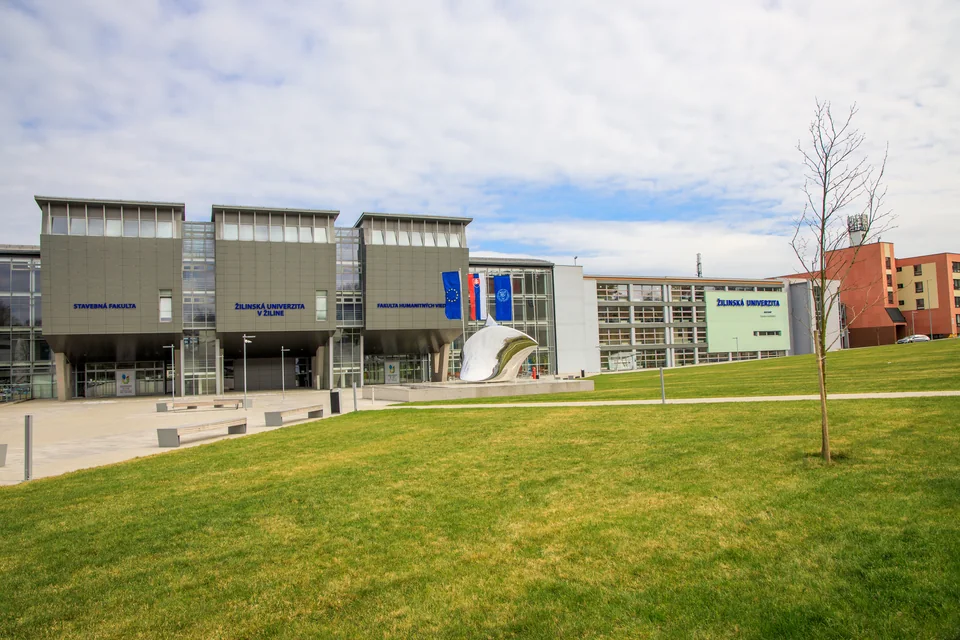
The University of Žilina (Žilinská univerzita v Žiline, UNIZA) is a public technical university in north-western Slovakia that grew out of a railway institute and still builds its profile around transport, logistics, computing and engineering. Degrees taught in Slovak are tuition-free for international students, but from 2027/28 almost every applicant educated abroad should expect an entrance test and a Slovak B1 requirement. English-taught tuition in 2026/27 is $3,970 (€3,500) a year; the Faculty of Civil Engineering charges less, $2,840 (€2,500) per bachelor's year and $3,410 (€3,000) per master's year. The first application round for 2027/28 closes on 31 March 2027 at every faculty.
| At a glance | Details |
|---|---|
| Type | public university in Žilina |
| Founded | 1 September 1953 in Prague as the University of Railway Transport; in Žilina since 6 September 1960 |
| Structure | 6 faculties and 2 university institutes |
| Students | about 7,700 |
| Slovak-taught degrees | free within the standard length of study |
| English-taught degrees, 2026/27 | $3,970 (€3,500) a year; Civil Engineering: $2,840 (€2,500) bachelor's, $3,410 (€3,000) master's |
| Slovak requirement | B1; UNIZA's online test is free for its applicants |
| 2027/28 deadline | 31 March 2027 (first round) |
| Dormitories (2027/28 brochures) | $75–150 (€66–134) a month, adults only |
Who UNIZA suits
Žilina works well if you want an engineering or transport degree and can invest a year or so in Slovak. The university runs programmes that are rare in Slovakia: railway and water transport, professional pilot training, rescue services and crisis management. The campus sits next to a forest park within walking distance of the town centre, and the halls of residence are close by.
Look elsewhere if:
- you need a broad range of English-taught bachelor's degrees. At bachelor's level UNIZA teaches only Air Transport and Civil Engineering Structures in English, and the civil engineering programme opens only if at least five applicants qualify;
- you cannot reach Slovak B1 by spring. In 2026 the university's test sessions ran from mid-April to mid-May, and ÚCV rules do not allow a retake;
- you prefer a capital city and a larger internship market. In Bratislava, the Slovak University of Technology covers similar fields and EUBA teaches economics in English;
- you are comparing technical universities in eastern Slovakia. See the Technical University of Košice.
Faculties and fields
| Faculty | Abbreviation | Bachelor's fields |
|---|---|---|
| Operation and Economics of Transport and Communications | FPEDAS | road, rail, air (including professional pilot) and water transport, freight forwarding and logistics, business economics, financial management, e-business |
| Mechanical Engineering | SjF | computer design and simulation, manufacturing technologies, energy and environmental technology, industrial engineering, vehicles and engines, production automation |
| Electrical Engineering and Information Technology | FEIT | control engineering, biomedical engineering, electro-optics, electrical engineering, communication technologies, multimedia |
| Civil Engineering | SvF | geodesy and cartography, building engineering, civil engineering structures, construction management |
| Security Engineering | FBI | security management, crisis management, rescue services |
| Management Science and Informatics | FRI | informatics, network technologies, informatics and management, management, computer engineering |
| Institute of Mediamatics and Cultural Heritage | ÚMKD | mediamatics and cultural heritage |
| Institute of High Mountain Biology | VÚVB | the Ranger programme, partly taught in Tatranská Javorina |
Master's students have more English options. The Faculty of Management Science and Informatics offers applied and biomedical informatics, intelligent information systems, applied network engineering, information management and computer engineering in English. In 2026/27 the transport faculty reserved 15 English-taught places each in its Road Transport and Railway Transport master's programmes.
English or Slovak: which route
| Slovak-taught | English-taught | |
|---|---|---|
| Tuition | $0 within the standard length | $3,970 (€3,500) a year; $2,840–3,410 at SvF |
| Language | Slovak B1 (Czech is accepted) | English B2 |
| Bachelor's choice | nearly every programme | Air Transport (15 places) and Civil Engineering Structures |
| Main risk | not reaching B1 in time | the programme may not open |
| Tuition for the whole bachelor's | $0 | $11,920 (€10,500) over three years |
| Cost before you start | a year of Slovak at ÚCV: $2,480 (€2,180) including registration, excluding books | none |
On a tight budget the Slovak route nearly always wins: a full year of Slovak at the university institute costs less than one year of English-taught tuition. If you want to start within months and already have B2 English, Air Transport or an English-taught master's is the faster path.
Admission for 2027/28: what changed
For 2027/28 the transport faculty states plainly that exam-free admission applies to applicants who passed the Slovak or Czech school-leaving exam. Grade averages, SCIO results and olympiads count only in that combination. For a school leaver from Russia, Kazakhstan, India or elsewhere, the practical conclusion is simple: prepare for the entrance test.
| Faculty | Exam for international applicants | Date | Application fee |
|---|---|---|---|
| FPEDAS | general knowledge, mathematics and one foreign language: English, German, Spanish, French or Russian | 1–2 June 2027 | $45 (€40) EU citizens, $57 (€50) others |
| FRI | mathematics and logical reasoning, 120 minutes | 3 June 2027 | $23 (€20); one application covers several ranked programmes |
| SvF | mathematics and general knowledge | 9 June 2027; second round 23 August | $40 (€35); $57 (€50) for the English programme |
| FBI | general aptitude test: maths word problems, Slovak language, current affairs | 10 June 2027 | $34 (€30) |
| FEIT | programme rules on the faculty website; interview for multimedia | 15–16 June 2027 | $28 (€25) |
| SjF | selection procedure under faculty rules | 16 June 2027 | $23 (€20) |
The transport faculty lets you choose Russian as the foreign-language part of the test. Its second round (applications until 31 July, exams on 11–12 August) is announced only for programmes that still have places. Fees are payable by bank transfer only and are not refunded if you miss or fail the exam.
Step-by-step timeline
- October 2026 – January 2027. Choose a faculty and programme, arrange an apostille for your school documents and start Slovak.
- February – March 2027. Apply online at vzdelavanie.uniza.sk or prihlaskavs.sk by 31 March, attaching a CV, proof of payment and your penultimate-year grades.
- April – May 2027. Take the UNIZA Slovak B1 test or submit a certificate if your faculty accepts one.
- June 2027. Sit your faculty's entrance exam. The dean's written decision follows within 14–30 days, depending on the faculty.
- June – August 2027. Recognition of your school certificate, residence permit application and dormitory request.
- September 2027. Enrolment; teaching at UNIZA usually starts on the last Monday of September.
Proving Slovak at B1
Faculty rules are similar but not identical. The transport faculty requires a passed UNIZA B1 test by enrolment and accepts results for five years. The Faculty of Management Science and Informatics wants B1 with an overall grade of A, B or C, taken before its exam date. The civil and mechanical engineering faculties accept a certified document; otherwise your Slovak is checked as part of the admission procedure.
UNIZA's Institute of Lifelong Learning (ÚCV) runs the test online via Microsoft Teams. It is free for UNIZA applicants, and results go to you and your faculty within 10 working days. You get one attempt only: ÚCV does not allow repeat testing. The maximum score is 80 points, with at least 60% needed in each part. A paper certificate of the level costs $72 (€63) under ÚCV's current price list.
Beginners can join ÚCV's 660-lesson intensive A1–B1 year. The 2026/27 course runs from 5 October 2026 to 25 June 2027 and costs $2,270 (€2,000), plus study materials and, for applicants with a contact address outside Slovakia, a $200 (€180) registration fee. It is already full; applications closed on 30 June 2026, so plan around the same date for the next intake. In summer 2026 ÚCV also ran a 120-lesson August intensive for students already admitted to UNIZA: the course itself was free for them, and they paid $28 (€25) for materials and a non-refundable $100 (€90) registration fee. More options are compared in our guide to Slovak preparatory courses.
Recognition of your school certificate and documents
Slovakia has published recognition statements (doložka) for common school certificates from EU countries, Ukraine, Russia and China. If one exists for your document, you download it from uznavanie.minedu.sk with the register extract and attach it to a certified copy of your certificate and its Slovak translation. Applicants from Kazakhstan, Uzbekistan and other countries without a statement need a decision from the Regional Office of School Administration (RÚŠS); for UNIZA that is the office in Žilina. Proof of recognition is due by enrolment day at the latest. Details are in our guide to recognition of school certificates in Slovakia.
What the application needs:
- an online application for a specific programme (FPEDAS requires a separate application and fee per programme);
- a CV;
- proof of payment;
- penultimate-year grades, followed later by the final certificate;
- for English-taught degrees, proof of English at B2;
- for Slovak-taught degrees, the B1 test result or a certificate.
The transport, civil engineering and informatics faculties do not ask for a medical certificate. The exception is the professional pilot specialisation, which requires an EASA Class 1 medical certificate by enrolment.
Tuition and living costs
| Item | Amount |
|---|---|
| Slovak-taught full-time study, standard length | $0 |
| English-taught degree, 2026/27, most faculties | $3,970 (€3,500) a year |
| English-taught degree at SvF, 2026/27 | $2,840 (€2,500) bachelor's, $3,410 (€3,000) master's |
| Exceeding the standard length, 2026/27 | $1,360 (€1,200) a year |
| A second programme in parallel, 2026/27 | $1,020 (€900) a year |
| Dormitory, 2027/28 brochures | $75–150 (€66–134) a month |
| Lunch in the university canteen, 2027/28 brochures | $1–5 (€1.10–4.70) |
| Application fee for 2027/28 | $23–57 (€20–50) |
Your annual minimum covers housing, food, insurance and local transport. The police may check that a residence permit holder has at least the subsistence minimum: from 1 July 2026 that is $340 (€295.22) a month, or $4,020 (€3,542.64) a year. A full budget with examples is in our guide to the cost of studying in Slovakia; students paying from Russia can read about legal payment routes.
Where to live
UNIZA runs four residences: Veľký Diel and Hliny in Žilina plus facilities in Ružomberok and Liptovský Mikuláš. Veľký Diel is the largest, with 2,330 places during the academic year: double and triple rooms, en-suite showers and toilets in blocks DE–DH, a kitchenette on every floor, a self-service laundry and a 150-seat cinema. Hliny houses students in five-person units (a double and a triple room) with shared showers on each floor.
According to the 2027/28 faculty brochures, first-year bachelor's students are entitled to a place under university rules, but only adults are accommodated. If you will be under 18 on 1 September, arrange private housing and budget for it.
Residence permit and timing
Non-EU students need temporary residence for the purpose of study. You apply at the Slovak embassy accredited to your country of citizenship or residence — for Russian citizens that is Moscow, for Kazakh citizens Astana — or at the foreign police in Slovakia if you are already there on a national visa or another residence permit. You need confirmation of admission and an apostilled criminal record certificate; university students do not have to prove accommodation. Since 15 July 2026 the police have up to 90 days to decide, so a June exam and a late-September start leave little slack. Apply as soon as the admission letter arrives. Every step is covered in our guide to the student residence permit in Slovakia.
University students with this permit may work up to 80 hours a month without a separate work permit and may extend their stay by nine months after graduation to look for a job.
Common mistakes
- Expecting admission on grades alone. From 2027/28 the transport faculty ties exam-free entry to a Slovak or Czech school-leaving exam.
- Leaving the Slovak test until summer. ÚCV sessions run in spring, and a failed attempt cannot be retaken.
- Assuming one application covers several FPEDAS programmes. It does not; each needs its own application and fee. At FRI, by contrast, you rank programmes in a single application.
- Not checking whether the English programme will run. Civil Engineering Structures in English opens only with five qualifying applicants.
- Arriving at 17 without a housing backup. UNIZA residences do not accommodate minors.
How StudyU helps
The first consultation is free and serves for orientation only. Assessing whether a UNIZA faculty or another university fits your 2027/28 plans, programme selection, a requirements check against your school certificate, a preparation plan for Slovak B1 and the entrance test, and preparation of the application and residence permit file are provided under an agreement with StudyU. The UNIZA faculty dean decides on admission, the ministry or RÚŠS on recognition, and the Slovak foreign police on the residence permit.
Other universities are listed in our Slovakia study guide and our overview of universities in Slovakia; the general procedure is explained in applying to universities in Slovakia.
FAQ
Can I study at the University of Žilina for free?
Yes, if the programme is full-time, taught in Slovak and completed within its standard length; nationality does not matter. You pay for English-taught degrees, for exceeding the standard length ($1,360 a year at the 2026/27 rate) and for a second parallel programme.
Which UNIZA programmes are taught in English?
For 2027/28 bachelor's entry: Air Transport (15 places) and Civil Engineering Structures. At master's level the choice is wider, including FPEDAS transport programmes and several informatics degrees at the Faculty of Management Science and Informatics.
Do I need an entrance exam if I finished school abroad?
Almost certainly. The exam-free routes rely on Slovak or Czech school-leaving exams, SCIO tests and olympiads. International applicants should prepare for their faculty's test, held in the first half of June.
Where can I prove Slovak at B1?
The most convenient option is UNIZA's online ÚCV test, which is free for UNIZA applicants and reports results to the faculty within 10 working days. You get only one attempt and ÚCV does not allow a retake, so book a spring session once you are confident of your level.
When should I apply for 2027/28?
The first round closes on 31 March 2027 at all faculties. Some faculties add a second round — transport until 31 July, civil engineering until 13 August — but only for programmes with remaining places.
How much is student housing in Žilina?
The 2027/28 faculty brochures quote $75–150 (€66–134) a month depending on the residence and room type. Only students who are already 18 are accommodated in UNIZA residences.
How does UNIZA differ from the Slovak University of Technology?
UNIZA has transport, logistics and security engineering faculties that STU lacks, while STU has architecture and chemical technology faculties. Living costs are lower in Žilina, but the internship market is smaller than in Bratislava.
Sources
- UNIZA: university profile and history — checked 30 Sept 2026
- UNIZA: applications, recognition and 2026/27 dates — checked 30 Sept 2026
- UNIZA: study programmes 2026/27, including English-taught options — checked 30 Sept 2026
- UNIZA: Annex 1 to Directive No. 243, tuition for 2026/27 (PDF) — checked 30 Sept 2026
- Faculty brochures for 2027/28: FPEDAS (PDF), FRI (PDF), SvF (PDF), SjF (PDF), FEIT (PDF), FBI (PDF) — checked 30 Sept 2026
- ÚCV UNIZA: Slovak B1/B2 test, intensive A1–B1 year, summer course — checked 30 Sept 2026
- UNIZA: accommodation — checked 30 Sept 2026
- Recognition statements database of the Slovak education ministry (MŠVVaM SR) — checked 30 Sept 2026
- IOM Migration Information Centre Slovakia: study residence rules; amendment in force from 15 July 2026 — checked 30 Sept 2026
Dollar amounts use the ECB reference rate of 29 Sept 2026 (the latest published on the check date, 30 Sept 2026): €1 = $1.1355, rounded to $1 below $100 and to $10 above.
If you want a timeline for Slovak and your documents ahead of a UNIZA exam, send us a request.
During the free initial consultation, we clarify your goal, profile, timing, and budget and identify the next realistic step.
Next steps
- Technical University of Košice (TUKE): Admission and Fees
- Studying in Slovakia for international applicants
- How to Pay for Studies Abroad from Russia: What Works in 2026
- Recognition of School Certificates in Slovakia: Recognition Statement, RÚŠS and Timelines
- Slovak Language Preparatory Courses Before University: Options, Costs and Immigration Status
- Applying to Universities in Slovakia: Deadlines, Documents and Entrance Exams for 2027/28
