
The Academy of Fine Arts Vienna is a public art university and the oldest art academy in Central Europe: Peter Strudel opened a private academy in 1688, and the earliest record of its official recognition by the emperor dates from 1692. For applicants, the defining point is that every programme except the research doctorates admits through an entrance examination, and Fine Arts, Scenography and Conservation-Restoration do not require a school-leaving certificate at all. Fine Arts students can prove German during their studies, by the third semester, whereas Architecture needs both German and English at B2 before enrolment. Fine Arts portfolios are accepted once a year, in January and February, and in 2026/27 non-EU students pay $850 (€752.92) per semester including the student union fee.
| At a glance | Details |
|---|---|
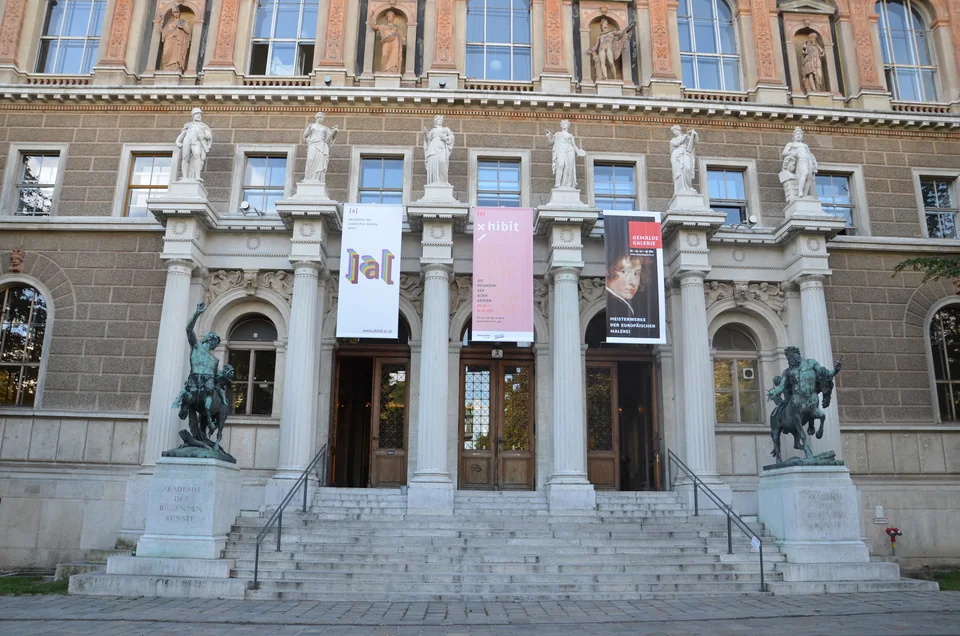
| Status | public university of the arts in Vienna, main building on Schillerplatz |
| History | private academy from 1688, imperial recognition recorded in 1692; the current Theophil Hansen building opened in 1877 |
| Programmes | Fine Arts, Scenography, Conservation and Restoration (diploma programmes); Architecture and Education in the Arts (bachelor's and master's); MA in Critical Studies; doctoral studies and PhD in Practice |
| Selection | an entrance examination for every programme except the research doctorates; study at another art school does not exempt you |
| School certificate | required only for Architecture and Education in the Arts |
| Non-EU fees in 2026/27 | $850 (€752.92) per semester: tuition plus ÖH fee |
Programmes and requirements side by side
| Programme | Format | Language before enrolment | 2026/27 selection (for orientation) |
|---|---|---|---|
| Fine Arts (Bildende Kunst) | diploma, 4 years in two 2-year sections, Mag. art. | none; German B1 (or A2 plus the course "Foreign Languages for Artists") by the third semester | portfolio 21 Jan–11 Feb 2026, exam 19–21 May 2026 |
| Scenography | diploma | same as Fine Arts | application and task 26 Jan–22 Feb 2026, second round 18–21 May 2026 |
| Conservation and Restoration | diploma, 10 semesters, 300 ECTS | German B2 | portfolio 19 Jan–1 Mar 2026, exam 8–9 Apr 2026 |
| Architecture, bachelor's | bachelor's | German B2 and English B2 | registration 11–29 May 2026, exercises due 15 Jun 2026, interviews 8–9 Jul 2026 |
| Architecture, master's | master's | German B2 and English B2 | registration 30 Mar–17 Apr 2026, upload by 27 Apr 2026 |
| Education in the Arts | bachelor's and master's | German B2 | registration and portfolio 23 Mar–20 Apr 2026 |
| Critical Studies | master's | German B2 | application and essay 2 Feb–3 Mar 2026, interviews 11–12 May 2026 |
| PhD in Practice | artistic doctorate | English B2 | by call |
All dates above belong to the 2026/27 admission cycle, and most have passed. The Academy publishes new dates on each programme page; expect the same rhythm, with Fine Arts and Scenography in January–February and Architecture and Education in the Arts in spring.
Education in the Arts is a teacher-training route: you study two subjects, and your pedagogic suitability is assessed alongside the entrance exam. The second subject can be taken at another university.
How the Fine Arts entrance examination works
Fine Arts is the most popular route, and its procedure is strict.
- Online registration and portfolio. In the 2026/27 cycle the window ran from 21 January (10:00 CET) to 11 February (12:00 CET). Registration and upload happen only through calls.akbild.ac.at; portfolios sent by email, delivered in person or on a USB stick are not accepted.
- Choosing a studio group. You select one or more groups at registration. Painting covers the studios for abstraction, expansion, graphics, figuration, context and drawing. Sculpture covers spatial strategies, public sphere, environment, object and installation. Media covers concept, media, film, performance, video and photography. Each studio is led by a named professor, so look at their work before choosing.
- Portfolio format. One PDF of up to 50 MB, your name on the first page, a CV included, and the file named "surname_firstname". Video and audio go in as links, with passwords if needed; nobody will contact you if a link fails. The rest of the content is your choice.
- Portfolio review. The examination senate reviewed work from 13 February to 10 March, and invitations to the second stage were announced on 20 March.
- Second stage. The examination task is emailed in advance (on 5 May in 2026). For Painting, the exam is in person in Vienna over three days (19–21 May), bringing works from your portfolio and your materials. For Sculpture and Media, it is a task plus a 30-minute Zoom interview. Interviews are held in German or English.
- Result. Final results were emailed on 29 May 2026.
What if you cannot travel for the in-person Painting exam? The Academy accepts reasons such as a refused visa, health problems, financial difficulties, or ecological concerns about long-haul flights. If you report this by the stated date (8 May in 2026), the exam can be held via Zoom instead.
The Academy looks for independent work that shows your interests, skills, motivation and methods. Work produced at school or in art courses should be included only if it supports your own artistic position.
Other programmes: what to watch for
Architecture. This is the only field where you must submit two language certificates, German and English at B2, together with a copy of your school certificate. Bachelor's applicants complete assignments sent by email and upload them with a portfolio and a letter of intent; interviews take place in person or by video. In 2026 they were held on 8–9 July, which leaves architecture applicants less time for the residence permit than Fine Arts applicants. Teaching is in German, with some courses in English. The Academy offers portfolio feedback for Architecture and Education in the Arts before you apply.
Scenography. The first round is remote: you explore a set theme (in 2026, Marc Augé's "non-places"), translate it into drawings, photographs and a model, and add a short text, a motivation letter and a portfolio. The second round is in person at the Department of Scenography in Vienna. The exam can be taken in German or English, and you may bring an interpreter to the interview.
Conservation and Restoration. The exam is held once a year, and your specialisation is fixed at that point; it cannot be changed later. There are five: paintings and sculptures; wooden objects and historic musical instruments; paper, photographs, books and archive material; mural paintings and architectural surfaces; and modern and contemporary art.
Critical Studies. A master's that combines theory and artistic practice. You write a project outline for your future master's thesis of 4,000 to 10,000 characters in German or English, followed by an online interview. A related bachelor's and German at B2 before enrolment are required.
Doctoral studies. PhD in Practice requires B2 English and runs through a call. The doctorates in philosophy, technical sciences and natural sciences have no online registration or entrance exam: the Registrar's Office admits you during the general admission period, and the working language is agreed with your supervisor.
Language requirements
| Programme | Level | When |
|---|---|---|
| Fine Arts, Scenography | German B1, or A2 plus the Academy's "Foreign Languages for Artists" course | before registering for the third semester |
| Conservation and Restoration, Education in the Arts, Critical Studies | German B2 | before enrolment |
| Architecture (bachelor's and master's) | German B2 and English B2 | before enrolment |
Accepted German proof includes ÖSD, Goethe, telc, ÖIF, TestDaF, DSH and DSD certificates, exams at Austrian university language centres, and the Academy's own German courses. English B2 can be shown through English in your school-leaving exam, TOEFL iBT 72, IELTS 6 or Cambridge First. Native speakers of German or English need no proof. Enrolled students can take German classes at the Academy.
After the exam: enrolment, residence permit, housing
Enrolment. For the 2026 winter semester, online pre-registration runs from 7 September to 31 October. You upload your passport, your Vienna registration certificate (Meldezettel), your school certificate (only for Architecture and Education in the Arts) and your degree (for the Architecture master's and doctoral studies). Documents not in German must come with a German translation carrying all required legalisations. For your visa file, the Registrar's Office issues a confirmation of admission once you email a passport scan and your exam registration number.
Residence permit. The Academy advises applying as soon as you receive your pass notice: if you do not apply in July, you may not arrive in time for October. Russian citizens apply in person at the Austrian Embassy in Moscow, and Vienna's immigration office (MA 35) decides. In 2026 you must show $820 (€722.58) per month under 24 or $1,490 (€1,308.39) from 24, for 12 months, plus more if rent exceeds $440 (€386.43). The permit fee is $250 (€218) and student health insurance with ÖGK costs $90 (€78.84) per month. See our guide to student visas and residence in Austria.
Housing. The Academy points to three sources: the ÖH student union's housing advice, ÖJAB student residences and OeAD Housing. A dormitory booking provides the accommodation proof needed for the permit, which is why the Academy recommends it to students who need a visa.
Costs
| Item | Amount |
|---|---|
| Non-EU tuition, 2026/27 | $830 (€726.72) per semester |
| ÖH student union fee, 2026/27 | $30 (€26.20) per semester, insurance included |
| Total for the 2026/27 academic year | $1,710 (€1,505.84) |
| Living costs in Austria (OeAD guideline, checked September 2026) | about $1,480 (€1,300) per month; housing in Vienna costs more |
Instalments are not possible, and unpaid fees block enrolment. Studio materials are a separate cost you should budget for yourself. For a full budget, see the cost of studying in Austria.
Who the Academy suits
- Artists with their own method and a coherent body of work: selection looks at your artistic position, not school technique.
- Applicants with a strong portfolio but no German yet: Fine Arts and Scenography require German only by the third semester.
- Pupils still at school: there is no age limit, Fine Arts needs no school certificate, and for Architecture you bring it at enrolment.
- Not a fit for design or applied arts, which belong to the University of Applied Arts Vienna (Die Angewandte), or for music and theatre, which belong to the University of Music and Performing Arts Vienna. For an overview, see universities in Vienna.
Common mistakes
- Emailing a portfolio or trusting untested links: work outside the portal is ignored and broken links are not checked.
- Choosing a studio group without looking at the professors.
- Hoping to move the exam date: the Academy does not offer alternative dates.
- Applying to Architecture with only one language certificate.
- Leaving the residence permit until autumn after a May exam.
- Assuming that studying at another art school exempts you from the exam; prior credits can only be recognised after admission.
FAQ
Do I need a school-leaving certificate for the Academy of Fine Arts Vienna?
Only for Architecture and Education in the Arts. Fine Arts, Scenography and Conservation-Restoration admit on the basis of the entrance exam alone. Where a certificate is required, you can present it at your first enrolment after the exam.
What German level is required for Fine Arts?
None to apply, as the exam can be taken in English. Before registering for your third semester you must prove German B1, or A2 together with the Academy's "Foreign Languages for Artists" course.
When is the Fine Arts portfolio deadline?
Portfolios are accepted once a year; in the 2026/27 cycle the window ran from 21 January to 11 February 2026. The Academy posts the next dates on the programme page, and you should expect the same winter window.
How much does the Academy cost for international students?
In 2026/27, non-EU students pay $850 (€752.92) per semester: $830 (€726.72) in tuition and $30 (€26.20) for the ÖH. Living costs, materials and housing are extra.
Can I take the entrance exam remotely?
For the Sculpture and Media groups, the second stage of Fine Arts takes place on Zoom. Painting is in person, but the Academy can switch to Zoom if your visa is refused or health or financial reasons prevent travel, provided you report this in advance.
Are there programmes in English?
The Academy does not list fully English-taught degrees, but the Fine Arts and Scenography exams can be taken in English and some Architecture courses are taught in English. PhD in Practice requires B2 English.
Can StudyU help with an application to the Academy?
Choosing a programme and studio group, planning your portfolio and deadlines, and preparing enrolment and residence permit documents are provided under an agreement with StudyU. The Academy's examination panel assesses the work and decides on admission, and Vienna's immigration office decides on the residence permit.
Sources
- Academy of Fine Arts Vienna: admission examinations, including Fine Arts, Architecture (bachelor's), Architecture (master's), Scenography, Conservation and Restoration, Critical Studies
- Fine Arts admission call 2026/27
- Language competency
- FAQ: application and admission examinations, range of studies, international students
- Tuition fees and online admission for winter semester 2026
- Residence for non-EU citizens and living in Vienna
- History of the Academy
- Study in Austria: living costs
The conversion rate is the ECB reference rate of 29 September 2026 (€1 = $1.1355), current when we compared the official pages on 30 September. All Austrian universities and the general admission rules are collected on studying in Austria.
Next steps
- University of Music and Performing Arts Vienna (mdw)
- Cost of Studying in Austria in 2026/27: Tuition, the Preparation Year and Living Costs
- Universities in Vienna for International Students: Public Universities, Universities of Applied Sciences and Private Options
- Austrian Student Visa and Residence Permit: Where to Apply, Proof of Funds, Timing and Renewal
- Studying in Austria for international applicants
- University of Klagenfurt (Universität Klagenfurt, AAU)
