
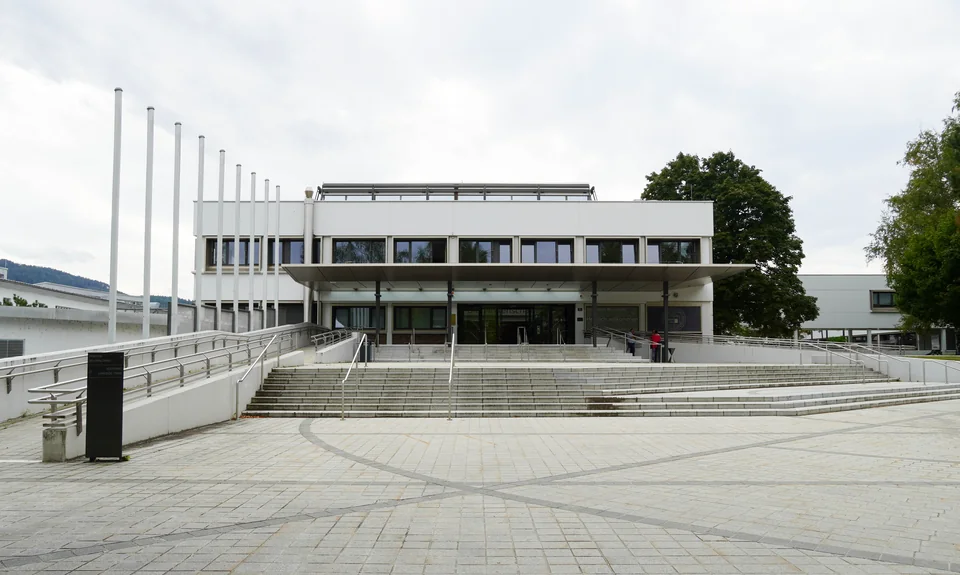
The University of Klagenfurt, also known as Alpen-Adria-Universität (AAU), is a public university founded in 1970 and now the largest academic institution in the Austrian state of Carinthia. For international applicants it stands out for something most Austrian universities lack: six bachelor's and eleven master's programmes taught entirely in English, including robotics and AI, international business, informatics and cybersecurity. The catch is the application window for non-EU citizens, which is early and narrow: 1 April to 30 June for the winter semester, with documents sent as certified paper copies. Fees in 2026/27 are $850 (€752.92) per semester including the student union fee, and the university can refund part of the tuition to high-achieving third-country students.
| At a glance | Details |
|---|---|
| Official name | Universität Klagenfurt (Alpen-Adria-Universität Klagenfurt, AAU) |
| Founded | 1970 |
| Structure | 4 faculties, 30 departments; campus in Klagenfurt am Wörthersee |
| Taught in English | 6 bachelor's and 11 master's programmes |
| Non-EU application window | 1 April–30 June (winter semester), 1–30 November (summer semester) |
| Processing time | at least two months, up to six |
| German for German-taught degrees | A2 when applying, B2 at enrolment |
| Non-EU fees in 2026/27 | $850 (€752.92) per semester, ÖH fee included |
Four faculties
- Arts, Humanities and Education, founded in 1993, covering the core humanities subjects.
- Management, Economics and Law, four departments working together under the faculty motto "rethink management".
- Technical Sciences, in existence since 2007, with nine departments and, according to the university, excellent staff-student ratios.
- Social Sciences, the newest, set up in 2023, where four departments and centres study societal questions.
Since January 2022 the university has been a member of YERUN, the Young European Research Universities Network, and in December 2025 planning approval was granted for a new building, the 22nd Century Center.
English-taught programmes
| Level | Programme | Special admission procedure |
|---|---|---|
| Bachelor's | International Business and Economics | yes; registration for 2026/27 ran 12 January–23 February 2026 |
| Bachelor's | Robotics & Artificial Intelligence | no |
| Bachelor's | Information and Communications Engineering | no |
| Bachelor's | Digital Media, Culture, and Communication | no |
| Bachelor's | Social Sciences | no |
| Bachelor's | Worlds of English | no (Latin exam required) |
| Master's | Artificial Intelligence and Cybersecurity | yes; 12 January–30 April 2026 |
| Master's | Game Studies and Engineering | yes; 12 January–30 April 2026; English C1 |
| Master's | International Management | yes; same dates; English C1 |
| Master's | Management, Economics, and Data Science | yes; 12 January–30 April 2026 |
| Master's | Media and Convergence Management | yes; same dates; English C1 |
| Master's | Informatics, Information Management, Information and Communications Engineering, Mathematics, Cross-Border Studies | no |
| Master's | Worlds of English | no; English C1 |
Special admission procedures run once a year, before the winter semester, and most of them charge a $57 (€50) fee in 2026/27. The dates above belong to the 2026/27 intake and have passed; if the pattern holds, the next cycle opens in January 2027. Programmes without a special procedure decide on the basis of your documents. For a wider comparison, see our guide to English-taught degrees in Austria.
Applying: three rules that cost people a year
The window. Non-EU and non-EEA citizens may apply only between 1 April and 30 June for the winter semester and between 1 and 30 November for the summer semester. Applications arriving outside these periods are not processed. A complete application takes at least two months and can take up to six, so a June submission leaves little margin before September.
Paper documents. AAU accepts notarised copies (preferred) or originals; simple copies and printouts are not processed. A document counts as official only if it carries a wet-ink signature and stamp or the Austrian electronic official signature. If you send originals, you arrange their return by courier yourself.
Legalisation and translation. Documents need legalisation according to the rules for the issuing country (an apostille for Hague Convention states such as Russia and Kazakhstan) and official translation. If your name is spelled differently across documents, add a document explaining the difference. Applicants whose schooling was completed in India, Pakistan or Bangladesh must also pass a competence check at VFS Global before applying.
After a positive decision, you register online and enrol in person during the general admission period: for winter semester 2026/27, 6 July to 5 September 2026 for bachelor's programmes and 6 July to 31 October for master's; for summer semester 2027, 8 January to 5 February and 8 January to 31 March respectively.
What to include in a bachelor's application
- the bachelor's application form;
- a simple copy of your passport showing your gender;
- your school-leaving certificate, or proof of at least three years of study at a recognised institution, legalised as required;
- official translations;
- your language certificate;
- documents explaining any change or variation in your name.
For a master's, replace the school certificate with your bachelor's degree certificate and transcript or diploma supplement. Each master's curriculum sets out the prior-education requirements, and the university checks your degree against them.
How Austrian universities assess non-EU school certificates and set supplementary exams is covered in applying to universities in Austria; the degree structure is explained in bachelor's and master's degrees in Austria.
Language requirements
| Language | Level | When |
|---|---|---|
| German, for a German-taught programme | A2 | at application |
| German | B2 | at enrolment |
| German for German Studies and teacher education, and at master's level also Business and Law, Business Law, Creative Writing and Psychotherapy | C1 | at enrolment |
| English, for an English-taught programme | B2 | at application |
| English for Worlds of English, Game Studies and Engineering, International Management, Media and Convergence Management | C1 | at application |
Accepted certificates are listed in the Rectorate's regulation on language proficiency. International Business and Economics has its own rules for proving English within its selection procedure.
Latin
A supplementary Latin exam is required for German Studies, Romance Studies, Slavonic Studies, the Worlds of English bachelor's, teacher education, and History, Social Studies and Citizenship. It must be passed before the final exam of the bachelor's; at least 10 weekly hours of Latin at secondary school exempt you.
VAAU: when your German is not there yet
VAAU is the university's own preparatory programme for applicants whose admission letter sets a supplementary German exam and/or other supplementary exams. It takes students to B2 or C1 and administers the exams that establish equivalence with the Austrian school-leaving certificate.
| Aspect | Details |
|---|---|
| Time allowed | 3 semesters to reach B2; 4 if other exams are also set; 4 semesters for C1; 5 for C1 with other exams; 3 if only subject exams are set |
| Format | modules of 15–20 ECTS, daily morning classes, 80% attendance required |
| Start | placement test at the start of the semester; for example, the course to B1 in winter 2026/27 runs 5 October 2026–29 January 2027 |
| Cost in winter 2026/27 | $1,020 (€900) per semester for modules I–II, $770 (€675) for module III, $120 (€110) per subject and attempt for exam only |
Supplementary exams passed at VAAU after the general admission period still allow enrolment until 31 October (winter) or 31 March (summer). For an overview of preparatory programmes, see our Vorstudienlehrgang guide.
Costs and housing
| Item | Amount | Note |
|---|---|---|
| Non-EU tuition fee, 2026/27 | $830 (€726.72) per semester | due by 31 October and 31 March |
| ÖH fee with insurance, 2026/27 | $30 (€26.20) per semester | paid by all students |
| Total for the 2026/27 academic year | $1,710 (€1,505.84) | winter and summer semesters |
| VAAU, winter semester 2026/27 (if required) | $770–1,020 (€675–900) per semester | depends on the module |
| Special admission procedure | $57 (€50) | most programmes with a procedure in 2026/27 |
| Living costs in Austria (OeAD guideline, September 2026) | about $1,480 (€1,300) per month | OeAD notes that housing in smaller cities costs less than in Vienna, but dormitory places are scarce |
Students from least developed countries on the OECD list are exempt from tuition; this does not apply to Russia, Kazakhstan or Uzbekistan.
Tuition refund for strong results. After each academic year, Klagenfurt refunds part of the tuition to third-country students with good results. Under the call for the 2025/26 academic year (performance from 1 October 2025 to 30 September 2026, applications from 1 to 31 October 2026), you need at least 40 ECTS in the year while staying within the standard duration plus two semesters. The refund is then $830 (€726.72) for the year, or $1,650 (€1,453.44) with a grade average better than 1.5 (in Austria 1 is the top grade). There is no legal entitlement: the Vice-Rector for Education sets the amount, so do not count this money towards the funds you show for the residence permit. See our guides to paying for studies abroad from Russia, the cost of studying in Austria and scholarships in Austria.
Housing in Klagenfurt is tight. As of November 2025 the ÖH Klagenfurt/Celovec student union estimated a shortage of about 250 dormitory places, and the university warns that admission does not come with a dormitory place. Start looking as soon as you apply: ÖH publishes a housing guide and a mailing list of offers, home4students is among the dormitory operators in the city, and international students can also apply through OeAD Housing. The university also warns about fraudulent listings.
Residence permit
Stays of more than six months require a student residence permit. Russian citizens file the first application in person at the Austrian Embassy in Moscow, and the Carinthian immigration authority decides. In 2026 you must show $820 (€722.58) per month under 24, or $1,490 (€1,308.39) from 24, for one year ahead, plus accommodation and insurance. After arrival, register your address within three working days. The full process is in our guide to student visas and residence in Austria. The university's Welcome Center for international students helps with practical questions after arrival.
Who Klagenfurt suits
- Applicants who want an English-taught bachelor's at a public university with Austrian fee levels, which is rare in Austria.
- Future engineers and IT specialists: robotics and AI, information and communications engineering, AI and cybersecurity, game studies.
- Business and management applicants ready for a competitive selection in English.
- Not a fit if you can only apply in summer, as the non-EU window closes on 30 June. For a German-taught comprehensive university in a larger city, compare the University of Graz and the University of Salzburg.
Common mistakes
- Sending a scan or a simple copy of the school certificate, which will not be processed.
- Applying in July, after the non-EU winter window has closed.
- Missing the January–April registration for special procedures such as International Management or AI and Cybersecurity.
- Applying with B2 English to a master's that requires C1.
- Assuming admission includes a dormitory place.
- Forgetting that processing can take six months and leaving too little time for the residence permit.
FAQ
Does the University of Klagenfurt offer bachelor's degrees in English?
Yes, six: International Business and Economics, Robotics & Artificial Intelligence, Information and Communications Engineering, Digital Media, Culture, and Communication, Social Sciences, and Worlds of English. International Business and Economics has a special admission procedure with registration in January and February.
When should non-EU applicants apply to AAU?
Between 1 April and 30 June for the winter semester and between 1 and 30 November for the summer semester. Applications outside these windows are not processed, and processing takes two to six months.
How much does it cost to study in Klagenfurt?
In 2026/27, non-EU students pay $850 (€752.92) per semester: $830 (€726.72) in tuition and $30 (€26.20) for the ÖH including insurance. Most programmes with a special admission procedure add a $57 (€50) fee. Third-country students who earn at least 40 ECTS a year may get $830 (€726.72) or more refunded, but there is no entitlement.
What English level do master's programmes require?
B2 at application for most English-taught programmes. Worlds of English, Game Studies and Engineering, International Management and Media and Convergence Management require C1. The certificate is submitted with the application.
Can I study in Klagenfurt without German?
Yes, in the English-taught programmes. For German-taught programmes, A2 is enough to apply and B2 is needed at enrolment (C1 for German Studies and teacher education), and the VAAU course can take you there.
Is it hard to find housing in Klagenfurt?
Yes. The student union estimated a shortage of about 250 dormitory places, and admission does not entitle you to one. Start searching as soon as you apply, using the ÖH housing guide and OeAD Housing.
Can StudyU help with an application to Klagenfurt?
Programme selection, a timeline for the 1 April–30 June window, notarised copies and translations, special-procedure registration and a residence permit plan are provided under an agreement with StudyU. The university decides on admission, and the Carinthian immigration authority decides on the residence permit.
Sources
- University of Klagenfurt: degree programmes in English
- Bachelor's admission without an Austrian certificate and master's admission
- Programmes with special admission procedures
- Term dates 2026/27 and university fees; tuition refund call for third-country students, 2025/26 (PDF)
- VAAU preparatory programme
- University profile, history, faculties
- Accommodation
- Austrian Embassy Moscow: residence permits
- Study in Austria: living costs
For conversions we used the ECB rate of 29 September 2026 (€1 = $1.1355), the latest published before our check on 30 September 2026. Residence permit amounts are the 2026 figures published by Austrian universities. Other universities and general admission rules are covered on studying in Austria.
Next steps
- Bachelor's Degree in Austria for International Students: Formats, Language, Full Cost and Timeline
- Master's Degree in Austria for International Students: Degree Requirements, English-Taught Programmes, Deadlines and Costs
- Studying in Austria in English: Bachelor's and Master's Programmes, Language Requirements and Costs
- Scholarships in Austria for International Students: What Is Actually Available in 2026/27
- How to Pay for Studies Abroad from Russia: What Works in 2026
- Applying to Universities in Austria: Deadlines, Documents, Supplementary Exams and the Residence Permit
