
The University of Salzburg (PLUS) is a public comprehensive university and the largest higher education institution in the state of Salzburg, with almost 18,000 students, six faculties and around 90 degree programmes. In 2026/27, students from outside the EU pay $850 (€752.92) per semester, which combines the tuition fee and the compulsory student union fee. Bachelor's programmes are taught in German and require B2 for direct admission; applicants with A2 can be admitted through the university's VPLUS preparatory course. Seventeen master's programmes are taught in English. The deadline that matters most for non-EU applicants is early: a complete application must reach the university by 10 August for the winter semester or 10 January for the summer semester.
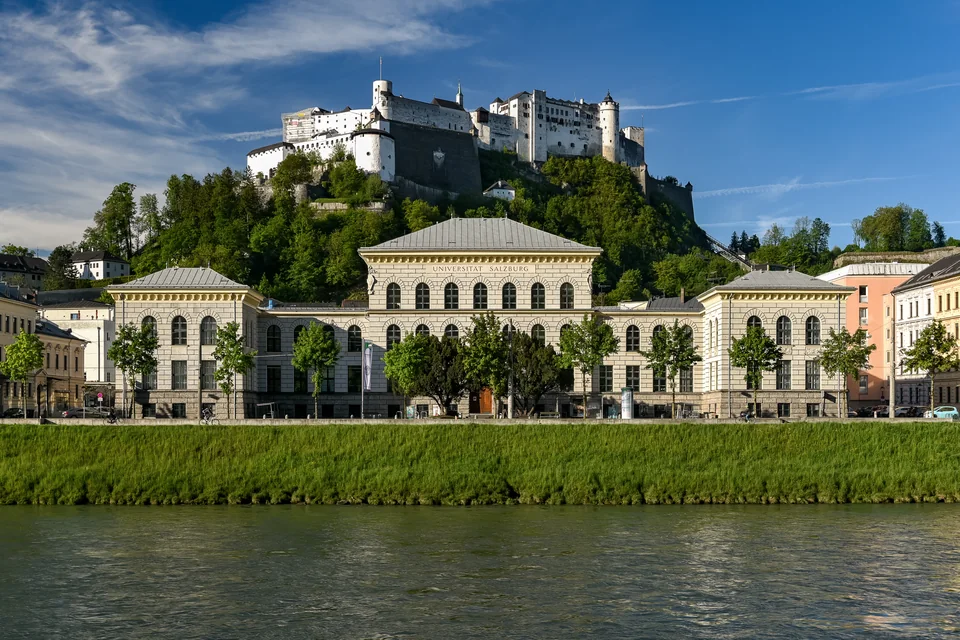
| At a glance | Details |
|---|---|
| Official name | Paris Lodron Universität Salzburg (PLUS) |
| History | founded in 1622 by Prince-Archbishop Paris Lodron, re-established in 1962 |
| Size | 6 faculties, 34 departments, about 90 programmes, almost 18,000 students |
| Non-EU fees in 2026/27 | $850 (€752.92) per semester: $830 (€726.72) tuition + $30 (€26.20) ÖH fee |
| Bachelor's language | German; B2 required for admission |
| English-taught master's | 17 programmes listed in September 2026 |
| Non-EU deadline | complete file by 10 Aug 2026 (winter) and 10 Jan 2027 (summer) |
| Semester start | 1 October and 1 March |
Four universities in one city: which one is PLUS?
Salzburg has several institutions with similar names, and the choice decides the admission route, language and cost.
| Institution | Type | Typical reason to choose it |
|---|---|---|
| Paris Lodron Universität Salzburg (PLUS) | public comprehensive university (this page) | law and business, psychology, computer science, data science, biology, humanities, social sciences |
| Universität Mozarteum Salzburg | public university of the arts | music, drama and arts education, with artistic entrance examinations |
| Fachhochschule Salzburg (FH Salzburg) | university of applied sciences | practice-oriented degrees with their own selection and fixed places |
| Paracelsus Medical Private University | private medical university | medicine; PLUS has no degree that qualifies you as a doctor |
PLUS does offer a Bachelor's in Medical Biology and a Master's in Medical Biology, but both train researchers, not physicians. For the route to a medical degree, read our guide to studying medicine in Austria and the MedAT.
Faculties and main subject areas
The six faculties are Digital and Analytical Sciences, Natural and Life Sciences, Social Sciences, Law, Business and Economics, Cultural Sciences, and Catholic Theology. The 2026/27 programme list shows where choice is broadest:
- computing and data: Bachelor's in Computer Science and in Artificial Intelligence; Master's in Data Science, Computer Science and Human-Computer Interaction;
- life sciences: biology, molecular biosciences, medical biology, and Nutrition–Exercise–Health;
- society and politics: psychology, political science, communication, sociology, education, and Philosophy, Politics and Economics;
- law and business: the Law and Business programme (LLB.oec. at bachelor's level, LLM.oec. at master's level) and a Master's in Economics;
- languages and culture: German, English, Romance and Slavonic studies, linguistics, history, art history, and musicology and dance studies.
Teacher education is coordinated by the School of Education, where students combine two of 26 school subjects. PLUS is a member of the CIVIS European university alliance, which gives students a structured route to semesters at partner universities.
English-taught programmes
The university's bachelor's list contains no English-taught degree. Even the new Artificial Intelligence bachelor's page does not name English as the language of instruction, so plan for German.
At master's level, programme pages in September 2026 list English as the language of instruction for:
| Field | English-taught master's programmes |
|---|---|
| Data and digital technology | Data Science, Computer Science (Dipl.-Ing.), Human-Computer Interaction, Applied Image and Signal Processing |
| Geoinformatics and earth sciences | Applied Geoinformatics, Copernicus Master in Digital Earth, Geography, TRACEE (Transdisciplinary Studies of Climate, Environment and Energy) |
| Biology and materials | Molecular Biology, Medical Biology, Ecology and Evolution, Chemistry and Physics of Materials, Science and Technology of Materials |
| Social sciences | Political Science, Political Science – Integration & Governance, European Union Studies, Philosophy |
An English programme title does not always mean English teaching: Religious Studies, for example, is taught in German. Proof of English must come from the university's list of accepted certificates, or from C1-level English recorded on a school-leaving certificate; Applied Geoinformatics and Philosophy explicitly name C1. For how Austrian master's admission works in general, see our guide to master's degrees in Austria.
Applying for a bachelor's degree with a non-EU school certificate
Austria has no central application system. You apply to the university itself (Antrag auf Zulassung), and the Office of Admissions reviews each file individually; the university warns that this can take several months.
- Check programme-specific conditions. Psychology, teacher education and sport science have their own admission procedures and dates. Biology and Applied Environmental and Geosciences require at least four weekly hours of biology from year 9 onwards. Some humanities degrees require Latin or Ancient Greek, which in most cases can be completed during your studies.
- Prepare documents. Documents from countries in the Hague Apostille Convention, which include Russia and Kazakhstan, need an apostille. Anything not in German needs a sworn translation, including the apostille itself; if the translation is made outside Austria, the translator's signature must also be certified. Documents in English are accepted without translation.
- Prove your German. B2 lets you start the degree immediately. With A2, the university sets a supplementary German examination (Ergänzungsprüfung) and admits you to the VPLUS preparatory course.
- Meet the non-EU deadline. For winter semester 2026/27, the complete file had to arrive by 10 August 2026; for summer semester 2027, the deadline is 10 January 2027. Complete means every required document has reached the university, not just the online form.
- Book your enrolment appointment. After a positive decision you book a slot online and enrol in person; booking opens in early July for the winter semester and in early January for the summer semester.
How Austrian universities assess an 11-year school certificate, national exam results and supplementary exams is covered in our guide to applying to universities in Austria. For the bachelor's system as a whole, see bachelor's degrees in Austria.
VPLUS, the university's preparatory course
VPLUS (Vorstudienlehrgang der Paris Lodron Universität Salzburg) is a university German course run by the Department of German Studies. It admits only applicants who already hold an admission decision with a supplementary German exam, and takes them from A2 to B2. The course runs for three semesters and costs $970 (€850) per semester in 2026/27. Enrolment in VPLUS can support a student residence permit, but the course office does not advise on visas. For how university-run courses compare with Vienna's VWU, see our guide to the Vorstudienlehrgang preparatory programme.
Master's and doctoral admission
Master's admission requires a relevant bachelor's degree; the university compares curricula case by case and may set additional coursework. Non-EU applicants face the same early deadline of 10 August or 10 January. Some programmes add their own selection: Data Science expects a degree in computer science, mathematics or statistics, may admit graduates of other fields on condition of up to 45 ECTS of additional work, and selects candidates on the basis of the documents submitted.
Doctoral programmes last six semesters and require a relevant master's or equivalent degree. A dissertation in English is possible when the supervisor agrees.
Key dates for 2026/27
| Step | Winter semester 2026/27 | Summer semester 2027 |
|---|---|---|
| Complete file from non-EU applicants | by 10 August 2026 | by 10 January 2027 |
| General admission period for bachelor's | until 5 September 2026 | until 5 February 2027 |
| Admission to master's and doctoral programmes | until 31 October 2026 | until 31 March 2027 |
| First-semester payment (bachelor's) | by 5 September 2026 | by 5 February 2027 |
| Teaching starts | 1 October 2026 | 1 March 2027 |
Some of these dates have passed. PLUS publishes the winter 2027/28 deadlines on its "Fristen und Termine" page; if the pattern holds, non-EU files will again be due in early August 2027, so aim to be ready in spring.
Costs
| Item | Amount | What it covers |
|---|---|---|
| Non-EU tuition fee, 2026/27 | $830 (€726.72) per semester | charged for the whole degree; the fee-free period for EU citizens does not apply |
| ÖH student union fee, 2026/27 | $30 (€26.20) per semester | union membership and accident insurance; paid by everyone |
| Total for the 2026/27 academic year | $1,710 (€1,505.84) | tuition and ÖH fee for both semesters |
| VPLUS, 2026/27 (if required) | $970 (€850) per semester, three-semester course | German preparation and exam |
| Living costs (OeAD guideline, September 2026) | about $1,480 (€1,300) per month | residence hall $510–790 (€450–700), food about $340 (€300), other about $570 (€500) |
| Funds for the residence permit, 2026 | $820 (€722.58) per month under 24, $1,490 (€1,308.39) from 24 | shown for 12 months in advance |
Fees are due each semester by 31 October or 31 March. A bank transfer can take up to five working days, the university cannot speed it up, and instalments are not possible. Our guides to paying for studies abroad from Russia and to the cost of studying in Austria cover the full budget. Scholarship options for non-EU students are summarised in scholarships in Austria.
Residence permit and arrival
Stays longer than six months require a student residence permit (Aufenthaltsbewilligung Studierender). Russian citizens file the first application in person at the Austrian Embassy in Moscow; external visa service providers do not accept it. The decision is made by the immigration authority of the state of Salzburg, not by the university. An admission to VPLUS can also serve as the basis for a permit. Documents and timing are covered in our guide to student visas and residence in Austria.
Russian applicants often ask whether they could be removed from their studies because of their citizenship. The university's own FAQ answers this directly: not automatically.
Housing
The university points students to two resources of the ÖH Salzburg student union: a list of all student residences in the city and a housing exchange. Apply for a residence place as soon as you receive your admission decision, because proof of accommodation is required for the residence permit. OeAD estimates a room in a student residence in Austria at $510–790 (€450–700) per month, depending on the city and what the rent includes.
Is PLUS the right choice?
- Good fit if you want an English-taught master's in data, geoinformatics, biology or political science in a smaller city that is cheaper than Vienna.
- Good fit if you will reach B2 German and want a bachelor's in law and business, psychology, German studies or communication.
- Look elsewhere for an English-taught bachelor's: the University of Klagenfurt offers six.
- Look elsewhere if you want to become a doctor: that route runs through the MedAT and a medical university such as the Medical University of Vienna.
- Look elsewhere for music or drama, which belong to the Mozarteum.
Comparable Austrian universities include the University of Graz, the University of Innsbruck and the University of Vienna.
Common mistakes
- Submitting the online form and sending documents after 10 August; for non-EU applicants the file then counts as incomplete.
- Confusing PLUS with FH Salzburg or the Mozarteum and preparing for the wrong selection.
- Translating a certificate without an apostille, or leaving the apostille untranslated.
- Expecting an English-taught bachelor's.
- Waiting for the admission decision before looking for housing, although the residence permit needs an accommodation document.
- Paying the semester fee by bank transfer on the last day.
FAQ
How much does the University of Salzburg cost for non-EU students?
In 2026/27, $850 (€752.92) per semester: $830 (€726.72) in tuition for non-EU nationals and $30 (€26.20) for the ÖH student union. That is $1,710 (€1,505.84) per academic year, before accommodation and living costs.
What level of German do I need?
To start a German-taught degree straight away you need a B2 certificate. With A2 you can still apply: the university sets a German supplementary exam, taken through the VPLUS course at $970 (€850) per semester in 2026/27.
Does the University of Salzburg teach in English?
Not at bachelor's level. Seventeen master's programmes are taught in English, including Data Science, Human-Computer Interaction, Applied Geoinformatics, Molecular Biology, Political Science and European Union Studies.
When is the application deadline for non-EU applicants?
The complete file must arrive by 10 August for the winter semester and by 10 January for the summer semester. The later general admission dates (5 September, 31 October) do not replace this earlier deadline for non-EU applicants.
Can I study medicine at the University of Salzburg?
No degree at PLUS leads to qualification as a physician. The Medical Biology bachelor's and master's are research-oriented. In Salzburg, doctors are trained at the private Paracelsus Medical University; public medical universities admit through the MedAT test.
How is PLUS different from the Mozarteum?
They are separate universities. PLUS covers law, business, sciences, social sciences and humanities. The Mozarteum is a university of the arts where admission depends on an artistic entrance examination in music, drama or visual arts education.
Can StudyU help with an application to Salzburg?
Programme selection, a check of your school certificate and language level, document preparation and legalisation, a timeline that meets the 10 August deadline and a budget plan are provided under an agreement with StudyU. The university decides on admission, and the immigration authority of the state of Salzburg decides on the residence permit.
Sources
- University of Salzburg: dates and deadlines 2026/27
- Admission requirements for bachelor's and diploma programmes
- Information for international applicants: legalisation, translation, language
- List of bachelor's and master's programmes
- Tuition and ÖH fee payment
- Office of Admissions FAQ
- VPLUS preparatory course
- Study in Austria: tuition fees and living costs
- Austrian Embassy Moscow: residence permits
Dollar figures use the ECB reference rate of 29 September 2026 (€1 = $1.1355), the most recent rate when sources were checked on 30 September 2026. The $830 (€726.72) tuition fee for third-country nationals is confirmed on Austrian public universities' fee pages as of the same date. For other universities and general rules, see studying in Austria.
Next steps
- Bachelor's Degree in Austria for International Students: Formats, Language, Full Cost and Timeline
- Master's Degree in Austria for International Students: Degree Requirements, English-Taught Programmes, Deadlines and Costs
- Scholarships in Austria for International Students: What Is Actually Available in 2026/27
- University of Klagenfurt (Universität Klagenfurt, AAU)
- How to Pay for Studies Abroad from Russia: What Works in 2026
- Studying Medicine in Austria as an International Student: MedAT, the 5% Quota, German C1 and the Preparation Year
