
Johns Hopkins University is a private research university in Baltimore, Maryland, founded in 1876. It is joint 20th in the QS World University Rankings 2027, joint 17th in the THE World University Rankings 2027 and 23rd in the 2026 Academic Ranking of World Universities (ARWU). First-year applicants use the Common App or Coalition on Scoir; for fall 2027 entry, Early Decision I closes on November 1, 2026 and Regular Decision on January 2, 2027. The SAT or ACT is required this cycle. The 2026–27 first-year cost of attendance is $94,858, plus $3,624 for the university health plan, which students on F-1 visas cannot waive. Hopkins meets the full demonstrated need of admitted international students, but it is need-aware for them, so asking for aid affects the admission decision.
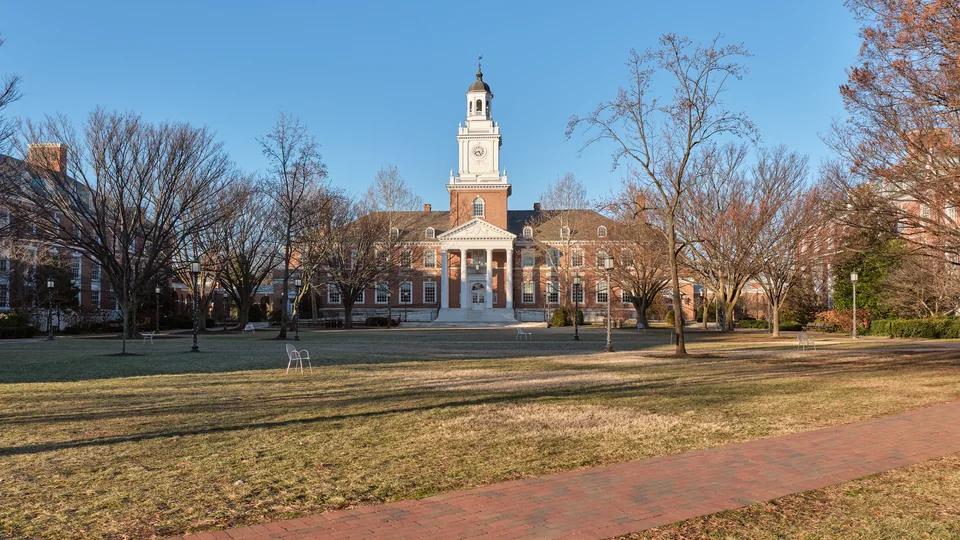
| At a glance | Details |
|---|---|
| Location | Baltimore, Maryland; undergraduates study on the Homewood campus, about 30 minutes from BWI airport |
| Founded | 1876 |
| Undergraduates | about 5,600, including 1,000+ international students from 80+ countries |
| Rankings | QS 2027: =20; THE 2027: =17; ARWU 2026: 23 |
| Undergraduate schools | Krieger School of Arts & Sciences and Whiting School of Engineering; Peabody Institute runs its own admissions |
| Application | Common App or Coalition on Scoir, $70 fee |
| Fall 2027 deadlines | ED I: November 1, 2026; ED II and Regular Decision: January 2, 2027 |
| SAT/ACT | required |
| English | test recommended; competitive range is IELTS 7.0 in every band or TOEFL iBT 5+ on the new scale |
| First-year cost, 2026–27 | $94,858 including $68,670 tuition; health plan $3,624 on top |
| Aid for international students | 100% of demonstrated need met without loans; need-aware review |
| Housing | on campus required for the first two years |
Who Hopkins suits, and who should look elsewhere
| Strengths | Trade-offs |
|---|---|
| Research access from year one: the university reports that 80% of undergraduates complete at least one research experience | Your application will not be reviewed without an SAT or ACT score |
| Admitted international students who asked for aid receive loan-free packages covering full need | Only about 10% of international students receive aid, and the request counts in admission |
| You can switch majors after enrolling, with one exception | Biomedical Engineering (BME) must be listed as your first-choice major |
| Most of the class is admitted through ED I and ED II | Early Decision is binding, so you cannot compare offers |
| First-year applicants can also apply to one master's program through a Direct Matriculation Program | From junior year, students rent apartments off campus |
Hopkins fits applicants aiming at biology and neuroscience, biomedical engineering, public health, international relations or applied mathematics who can show that interest through projects, not just grades. If your family needs substantial aid, balance the list: Harvard reviews international applicants need-blind, while Duke runs a similar need-aware process. For the wider picture, see our guide to studying in the USA.
Schools and majors
Applicants to Arts & Sciences and Engineering are admitted to the university as a whole. After enrolling you may choose any major in the Krieger or Whiting schools; the intended major on your application is not binding. Hopkins lists more than 100 majors and minors.
Biomedical Engineering is the exception. It must be your first-choice major, and admission to BME is decided separately. You can be admitted to Hopkins but not to BME, and students who were not admitted to the major, or did not apply to it, cannot select it later.
The Peabody Institute, Hopkins' conservatory, has its own application and audition process. Graduate and professional schools — including the Bloomberg School of Public Health, the School of Medicine, Nursing, the Carey Business School, Education and SAIS for international affairs — admit students separately.
First-year applicants can also apply to one Direct Matriculation Program, which reserves a place in a master's degree in International Health, International Relations or the MBA. If accepted, you move on to the master's program without another application or entrance exam. The short DMP essay is submitted in the applicant portal after the main application.
How the first-year application works
International applicants follow the same process and deadlines as everyone else. The differences are the financial forms and document translations.
Required materials
- Common App or Coalition on Scoir application with the personal statement, activities list and Hopkins supplement. The $70 fee can be waived through the application or a Hopkins fee-waiver form.
- Hopkins essay, 350 words. The 2026–27 prompt asks what you have learned from engaging across differences and how it shapes the way you build community and work with others.
- Secondary School Report with the counselor recommendation, transcript and school profile, submitted by a school official.
- Two teacher evaluations from teachers of different academic subjects.
- Mid-year report for the first half of senior year, usually due in mid-February.
- International Certification of Finances (COF). Every international applicant must submit it; the form appears in the portal after you apply and is due by your plan's deadline.
- Academic records equivalent to US grades 9–11, with verified English translations.
Optional extras include an additional recommendation, a résumé, a Schoolhouse.world portfolio and updates on achievements. Hopkins does not offer interviews.
SAT or ACT is required
Hopkins requires the SAT (Math and Evidence-Based Reading and Writing) or the ACT (Math, Reading and English). You may self-report scores and send official reports only if you enroll. The university superscores: it combines your highest section scores across test dates. ACT Science and Writing are optional and are not part of the superscore.
Hopkins recommends finishing testing by October of senior year for Early Decision and by December for Regular Decision; if you plan a later sitting, say so on the application. Our guide on choosing between the SAT and ACT covers the formats. Applicants in Russia should look up test centres on the College Board and ACT sites early and leave time for a retake.
English proficiency
An English test is recommended if English is not your primary language or you have not attended an English-medium school for the past three years. Hopkins particularly encourages a score if your SAT reading and writing result is below 690, or if both your ACT Reading and English scores are below 30.
| Test | Competitive profile |
|---|---|
| TOEFL iBT (new 1–6 scale) | 5 overall; preferred 5.5 in Reading and Listening, 5 in Writing and Speaking |
| IELTS | 7.0 in each band |
| Duolingo English Test | 120 overall; preferred Literacy 125, Conversation 120, Comprehension 135, Production 105 |
| Cambridge C1 Advanced or C2 Proficiency | 185 or higher |
Fall 2027 deadlines and timeline
| Step | ED I | ED II | Regular Decision | Transfer |
|---|---|---|---|---|
| Application | November 1, 2026 | January 2, 2027 | January 2, 2027 | March 1, 2027 |
| Financial aid documents | November 15, 2026 | January 15, 2027 | January 15, 2027 | March 15, 2027 |
| Decision release | December 11, 2026 | February 12, 2027 | March 24, 2027 | May 14, 2027 |
| Reply by | January 15, 2027 | February 26, 2027 | May 1, 2027 | June 1, 2027 |
Early Decision is binding. The agreement is signed by you, a parent or guardian and your counselor, and if admitted you withdraw your other applications. Hopkins states openly that it historically admits most of its class through Early Decision. ED I applicants can be admitted, denied or deferred to Regular Decision.
A realistic sequence:
- By late summer 2026: take the SAT or ACT and an English test, decide whether you will request aid, and choose ED I, ED II or Regular Decision.
- September–October: ask two teachers for recommendations, arrange translated records with your school, and write the personal statement and Hopkins essay.
- By November 1 or January 2: submit the application (and the ED agreement if applicable), then complete the COF in the portal.
- By November 15 or January 15: submit the CSS Profile and your family's tax documents if you are applying for aid.
- Mid-February: mid-year grades.
- After admission: proof of funding for the I-20, the F-1 visa and your final school certificate.
Admission statistics
For fall 2025 entry (the Class of 2029), Hopkins received 49,112 applications and enrolled 1,297 students. The middle 50% SAT range of enrolled students was 1530–1570 and the ACT middle score was 35; 99% ranked in the top 10% of their class. International students made up 13.5% of the entering class. The fast-facts page does not publish an admit rate, so we do not calculate one. These figures describe the pool, not any individual applicant's prospects.
Cost of attendance
| First year, 2026–27, living on campus | Amount |
|---|---|
| Tuition (12+ credits per semester) | $68,670 |
| One-time matriculation fee | $500 |
| Housing | $13,073 |
| Meals | $8,894 |
| Personal expenses | $1,606 |
| Books and supplies | $1,377 |
| Transportation (average) | $738 |
| Total cost of attendance | $94,858 |
| Student health insurance (cannot be waived on F-1) | $3,624 |
The sophomore on-campus budget is $95,729 because housing costs more, though there is no matriculation fee. Juniors and seniors live off campus; the official off-campus estimate is $12,040 for rent and utilities and $3,802 for groceries over nine months, for a total of $88,233. Add international flights and visa costs. For multi-year budgeting, see our guide to the cost of studying in the USA.
Financial aid for international students
Hopkins offers need-based and merit scholarships to international applicants, but both are limited.
- Need-aware review. For international citizens who apply for aid, finances are considered in the admission decision. US citizens and permanent residents are reviewed need-blind.
- Full need met. Admitted international students with aid receive loan-free packages covering the gap between the cost of attendance and what the family can pay.
- About 10% of international students receive aid, according to the university's international FAQ.
- One chance to apply. International students who do not apply for aid as first-year applicants cannot apply later, even if family circumstances change. International transfer students are not offered aid.
- Forms. You need the COF and the CSS Profile. If you cannot complete the CSS Profile, Hopkins accepts its free Johns Hopkins University International Student Financial Aid Application instead.
- Automatic renewal. Aid awarded in the first year renews without a new application.
- Merit awards. A small number go to international students each year; everyone is considered automatically.
The university decides on admission and on the size of any award. Our overview of financial aid for international students in the USA explains how to compare these policies across universities.
Graduate, medical and professional study
There is no single graduate application; each school sets its own deadlines, tests and fees, so check the relevant school directly. This profile focuses on undergraduate entry.
Medicine in the US is graduate-level: students complete a bachelor's degree with the required science courses, take the MCAT and then apply to medical school. Hopkins reports that 85% of its applicants to medical school are admitted. Our guide to medical school in the USA explains the route.
Living at Hopkins
All undergraduates live on the Homewood campus for their first two years. First-year students choose among five halls: traditional buildings with hallway bathrooms (AMR I and AMR II) and suite-style halls with two or three bedrooms (AMR III, Wolman and McCoy). There are seven dining locations and the new Bloomberg Student Center. Juniors and seniors move into nearby apartments, with support from the Office of Off-Campus Housing.
Baltimore is a train ride from Washington, DC, and BWI airport is close to the city, which helps with trips home and internships in the capital. For renting after the residence halls, see our guide to student housing in the USA.
F-1 visa and work
The Office of International Services (OIS) issues the I-20 after you accept your offer and document your funding. You then pay the SEVIS fee ($350) and the visa application fee ($185; amounts as of September 30, 2026, so confirm them and any new fees on the embassy site before paying) and book an interview. The US Embassy in Moscow no longer offers routine visa services, and Russian citizens are directed to the embassies in Warsaw or Astana; F-1 applicants are asked to set their social media profiles to public. The consulate decides on the visa. Our F-1 student visa guide walks through the steps.
On-campus jobs, CPT, OPT and the STEM OPT extension are covered in our guide to working while studying and OPT. At Hopkins, OIS handles the paperwork.
Notes for applicants from Russia and Kazakhstan
- A Russian or Kazakh school certificate is accepted for first-year entry, but you must send records for the years equivalent to US grades 9–11 with verified translations.
- If your school does not use GPAs or class rank, leave those fields blank; Hopkins says this does not disadvantage you.
- Missing SAT or ACT scores is the main risk, because the test is required. Plan any trip to a test centre well ahead.
- Tuition must be paid through legal channels; our guide on how to pay for studies abroad from Russia sets out the options.
- If you are finishing an 11-year school, read our guide to US universities after 11 years of school.
University shortlisting, a testing plan, essay coaching, financial forms and visa preparation are provided under an agreement with StudyU. Johns Hopkins University decides on admission and aid, and the US consulate decides on the visa.
Common mistakes
- Not requesting aid on the first-year application. International students get no second chance.
- Applying without the SAT or ACT. Testing is required at Hopkins.
- Listing BME as a second choice. You will not be considered for the major at all.
- Skipping the COF. An international application is incomplete without it.
- Waiting for an interview. Hopkins does not interview, so your essays and recommendations must carry the story.
- Choosing Early Decision without a budget. The commitment is binding and you only see the aid offer with your admission.
- Transferring from a home-country university expecting aid. International transfers are not eligible.
Rankings
| Ranking | Position |
|---|---|
| QS World University Rankings 2027 | =20 |
| THE World University Rankings 2027 | =17 |
| ARWU 2026 | 23 |
ARWU weighs research output heavily, while QS relies more on reputation surveys, which explains the gaps. For an undergraduate decision, programs and admission rules matter more than a few places either way.
FAQ
Can I apply to Johns Hopkins straight after finishing school in Russia or Kazakhstan?
Yes. A completed secondary school certificate allows you to apply as a first-year student. You need records for the years equivalent to US grades 9–11 with verified translations, SAT or ACT scores and the COF.
Is the SAT required at Johns Hopkins?
Yes. First-year applicants must submit the SAT or ACT. Hopkins superscores section results across test dates and accepts self-reported scores, with official reports required only after you enroll.
How much does a year at Johns Hopkins cost?
The 2026–27 first-year cost of attendance is $94,858, including $68,670 tuition. Students on F-1 visas also pay $3,624 for the university health plan, which they cannot waive.
Does Johns Hopkins give financial aid to international students?
Yes, but it is need-aware for international applicants who request aid. Admitted students have their full demonstrated need met without loans; about 10% of international students receive aid.
Does Johns Hopkins interview applicants?
No. Hopkins does not offer interviews or one-on-one meetings, so your essays, recommendations and activities list must explain everything the committee needs to know about you.
Can I change my major after enrolling?
Yes, you can choose any major in the Krieger or Whiting schools. The exception is Biomedical Engineering, which is open only to students admitted to it after listing it as their first choice.
Where do students live?
For the first two years, residence halls on the Homewood campus are mandatory for every undergraduate. Juniors and seniors typically rent apartments within about three blocks of campus.
Sources
- Johns Hopkins Admissions: Application Deadlines & Requirements
- Johns Hopkins Admissions: Standardized Testing
- Johns Hopkins Admissions: International Applicants
- Johns Hopkins Admissions: Frequently Asked Questions
- Johns Hopkins Admissions: Fast Facts
- Johns Hopkins Admissions: Estimate Your College Costs
- Student Financial Support: Cost & Tuition 2026–27
- Johns Hopkins Admissions: Living at Hopkins
- Johns Hopkins Admissions: Majors, Minors & Programs
- US Embassy in Russia: Visas
- ICE: I-901 SEVIS Fee
- US Department of State: Visa Fees
- QS World University Rankings 2027
- THE World University Rankings 2027
- ShanghaiRanking ARWU 2026
All amounts are in US dollars as published by the university; checked on September 30, 2026. More US universities are listed on our study in the USA page. To find out whether Hopkins fits your profile and budget, and which application plan makes sense, send us a request.
During the free initial consultation, we clarify your goal, profile, timing, and budget and identify the next realistic step.
