
A student from outside the EU can apply to Bulgarian public universities, dedicated medical universities and a handful of private institutions. Language usually decides the shortlist: the bulk of degree teaching is in Bulgarian, so without it your realistic options are English-taught medicine, dentistry and pharmacy, around ten English programmes at Sofia University, and the private AUBG and NBU. For the 2026/27 academic year, published fees for non-EU students start at $3,750 (€3,300) a year at Sofia University and reach $15,670 (€13,800) at the American University in Bulgaria.
This guide covers the types of institution, named universities with their official fees, how to check accreditation, and a goal-by-goal shortlist. Bulgaria adopted the euro on 1 January 2026, so universities now publish fees in euros; older lev amounts convert at the fixed rate of 1.95583. For a general overview, see studying in Bulgaria.
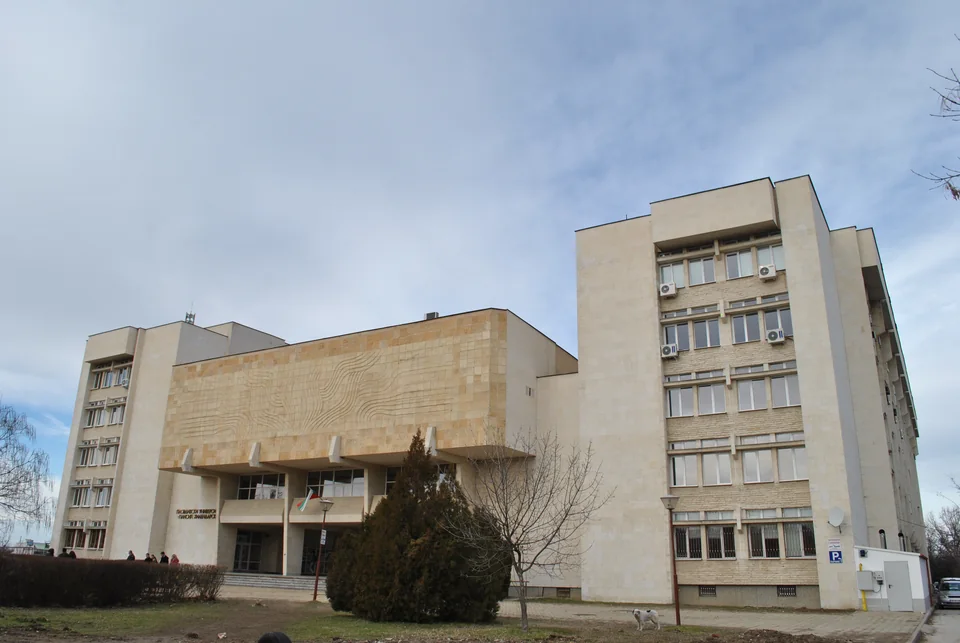
Types of higher education institutions in Bulgaria
Bulgaria's Higher Education Act recognises three kinds of institution, and the type determines which degrees they may award.
| Type | Degrees | Examples | What it means for you |
|---|---|---|---|
| University, including medical universities | bachelor's, master's, doctorate | Sofia University St. Kliment Ohridski, Plovdiv University, MU-Sofia, MU-Plovdiv, MU-Varna, MU-Pleven | classical universities have the widest choice; medical universities run English-taught medicine, dentistry and pharmacy |
| Specialised higher school | narrow profile such as arts, sport or architecture | national academies of arts and sport | mostly taught in Bulgarian, often with creative or sports tests |
| College | professional bachelor's, three years | colleges attached to universities, including medical colleges | taught in Bulgarian; a master's afterwards may be closed to you |
Private institutions exist in every category. The two best known among international students are the American University in Bulgaria (AUBG) in Blagoevgrad and New Bulgarian University (NBU) in Sofia. Being private is neither a quality mark nor a warning sign; accreditation and the specific programme matter more.
What Bulgarian universities charge international students
Annual fees for citizens of countries outside the EU/EEA. Public universities set them by rector's order under a Council of Ministers decision (for 2026/27, Decision No. 438 of 3 June 2026); private universities set their own.
| University, city | Field | Annual fee | Year and notes |
|---|---|---|---|
| Sofia University (SU), Sofia | economics, management, tourism, law, philosophy, sociology, education | $3,750 (€3,300) | 2026/27, full-time, bachelor's and integrated master's |
| SU | mathematics, statistics, data analysis | $4,040 (€3,560) | 2026/27 |
| SU | informatics, computer science, software engineering | $4,560 (€4,020) | 2026/27 |
| SU | biology / physics / chemistry | $5,000 (€4,400) / $5,620 (€4,950) / $5,960 (€5,250) | 2026/27 |
| SU | medicine in Bulgarian or English / pharmacy | $9,080 (€8,000) / $6,810 (€6,000) | 2026/27 |
| MU-Sofia | medicine in Bulgarian or English / dentistry in English / pharmacy | $11,300 (€9,950) / $11,360 (€10,000) / $9,080 (€8,000) | 2026/27 |
| MU-Varna | medicine and dentistry in English / pharmacy in English | $11,360 (€10,000) / $9,080 (€8,000) | 2026/27, first year |
| MU-Plovdiv | medicine and dentistry / pharmacy (all three taught in English) | $11,360 (€10,000) / $7,040 (€6,200) | 2026/27, first year |
| MU-Pleven | medicine in English | $10,220 (€9,000) | 2026/27 |
| AUBG, Blagoevgrad | bachelor's in business, economics, computer science and more | $15,670 (€13,800) | 2026/27, before financial aid |
| NBU, Sofia | bachelor's | $5,920–7,660 (€5,215–6,749) | range shown on the university page on 29 Sept 2026; no academic year stated |
Three things stand out:
- The same subject is priced differently at different institutions. For 2026/27, medicine at Sofia University costs $2,210 (€1,950) a year less than at MU-Sofia.
- At medical universities the English track costs the same as the Bulgarian one or more. MU-Sofia charges $7,440 (€6,550) for dentistry in Bulgarian and $11,360 (€10,000) in English.
- Non-EU fees are many times higher than what state-funded Bulgarian and EU students pay. At Sofia University a state-funded medical student pays $550 (€480) a year; a fee-paying non-EU student pays $9,080 (€8,000). Who qualifies for the Bulgarian rate: see free education in Bulgaria.
Tuition is only part of the budget. For the full first-year and whole-degree picture, see the cost of studying in Bulgaria.
Sofia University: the widest choice, mostly in Bulgarian
Bulgaria's oldest university, Sofia University St. Kliment Ohridski, also offers the widest range of subjects. QS placed it in the 751–760 band for 2027.
Its 2026/27 fee order marks these programmes as taught in English or a foreign language: international trade and investment; accounting, finance and digital applications; media pedagogy and artistic communication; African studies; philosophy; nuclear and particle physics; quantum physics and nuclear and particle physics; informatics in a foreign language; medicine; and pharmacy — ten programmes in all. Climate Change and Management appears with an English title, so confirm its teaching language with admissions. The international admissions page also lists European Union and European Integration as taught in English. Everything else is taught in Bulgarian. For those programmes the university runs a preparatory language course priced at $3,970 (€3,500) for 2026/27, and half of it is due before the enrolment certificate for the course is issued.
See our full Sofia University profile.
Medical universities: the main reason students choose Bulgaria
English-taught medicine, dentistry and pharmacy are offered by MU-Sofia, MU-Plovdiv, MU-Varna and MU-Pleven, and medical faculties also operate at Sofia University and Trakia University in Stara Zagora. The programmes are integrated: medicine and dentistry take six years, pharmacy five, and graduates receive a master's degree.
Entrance tests in biology and chemistry, plus an English check, set medicine apart. MU-Plovdiv and MU-Sofia calculate the competition score the same way: three times the biology mark plus three times the chemistry mark plus the English mark, for a maximum of 42. Cut-offs move a lot within one cycle: MU-Plovdiv's lowest admitted score for medicine was 39.12 in April 2026 and 25.89 in late September. Exam dates, preparation and a school-by-school comparison are in our guide to medicine in Bulgaria, with profiles of MU-Sofia and MU-Varna.
Private universities: AUBG and NBU
These two are worth a look if you want a non-medical degree taught in English.
- AUBG (Blagoevgrad) follows the American liberal arts model and teaches entirely in English. For 2026/27 it lists tuition of $15,670 (€13,800) before financial aid, campus housing from $2,100 (€1,850) per academic year, a $730 (€640) student activity fee and a $100 (€90) health insurance fee. AUBG decides financial aid itself, so only its individual offer shows your real price.
- NBU (Sofia) is a private university that charges per semester. For non-EU students it lists $5,920–7,660 (€5,215–6,749) a year and states that the fee stays the same for the whole course. The admissions office confirms the exact figure for each programme.
How to check that a university and programme are accredited
It takes half an hour, and skipping it can cost a year of study plus fees already paid.
- The institution is in the Register of Higher Education Institutions. NACID, the National Centre for Information and Documentation under the Ministry of Education and Science, maintains it. It lists faculties, branches, accredited fields and programmes, and the accreditation grade and term.
- The programme you want is open at that university in that language. The fee order for foreign students names programmes one by one. If the order has no English version of a programme, there is probably no fee-paying English intake that year; confirm by email with admissions.
- The university can issue the certificate for a D visa. For non-EU applicants this is an electronic Ministry of Education certificate that the university requests through the NACID system after approving you. Without it the consulate will not issue a study visa; see our Bulgaria student visa guide.
Which university fits which goal
| Goal | Where to look | What to check |
|---|---|---|
| Doctor or dentist, taught in English | MU-Sofia, MU-Plovdiv, MU-Varna, MU-Pleven, SU Faculty of Medicine | exam dates open to non-EU applicants, six-year fees, clinical training city |
| Business, economics or IT in English | SU English programmes, AUBG, NBU | whether the programme is in the fee order; total cost for the degree |
| Widest range of subjects | Sofia, Plovdiv and other public universities | willingness to spend a year on Bulgarian and the preparatory course fee |
| Lowest tuition | humanities and social sciences at public universities | $3,750 (€3,300) a year at SU, plus a preparatory year for Bulgarian-taught study |
| Bulgarian-rate fees | public universities under Decree No. 103 | only for people of Bulgarian ethnic origin; see free education in Bulgaria |
Language: English, Bulgarian or a preparatory year
For Bulgarian-taught programmes, universities test your Bulgarian or send you to a preparatory year. Prices for 2026/27:
| University | Preparatory course | Price |
|---|---|---|
| Sofia University | Bulgarian | $3,970 (€3,500) |
| MU-Sofia | Bulgarian or English, 1,000 teaching hours | $4,200 (€3,700) / $5,450 (€4,800) |
| MU-Varna | Bulgarian or English, nine months | $5,680 (€5,000) |
| MU-Pleven | English | $4,540 (€4,000) |
At medical universities the preparatory year is more than language training. MU-Plovdiv's course covers biology, chemistry, physics and Latin, and students who complete it may continue straight into the programme they listed first.
English-taught programmes skip the preparatory year but expect strong English and, for medicine, entrance tests. MU-Varna, for instance, accepts IELTS Academic 6.5 or TOEFL iBT 90.
Cities: where to study
- Sofia: the capital and the most expensive city, home to SU, MU-Sofia, the Technical University and NBU.
- Plovdiv: the second-largest city, with the Medical University and Plovdiv University.
- Varna: on the Black Sea coast, with the Medical University. MU-Varna estimates private rent for a room or flat at 500–700 leva a month, or $290–410 (€256–358) at the fixed rate.
- Pleven: a small northern city. Its Medical University puts minimum living costs at $570 (€500) a month.
- Blagoevgrad: in the south-west, home to AUBG and South-West University.
The European Commission estimates student living costs in Bulgaria at $570–1,020 (€500–900) a month, covering housing, food, transport and personal spending.
Common mistakes when choosing a university
- Ranking before language. A high ranking is useless if your subject is only taught in Bulgarian.
- Comparing "from" prices. Sofia University starts at $3,750 (€3,300), but sciences and medicine cost 1.3 to 2.4 times more.
- Forgetting the preparatory year, which adds a year of fees and living costs.
- Relying on old lev figures. If a university document still shows leva, divide by 1.95583.
- Applying through an agent the university does not recognise. For 2026/27 MU-Sofia says plainly that no private company recruits on its behalf and that nobody is authorised to represent it.
FAQ
NACID's Register of Higher Education Institutions lists every accredited institution and programme. For a non-EU applicant the practical list is shorter: universities whose fee order for foreign students includes your programme in the language you need.
Yes, on English-taught programmes: medicine, dentistry and pharmacy at the medical universities, the English programmes at Sofia University, AUBG and NBU. Bulgarian-taught programmes become an option after a university preparatory language year.
Sofia University is the Bulgarian name you will see most often in international rankings; in the QS World University Rankings 2027 it is in the 751–760 band. Future doctors should compare admission rules, clinical facilities and programme cost rather than overall rankings.
The fee orders for foreign students at the largest public universities we checked list programmes in Bulgarian and English only. If an institution advertises Russian-taught study, ask for the document showing that programme as an accredited specialty.
Bulgaria is an EU member and part of the Bologna Process. Basic medical training that meets Directive 2005/36/EC is automatically recognised across the EU. Recognition in Russia and other CIS countries follows their own national procedures and is decided diploma by diploma.
For public universities the Council of Ministers approves foreign-student fees, usually in May or June, and universities then issue their own orders. Fees for 2027/28 will appear in summer 2027, so plan with the 2026/27 figures and leave a margin.
Sources
- Sofia University: annual fees 2026/27, orders RD-19-297 of 8 July 2026 (non-EU students), RD-19-296 of 8 July 2026 (preparatory course) and RD-19-276 of 15 June 2026 (state-funded places); checked 29 Sept 2026
- MU-Sofia: admission of foreign citizens and fees 2026/27; checked 29 Sept 2026
- MU-Varna: fees 2026/27, non-EU requirements and accommodation; checked 29 Sept 2026
- MU-Plovdiv: English programmes, fees and cut-off scores 2026/27; checked 29 Sept 2026
- MU-Pleven: fees and living costs 2026/27; checked 29 Sept 2026
- AUBG: cost of attendance 2026/27 (PDF) and NBU: fees for international students; checked 29 Sept 2026
- NACID: Register of Higher Education Institutions and D-visa certificate register; checked 29 Sept 2026
- QS: Sofia University, 2027 ranking; checked 29 Sept 2026
- European Commission: Bulgaria and the euro, Study in Europe: Bulgaria, automatic recognition of medical training; checked 29 Sept 2026
- ECB rate of 29.09.2026: €1 = $1.1355. Rounding step: $1 below $100, otherwise $10.
University shortlisting, requirement checks and document preparation are provided under an agreement with StudyU; the university makes the admission decision and the Bulgarian consulate decides on the visa.
Next steps
- Free Education in Bulgaria for International Students: Who Qualifies for Lower Fees
- Medicine in Bulgaria: Medical Universities, English-Taught Programmes, Fees and Exams
- Cost of Studying in Bulgaria: Tuition, Living Costs and a First-Year Budget
- Bulgaria Student Visa: D Visa, Documents, Timing and Residence Permit
- Studying in Bulgaria for international applicants
- Medical University of Sofia (MU-Sofia): Admission for International Students
