
Nanotechnology engineering in Turkey: the short answer
In Turkey, nanotechnology is taught to undergraduates mainly as a combined materials degree: Istanbul Gedik University runs Materials Science and Nanotechnology Engineering in Turkish, and Sabancı University runs Materials Science and Nano Engineering in English. Gedik's latest published list (2025–26) charges $5 000 a year; Sabancı charges $36 500 a year for 2026–27. Both are four-year engineering bachelor's degrees built on physics, chemistry and mathematics.
| Question | Answer |
|---|---|
| Degree and length | Bachelor of Science in engineering, 4 years; a preparatory language year may come first |
| What it really is | Materials science and engineering with extra depth in nanoscale materials, thin films and characterisation |
| Teaching language | Turkish at Gedik; English at Sabancı |
| Published tuition | $5 000 a year at Gedik (2025–26 list); $36 500 a year at Sabancı (2026–27) |
| Key school subjects | Mathematics, physics and chemistry at a strong level |
| Typical next step | Industry R&D or a master’s in materials, nanoscience or semiconductor technology |
Read the title carefully. A programme called nanotechnology engineering does not train you in a separate profession: graduates are materials engineers who can work at the nanoscale. That is good news for employability, because the materials-engineering label is widely understood by employers and recognition bodies.
What the curriculum covers
The first two years look like any engineering degree: calculus, physics, chemistry, programming and thermodynamics. From the third year the focus narrows to how structure at the atomic and nanometre scale controls strength, conductivity, optical behaviour and biocompatibility. Laboratory work with microscopes, spectroscopy and thin-film equipment is where the degree differs most from classical metallurgy.
- Calculus and linear algebra
- Physics I–II
- General chemistry
- Introduction to programming
- Introduction to materials science
- Thermodynamics of materials
- Crystal structure and defects
- Quantum physics for engineers
- Mechanical behaviour of materials
- Nanomaterials synthesis
- Characterisation: SEM, TEM, XRD and spectroscopy
- Semiconductors and electronic materials
- Polymers, ceramics and composites
- Summer internship
- Thin films and surface engineering
- Electives: biomaterials, energy materials, nano-electronics
- Materials selection and design project
- Graduation project in a research lab
A good fit if you
- enjoy physics and chemistry more than pure coding;
- want a research-heavy engineering degree that can lead to a master’s abroad;
- are comfortable spending long hours in laboratories and cleanrooms.
Consider another route if you
- want to design devices end-to-end, where electrical engineering fits better;
- hope for a large local job market straight after the bachelor’s, since nanoscale R&D roles are concentrated in a few research centres and companies;
- need low fees in English, because the English-taught option in our table is at the top of the Turkish price range.
Entry requirements for international applicants
Private universities set their own entry rules, so the steps below describe a typical application rather than a national standard. Engineering departments look hardest at mathematics and science results.
- School documents. Secondary-school certificate and transcript with good marks in mathematics, physics and chemistry. Holders of the Russian or CIS 11-year certificate should confirm with the university that it is accepted for engineering entry.
- Exam results. Private universities accept combinations of school grades, SAT, TR-YÖS or national exam scores; state universities rank applicants by exam. Sabancı publishes its own list of accepted exams and minimums.
- Language. For Gedik’s Turkish programme, a Turkish certificate or the university’s Turkish preparatory year. For Sabancı, an accepted English score or its proficiency exam, otherwise an English preparatory year.
- After admission. The equivalence certificate (denklik) from the Ministry of National Education and a student residence permit.
The university decides admission and any scholarship; the Ministry of National Education decides the equivalence of your certificate, and the Presidency of Migration Management decides the residence permit.
How to compare nanotechnology and materials programmes
The name on the diploma matters less than the laboratories you can actually use. Ask each department for specifics.
| What to ask | Why it matters |
|---|---|
| Which characterisation equipment do undergraduates operate themselves? | Hands-on SEM, XRD or AFM experience is what research labs and employers look for |
| Is there access to a cleanroom or a nanotechnology research centre? | Thin-film and semiconductor work needs controlled facilities |
| Is the programme accredited by MÜDEK or listed for EUR-ACE? | Engineering accreditation eases recognition and graduate study abroad |
| How many industry internships are compulsory? | Placements in manufacturing, energy or electronics firms build the CV |
| Can undergraduates join faculty research projects? | Research experience is decisive for a funded master’s or PhD |
For budgeting, remember that the Turkish-taught option usually needs a preparatory year in Turkish, while the English-taught one may need an English preparatory year; either adds a year of fees and living costs.
Universities offering Nanotechnology Engineering
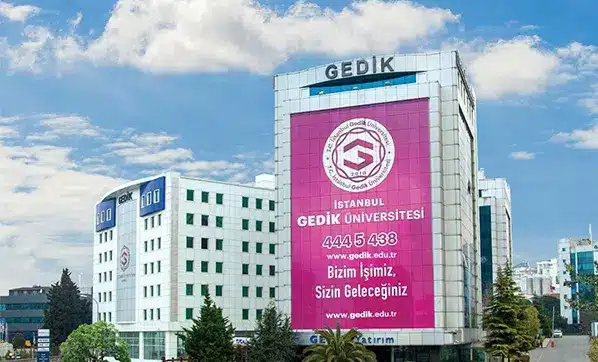
Two undergraduate routes: Gedik in Turkish and Sabancı in English. Fees are annual list prices.
| University | Degree | Language | Tuition |
|---|---|---|---|
| Gedik University | Bachelor | Turkish | $5 000/yr (2025–26 list, latest published) · fee source |
| Sabanci University | Bachelor | English | $36 500/yr (2026–27) · fee source |
Gedik’s programme is Materials Science and Nanotechnology Engineering; Sabancı’s is Materials Science and Nano Engineering, and Sabancı students enter a faculty and choose their major after a common first-year programme. Gedik had not published a 2026–27 list when we checked on 29 September 2026, so ask it to confirm the fee for your intake.
Careers after a nanotechnology degree
Graduates start as materials, process or quality engineers in electronics, coatings, energy storage, automotive, aerospace, textiles and medical devices, or as laboratory engineers in university and private research centres. Characterisation skills are portable: the same microscopes and spectrometers are used in failure analysis, forensic labs and quality control.
Many graduates continue to a master’s in materials science, nanoscience, semiconductor engineering or energy materials, in Turkey or abroad. Research posts and most R&D roles expect at least a master’s. In Turkey, engineers practise under the chambers of the Union of Chambers of Turkish Engineers and Architects (TMMOB), and foreign graduates also need a work permit; in other countries the national engineering body decides on chartered or licensed status.
Nanotechnology engineering in Turkey: questions applicants ask
Yes. Sabancı University teaches Materials Science and Nano Engineering in English, while Gedik’s Materials Science and Nanotechnology Engineering is taught in Turkish.
Sabancı lists $36 500 a year for 2026–27. Gedik’s latest published list, for 2025–26, shows $5 000 a year, so ask Gedik for the fee that will apply to your intake.
Largely. The Turkish programmes combine the two, so graduates are trained as materials engineers with extra depth in nanoscale materials and characterisation methods.
Mathematics, physics and chemistry. Weak mathematics is the most common reason first-year engineering students fall behind.
Not for engineering jobs in manufacturing or quality, but research and most R&D positions expect a master’s or PhD.
Materials and metallurgical engineering, chemical engineering, electrical and electronics engineering and biomedical engineering cover neighbouring ground with larger job markets.
Programme comparison, eligibility checks, document preparation and application follow-up are provided under an agreement with StudyU. The university alone decides admission.
Considering nanotechnology engineering in Turkey?
During the free initial consultation, we clarify your goal, profile, timing, and budget and identify the next realistic step. A personal strategy, requirement checks, selection of agreed options, document preparation, applications, and support are provided under an agreement with StudyU.
Official sources
- YÖK Atlas: official program catalogue — program availability, institution and stated language of instruction. International quotas and tuition require the university's own current source.
- YÖK: official international-student information — the official university search route and general international-student guidance. The chosen university still owns its admission requirements.
- ÖSYM: official TR-YÖS exam (2026) — the official calendar and application route for TR-YÖS/1 in 2026. Each university publishes whether the result is required for the selected program.
Tuition figures come from the universities’ own fee lists for international students: İstanbul Gedik University: tuition fees; Sabancı University: 2026–2027 tuition fee. Where a list is available online, the fee cell in the table links to it. All fees are published in US dollars, so no currency conversion was applied. Fees were checked on 29 September 2026; confirm language, curriculum, quota and tuition with the university for your intake before paying.
Updated:
